
Non-FictionSelf-HelpSelf Compassion
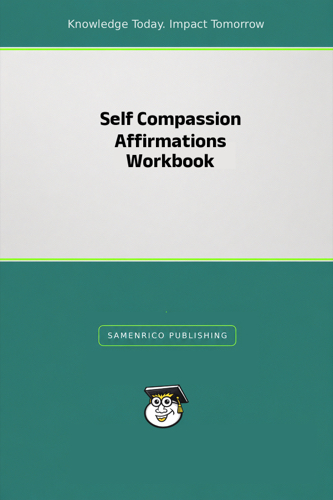
Self Compassion Affirmations Workbook eBook
Replace self criticism with kindness using this pr
Replace self criticism with kindness using this practical self talk rewiring guide.
Formats
Free sample
Chapter 1: The Overprotective Security Guard--Let me ask you something you have probably never been asked before.What if the voice that calls you stupid, lazy, ugly, or not enough is not trying to hurt you?What if it is actually trying to save your life?Pause for a moment. Let that land. Because everything you are about to learn in this workbook hinges on this single, counterintuitive idea. The voice that keeps you up at night replaying that embarrassing thing you said three years ago? The voice that won't let you enjoy a compliment because it is already whispering, "They're just being nice"?
The voice that turns a single typo in an email into evidence that you are a fraud who is about to be fired?That voice thinks it is your bodyguard.It is just a terrible bodyguard.The Most Misunderstood Voice in Your Head If you are like most people who pick up this workbook, you have spent years trying to silence your inner critic. You have tried ignoring it. You have tried fighting it. You have tried drinking it away, working it away, or scrolling past it at 2 a.m. Nothing worked.
The voice always came back.That is because you were trying to fire someone who was never on your payroll to begin with.Here is the truth that changed everything for me when I first learned it, and that will change everything for you over the next twelve chapters: your inner critic is not an enemy. It is a misfired protection system. It is an ancient alarm bell that was designed to keep you safe from predators and now goes off every time you might be rejected, embarrassed, or imperfect.Your brain has not evolved much since your ancestors were running from saber-toothed tigers. Back then, being rejected from the tribe meant death. Alone in the savanna, you were eaten.
So your brain developed an exquisitely sensitive threat-detection system. Anything that could lead to social exclusion—a mistake, an awkward comment, a weird look from the chief—triggered a full-body alarm.The problem is that your amygdala, the part of your brain that sounds this alarm, cannot tell the difference between a tiger and a typo. It cannot tell the difference between being banished from the village and being mildly embarrassed in a Zoom meeting. All it knows is: something is wrong. Sound the alarm.
Criticize everything until the problem is fixed.This is why your inner critic is so loud. It is not mean. It is desperate.Introducing the Overprotective Security Guard Throughout this workbook, we are going to use a metaphor that will make this whole process much easier to understand and much easier to laugh at. Because if there is one thing that disarms the inner critic faster than anything else, it is humor.Imagine that inside your mind, there is a security guard. Let us call him Gary.Gary has one job: keep you safe.
He sits in a little booth with a bank of security monitors, watching for threats. The problem is that Gary is not very smart. He means well. He genuinely wants you to survive. But his threat-detection equipment is from 50,000 years ago.
Every time something mildly uncomfortable happens, Gary hits the big red panic button and screams into his walkie-talkie.Someone looks at you funny? PANIC. You make a small mistake at work? PANIC. You look in the mirror and notice a new wrinkle?
PANIC. You think about asking for a raise? PANIC. You remember that awkward thing you said at a party in 2017? PANIC.Gary does not know the difference between a life-threatening emergency and a mildly uncomfortable social situation.
To Gary, everything is a five-alarm fire.And here is the most important thing to understand: Gary is not evil. Gary is not trying to ruin your life. Gary is terrified. He is doing the only thing he knows how to do, which is scream as loudly as possible until the threat goes away.The problem is that Gary's screaming has become the dominant voice in your head. You have been listening to him for so long that you forgot he was even there.
You just assumed that voice was you. You assumed that the constant criticism, the endless nitpicking, the relentless pressure—that was just what it felt like to be alive.But that voice is not you. That voice is Gary. And Gary needs a new job description.The Neuroscience of Nagging: Why Criticism Sticks Like Velcro Let us get specific about what is happening in your brain, because understanding the mechanics of self-criticism is the first step to disarming it.Your brain has a built-in negativity bias. This is not a character flaw.
It is not a sign that you are broken or depressed or weak. It is an evolutionary feature that kept your ancestors alive. Negative information is processed more thoroughly than positive information. Threats are remembered longer than rewards. A single criticism from a boss will stick in your memory for days, while five compliments from the same boss will slide off like water off a Teflon pan.Researchers have a name for this.
They call it the "Velcro and Teflon" effect. Negative experiences stick like Velcro. Positive experiences slide off like Teflon.Why? Because from an evolutionary perspective, missing a reward might make you slightly less happy, but missing a threat could kill you. Your brain is wired to prioritize bad news because bad news was historically more urgent than good news.
That tiger in the bushes? Urgent. That delicious berry bush? Less urgent.The problem is that your brain applies the same urgency to social threats. A critical comment from a colleague feels urgent.
A mistake on a report feels urgent. An imperfection in your appearance feels urgent. Your brain treats these events as though your life is on the line.This is why Gary screams so loudly. He is running ancient software on modern problems. He is trying to protect you from rejection the same way he would protect you from a predator.
And because his warnings feel urgent and true, you have learned to believe him.But here is what Gary does not understand: you are not going to die from embarrassment. You are not going to be eaten by a tiger because you forgot to reply to an email. You are not going to be banished from the village because your presentation had a typo.Gary is overreacting. And it is time for you to take over.The Thanks, Brain Log: Your First Tool Before we can change anything, we have to see it clearly. Most of us are so accustomed to the voice of self-criticism that we do not even notice it anymore.
It has become background noise, like the hum of a refrigerator. We feel bad, but we cannot always pinpoint why. We just assume that is how life feels.The first exercise in this workbook is designed to turn up the volume on that background noise so you can actually hear what Gary is saying. Not to judge it. Not to fight it.
Just to notice it.The Thanks, Brain Log For the next seven days, carry a small notebook or use the notes…
This is the end of the free sample. Get the eBook to keep going. Buy now
About this book
Details
- Author
- Lacy Hyacinth
- Publisher
- SamEnrico
- Language
- English
- Genre
- Non-Fiction, Self-Help, Self Compassion
- Released
- 2026-06-06
- Pages (approx.)
- 132
- Available as
- eBook, Audiobook

Read better in the ZLOADR app
Your eBooks on your phone or tablet. Sign in with your SamEnrico account and start reading.
More by Lacy Hyacinth
 Wearable Device Owners ProfileLacy Hyacinth$11.99
 Mauritius Independence GuideLacy Hyacinth$11.99
 Butterfly TransformationLacy Hyacinth$11.99
 The John Wayne Gacy Victim List AnalysisLacy Hyacinth$11.99
 The Lost Codex: How a 15th-Century Bible Vanished—And ReappearedLacy Hyacinth$11.99
 PartnerLacy Hyacinth$11.99
 Remote Team Personality Conflict GuideLacy Hyacinth$12.99
 AI Background Removal GuideLacy Hyacinth$12.99
 How to Become a Coal SamplerLacy Hyacinth$11.99
 Understanding Mucolipidosis Type 3Lacy Hyacinth$17.99
You may also like
 Hong Kong Handover 1997Dunn Johnnie$11.99
 Zumba For Postnatal Recovery CourseNeal Christian$11.99
 Zumba for BeginnersLadner Nikia$11.99
 YouTube Comment Mining GuideHumes Pandora$12.99
 Worry Box MeditationCarlin Rudy$11.99
 Workplace Stress MeditationNguyen Lynn$11.99
 Workplace Stress and Sleep RepairHawley Ivory$11.99
 Workplace Perfectionism CureDelaney Jeffry$11.99
 Workplace Injustice Anger GuideWallen Isabelle$11.99
 Work Addiction and Burnout LinkGreenwood Ester$11.99
 Women in Yoga and WellnessBeattie Galina$11.99
 Women in Stand Up ComedyChun Evangeline$11.99