
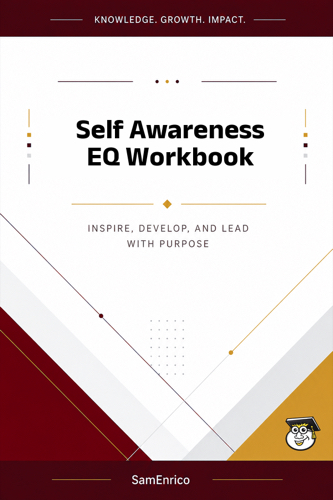
Non-FictionSelf-HelpSelf Awareness
Self Awareness EQ Workbook eBook
Identify your emotional patterns and triggers usin
Identify your emotional patterns and triggers using this practical emotional intelligence guide.
Formats
Free sample
Chapter 1: The Passenger Paradox--–- You are not the driver. You have never been the driver. And that is the first thing you need to know if you ever want to take the wheel.Imagine you are sitting in the passenger seat of a car. The driver is someone you do not trust—impulsive, easily startled, quick to anger. This driver slams the accelerator at every yellow light, swerves to avoid imaginary obstacles, and once, memorably, drove straight into a ditch because a bee flew through the window.
You spend most of your time gripping the door handle, offering useless advice from the passenger seat, and cleaning up the mess after each crash.Now imagine someone tells you that you are not the passenger. You are the car.This is the truth of your emotional life. For years, you have believed that you are the rational mind sitting somewhere behind your eyes, observing your emotions as if they were weather patterns—something that happens to you. But neuroscience has a different story. You are not the observer of your emotions.
You are the biological machine that produces them. And the machine has design flaws.Let me show you what I mean.Think back to the last time you said something you immediately regretted. A sharp comment to a partner. A sarcastic email to a colleague. A snap at your child over something trivial.
In the moment before the words left your mouth, did you feel a sense of choice? Did you weigh options, consider consequences, and then deliberately select those words? Of course not. The words came out before you knew they were coming. You were a passenger watching yourself speak.Then came the shame.
Then came the apology. Then came the quiet promise that you would do better next time.But here is the question this workbook asks: better how? Better through willpower? Better through sheer determination? If willpower were the answer, you would have fixed this years ago.
You have tried willpower. You have tried promising yourself. You have tried counting to ten. None of it has worked consistently because none of it addresses the actual mechanism.You cannot think your way out of a problem that begins before thinking.This chapter introduces the foundational science that every other exercise in this book will build upon. You will learn about the three brains inside your head—one that keeps you alive, one that feels, and one that plans—and why the feeling brain is wired to win every race.
You will learn the exact number of milliseconds between a trigger and an explosion, and why that gap is both your enemy and your only hope. You will meet a recurring character named Jamie, who will fail and succeed and fail again so that you do not have to do this alone. And you will complete your first Body Scan Log, creating a personal map of where your emotions live in your physical body.By the end of this chapter, you will understand something that most people never learn: you are not broken. Your nervous system is working exactly as designed. The design is just three million years out of date.
And the first step to updating the software is admitting that you have been running on factory settings your entire life.Let us open the hood.The Three Brains You Never Knew You Had Close your eyes for a moment. Just for five seconds. Notice your breathing. Notice your heartbeat if you can feel it. Notice the temperature of the air on your skin.Now open them.What you just experienced—the effortless regulation of breathing, the pulsing of blood, the unconscious maintenance of body temperature—is the work of your autonomic brain.
Sometimes called the reptilian brain, this is the oldest layer of your neural architecture. It sits at the base of your skull, connecting your brain to your spinal cord. It does not think. It does not feel. It simply survives.
It controls your heart rate, your digestion, your fight-or-flight response. It has been running continuously since before you were born, and it will run until you die, asking for nothing in return.Wrapped around the autonomic brain is the limbic system—the mammalian brain. This is where emotion and memory live. It is why you feel a pang of sadness when you smell a particular perfume (your grandmother wore it). It is why your stomach drops when you see a police car in your rearview mirror (you once got a ticket).
It is why you can hear a song from high school and suddenly feel seventeen again. The limbic system does not use language. It does not understand time. It operates in the present tense, on pure sensation and association.Wrapped around both is the neocortex, and specifically the prefrontal cortex—the rational brain. This is the newest layer in evolutionary terms.
It is what allows you to plan for retirement, to resist the second slice of cake, to apologize even when you do not want to. It inhibits impulses. It considers the future. It is the part of you that reads self-help books and thinks, "Yes, this is exactly what I need to do differently."Here is the problem that no one tells you about.The limbic system reacts to a perceived threat in approximately 20 to 50 milliseconds. That is faster than the blink of an eye, which takes about 100 to 150 milliseconds.
Your amygdala—two almond-shaped clusters of neurons deep in your limbic system—scans your environment constantly, unconsciously, for signs of danger. It is looking for raised voices, sudden movements, angry faces, slamming doors, critical tones. It does not distinguish between a saber-toothed tiger and a disappointed boss. It distinguishes only between safe and not safe.When the amygdala detects a threat, it sounds the alarm. A cascade of stress hormones floods your system.
Cortisol and adrenaline surge. Your heart rate spikes. Your breathing becomes shallow and fast. Blood rushes away from your digestive system and toward your large muscle groups, preparing you to fight or flee. Your pupils dilate.
Your hearing sharpens. Your prefrontal cortex—the rational part of your brain that could say, "Wait, this is just a meeting, not a life-or-death situation"—is temporarily bypassed. Shut out of the loop. Left standing on the platform as the emotional train leaves the station.This is called an amygdala hijack, a term popularized by psychologist Daniel Goleman. The hijack takes less than a second.
The rational brain, by contrast, takes approximately three to seven seconds longer to receive the same information, process it, and begin to exert inhibitory control.Three to seven seconds.That is the entire window between the moment you feel something and the moment you can do something about it. And in that window, you are not driving. Your limbic system is driving. You are the passenger watching yourself snap, yell, freeze, or flee.Here is what this looks like in real life. Your boss sends an email that could be interpreted as critical.
Your amygdala interprets it as a threat. In milliseconds, you are flooded with cortisol. Your jaw clenches. Your shoulders rise. Your heart pounds.
Your rational brain, still catching up, has not yet arrived. By the time it does—three to seven seconds later—you have…
This is the end of the free sample. Get the eBook to keep going. Buy now
About this book
Details
- Author
- Hannah Mariel
- Publisher
- SamEnrico
- Language
- English
- Genre
- Non-Fiction, Self-Help, Self Awareness
- Released
- 2026-06-07
- Pages (approx.)
- 148
- Available as
- eBook, Audiobook

Read better in the ZLOADR app
Your eBooks on your phone or tablet. Sign in with your SamEnrico account and start reading.
More by Hannah Mariel
 Trustee Guide for SeniorsHannah Mariel$11.99
 Compulsive Spending Recovery PrimerHannah Mariel$11.99
 Gaslighting Response GuideHannah Mariel$11.99
 Survivor Guilt RecoveryHannah Mariel$11.99
 Self Hypnosis for RelationshipsHannah Mariel$11.99
 Hormonal Birth Control For PMDDHannah Mariel$11.99
 The Vanishing Millionaire: The Disappearance of Charles E. PettusHannah Mariel$11.99
 Difficult Conversations about RaceHannah Mariel$11.99
 The Shadow of the First Olympics: Ethiopia's Forgotten Doping Scandal of 1896Hannah Mariel$11.99
 How to Produce Patch PanelsHannah Mariel$11.99
 How to Produce Crafting Patterns and MoldsHannah Mariel$11.99
 Renewable Energy B2B SalesHannah Mariel$12.99
You may also like
 Hong Kong Handover 1997Dunn Johnnie$11.99
 Zumba For Postnatal Recovery CourseNeal Christian$11.99
 Zumba for BeginnersLadner Nikia$11.99
 YouTube Comment Mining GuideHumes Pandora$12.99
 Worry Box MeditationCarlin Rudy$11.99
 Workplace Stress MeditationNguyen Lynn$11.99
 Workplace Stress and Sleep RepairHawley Ivory$11.99
 Workplace Perfectionism CureDelaney Jeffry$11.99
 Workplace Injustice Anger GuideWallen Isabelle$11.99
 Work Addiction and Burnout LinkGreenwood Ester$11.99
 Women in Yoga and WellnessBeattie Galina$11.99
 Women in Stand Up ComedyChun Evangeline$11.99