
Non-FictionInformativeEducational
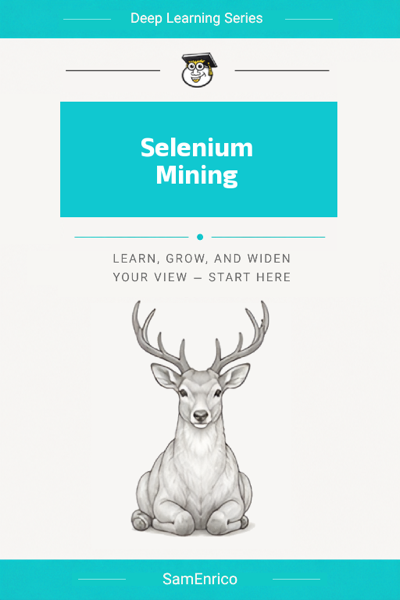
Selenium Mining eBook
A Coursebook on Selenium Mining
by Egan Alline
A Coursebook on Selenium Mining
Formats
Free sample
Chapter 1: The Moon Element...--In the autumn of 1817, a Swedish chemist lay dying in his laboratory. Jöns Jacob Berzelius, already a towering figure in early chemistry, was suffering from what he believed to be heavy metal poisoning. His hands trembled. His vision blurred. And worst of all, a persistent, foul odor—something like rotting horseradish—seemed to follow him everywhere.
The source of his torment was a mysterious red sludge that kept forming in his lead chambers during the production of sulfuric acid. His colleagues urged him to discard it. His assistants called it a nuisance. But Berzelius, bedridden and obsessive, refused to let it go. He demanded to know what this strange substance was.
When he finally isolated it, he discovered something that would, two centuries later, become essential to solar panels, deadly to wildlife, and worth more than silver by weight. He named it after the moon.That element is selenium. And almost nobody knows it exists.This book is about why that matters.The Most Important Element You Have Never Heard Of Selenium occupies a peculiar place on the periodic table. It sits directly below sulfur, its chemical cousin, and above tellurium, its heavier sibling. In Group 16, the chalcogens, selenium is the middle child—less famous than oxygen, less infamous than polonium, but far more interesting than its quiet reputation suggests.What makes selenium unique is not a single property but a constellation of them.
First, there is allotropy. Unlike most elements that settle into one stable crystal structure, selenium can exist in multiple distinct forms. The red amorphous form—sometimes called vitreous selenium—looks like crushed brick dust. It is brittle, glassy, and non-conductive. The gray crystalline form, by contrast, is metallic, stable, and highly conductive, especially when exposed to light.
This second property, photoconductivity, is selenium's superpower. When light strikes gray crystalline selenium, its electrical conductivity increases dramatically—by a factor of up to a thousand times. This is not a laboratory curiosity. It is the principle that made the first photocopiers possible, the same physics that still enables some of the world's most sensitive radiation detectors.Then there is catalysis. In certain organic reactions, selenium acts as a mild, selective catalyst—neither as aggressive as platinum nor as mild as nothing at all.
It occupies a chemical Goldilocks zone, doing just enough to transform molecules without destroying them. This property, largely unexploited commercially, hints at applications yet to come.But the most important fact about selenium is not chemical. It is economic. Selenium is almost never mined as a primary product. Unlike copper, gold, or lithium, there are no dedicated selenium mines anywhere on Earth.
Instead, selenium is a byproduct—an accidental element, recovered from the waste streams of other industries. Specifically, it comes from two sources: the anode slimes of copper electrorefining and the flue dusts of copper and nickel sulfide roasting. In other words, selenium is a hitchhiker. It goes where copper goes. When copper demand rises, smelters process more ore, and selenium supply increases—regardless of whether anyone wants more selenium.
When copper demand falls, selenium supply contracts, sometimes causing shortages in industries that depend on it.This inelastic supply is the single most important fact driving the entire selenium industry. It means that selenium prices are not determined by selenium demand alone. They are determined by copper prices, copper mine output, copper smelter maintenance schedules, copper labor strikes, and copper discoveries. The glass manufacturer who needs selenium to decolorize bottles has no control over any of these factors. Neither does the solar panel producer who needs selenium for thin-film photovoltaics.
Neither does the farmer who adds selenium to fertilizer in selenium-deficient regions. They are all passengers in a vehicle driven by the copper industry.This chapter establishes the foundations for everything that follows. We will explore selenium's physical and chemical properties in detail, trace its accidental discovery, and explain the economic paradox that defines its markets. By the end, you will understand why an element that touches everything from wine bottles to solar cells remains invisible to the public—and why that invisibility is a problem.The Periodic Puzzle: Selenium's Chemical Identity To understand selenium, one must first understand where it sits in the periodic table. Group 16 contains oxygen (O), sulfur (S), selenium (Se), tellurium (Te), and polonium (Po).
As one moves down the group, elements become less non-metallic and more metallic. Oxygen is a gas, a nonmetal. Sulfur is a solid nonmetal. Selenium is a metalloid—it straddles the boundary, exhibiting both nonmetal and metal characteristics. Tellurium is more metallic.
Polonium is a true metal, though radioactive.This gradation explains selenium's dual personality. Under some conditions, it behaves like sulfur, forming selenides and seleno-organic compounds. Under others, it behaves like a metal, conducting electricity and forming alloys. The red amorphous form is nonmetallic; the gray crystalline form is distinctly metallic.Selenium's electron configuration is [Ar] 3d¹⁰ 4s² 4p⁴. The four valence electrons in the 4p orbital are the key to its chemistry.
Like sulfur, selenium can exist in multiple oxidation states: -2 (selenide, Se²⁻), 0 (elemental Se), +4 (selenite, Se O₃²⁻), and +6 (selenate, Se O₄²⁻). This range of oxidation states makes selenium environmentally mobile and chemically versatile. In reducing conditions (low oxygen, high organic matter), selenium tends to form insoluble elemental selenium or metal selenides. In oxidizing conditions, it forms soluble selenate and selenite ions that can travel hundreds of kilometers in groundwater.This environmental mobility is the source of both selenium's agricultural benefit and its ecological danger. In small amounts—micrograms per day—selenium is essential for human and animal health.
It is a component of selenoproteins, enzymes that protect cells from oxidative damage. Selenium deficiency causes Keshan disease (a cardiomyopathy) and Kashin-Beck disease (an osteoarthropathy), both named after regions in China where soils are selenium-poor. But in larger amounts—milligrams per day—selenium becomes a potent toxin. Selenosis causes hair loss, nail brittleness, neurological damage, and death.The gap between deficiency and toxicity is narrower for selenium than for almost any other essential trace element. The recommended daily intake for adults is approximately 55 micrograms.
The toxic threshold is around 400 micrograms per day sustained, or a few milligrams acutely. This is a safety window of less than an order of magnitude—unusually tight. For comparison, the gap between essential and toxic for zinc is nearly two orders of magnitude; for iron, even wider.This narrow therapeutic window is why selenium regulation is so stringent and why environmental releases are so dangerous.The Discovery of Selenium: An Accident Repeated The story of selenium's discovery is a story of accidents piling upon accidents. In 1817, Berzelius was not looking for a new element. He was trying to produce sulfuric acid for his laboratory using the lead chamber process, a method that involved burning sulfur with saltpeter in large lead-lined rooms.
The problem was that his acid kept coming out contaminated—first with lead residues, then with a strange reddish-brown sludge.Berzelius initially assumed the sludge was arsenic, a common impurity in sulfur ores. But when he analyzed it, the results made no sense. It wasn't arsenic. It wasn't sulfur. It wasn't any known element.
His colleague, the German chemist Alexander Marcet, suggested it might be a new substance. Berzelius, already ill and frustrated, did…
This is the end of the free sample. Get the eBook to keep going. Buy now
About this book
Details
- Author
- Egan Alline
- Publisher
- SamEnrico
- Language
- English
- Genre
- Non-Fiction, Informative, Educational
- Released
- 2026-05-04
- Pages (approx.)
- 153
- Available as
- eBook, Audiobook

Read better in the ZLOADR app
Your eBooks on your phone or tablet. Sign in with your SamEnrico account and start reading.
More by Egan Alline
 Coworking Space Distraction ControlEgan Alline$11.99
 Senior Famous Late BloomersEgan Alline$11.99
 Self Hypnosis for SkateboardingEgan Alline$11.99
 Coin Master Village GrindEgan Alline$11.99
 The Crown Jewel Heist: A Royal Murder in the Shadows of WWIIEgan Alline$11.99
 How to Produce an Air ClassifierEgan Alline$11.99
 How to Become a Glove TurnerEgan Alline$11.99
 Transaction Cost Analysis GuideEgan Alline$12.99
You may also like
 Hong Kong Handover 1997Dunn Johnnie$11.99
 Zumba For Postnatal Recovery CourseNeal Christian$11.99
 Zumba for BeginnersLadner Nikia$11.99
 YouTube Comment Mining GuideHumes Pandora$12.99
 Worry Box MeditationCarlin Rudy$11.99
 Workplace Stress MeditationNguyen Lynn$11.99
 Workplace Stress and Sleep RepairHawley Ivory$11.99
 Workplace Perfectionism CureDelaney Jeffry$11.99
 Workplace Injustice Anger GuideWallen Isabelle$11.99
 Work Addiction and Burnout LinkGreenwood Ester$11.99
 Women in Yoga and WellnessBeattie Galina$11.99
 Women in Stand Up ComedyChun Evangeline$11.99