
Non-FictionStrategic AtlasMarket Segmentation
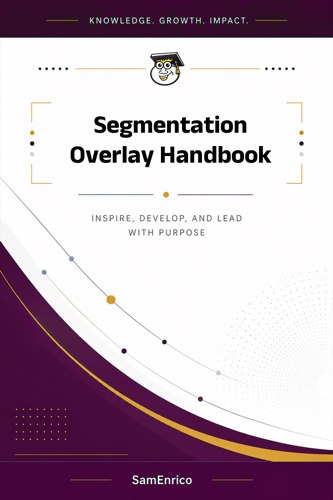
Segmentation Overlay Handbook eBook
Layer customer segment density maps onto competiti
Layer customer segment density maps onto competitive positions to reveal underserved groups.
Formats
Free sample
Chapter 1: The Billion-Dollar Blind Spot--– In 2007, a tiny DVD-by-mail company with barely any streaming business decided to ignore the total addressable market for video rental. Blockbuster, the industry giant, had a TAM of over $10 billion. Netflix had a niche of movie enthusiasts who were willing to wait three days for a disc. By every conventional metric, Blockbuster was making the rational choice and Netflix was playing a fool’s game.We know how that story ended.Blockbuster filed for bankruptcy in 2010. Netflix became a trillion-dollar company.
The post-mortems have been written a thousand times, but almost all of them miss the real strategic lesson. The lesson is not that Netflix predicted the future of streaming. The lesson is that Blockbuster was measuring the wrong thing entirely.Blockbuster was obsessed with the size of the market. Netflix was obsessed with the shape of the market.This chapter will dismantle the most dangerous metric in business strategy: Total Addressable Market, or TAM. You have probably used it.
Your investors have demanded it. Your board has nodded along to Power Point slides showing ever-expanding circles labeled “TAM,” “SAM,” and “SOM.” And while you were drawing those circles, your competitors were quietly building a fortress inside a segment you didn’t even know existed.The argument of this chapter—and indeed this entire book—is simple: TAM is a rearview mirror. Density is a GPS.TAM tells you how big the market was yesterday. Density tells you where the customers are clustering today and, more importantly, which of those clusters are being ignored by every single one of your competitors.This chapter introduces the core reframing that makes the Segmentation Overlay method possible. We will explore why chasing size over fit is a strategic trap, what “market-driven management” actually means in practice, and how the most successful companies of the past two decades won by solving for a minority that acted like a majority.The Tyranny of the Big Number Let us begin with a simple exercise.
Imagine you are the head of strategy for a mid-sized consumer goods company. Your category is breakfast cereal. Your team presents you with the following data point: the global breakfast cereal market is $40 billion and growing at 2 percent annually.What do you do with this information?If you are like most executives, you feel a sense of reassurance. The pie is big. There is room to grow.
You authorize a new product line, allocate marketing spend, and compete for share against Kellogg’s and General Mills.But here is the problem: that $40 billion number is a fiction. Not because it is inaccurate as a mathematical sum, but because it does not describe a real market. It describes an aggregation of hundreds of distinct customer segments, each with different needs, different willingness to pay, and different competitive dynamics. By treating the aggregate as the unit of analysis, you have already lost.The psychologist Daniel Kahneman won a Nobel Prize for demonstrating that humans are systematically overconfident when making decisions based on aggregate statistics. We mistake the map for the territory.
When a strategist says “the market is $40 billion,” what they are really saying is “I have no idea which customers matter, so I will assume they all do.”This is the tyranny of the big number. It seduces you into believing that size equals opportunity. It encourages you to build products for the mythical “average customer” who does not exist. And it blinds you to the reality that in almost every market, the vast majority of profits come from a tiny fraction of segments—segments that are often invisible from the aggregate view.Consider the airline industry. The total addressable market for air travel is enormous.
But within that market, the profit distribution is wildly uneven. Business travelers who book last minute and fly on Tuesday mornings generate orders of magnitude more profit per seat than leisure travelers who book six weeks in advance. Airlines that treat all travelers as one market go bankrupt. Airlines that understand density—like Southwest, which focused on price-sensitive, point-to-point travelers ignored by hub-and-spoke carriers—become legends.The first step toward strategic clarity, then, is to declare bankruptcy on TAM. Not to ignore market size entirely, but to demote it from the throne where it currently sits.
Size is a constraint, not a strategy. Density is the engine.Market-Driven Management: Starting with Heterogeneity The alternative to TAM-driven thinking is a philosophy called market-driven management. This term, popularized by marketing scholars like George Day, stands conventional strategic planning on its head.Traditional strategic planning begins with an internal assessment of resources and capabilities. You ask: what are we good at? Then you look outward at the market and ask: where can we sell what we make?
This is called inside-out strategy.Market-driven management reverses the order. It begins with customer heterogeneity—the observation that no two customers are alike and that their differences are not noise but signal. You ask: who are the different groups of customers in this market? What do they value differently? Which groups are currently being poorly served?
Then you ask: what capabilities do we need to build to serve them well?This is outside-in strategy. And it is the foundation of every successful underserved market play in modern business history.Let us make this concrete with a case that will appear throughout this book: the rise of Dollar General in the shadow of Walmart.In 2005, Walmart was the undisputed king of retail. Its TAM was essentially all consumer goods purchased by all Americans. Walmart’s strategy was built around scale: bigger stores, broader assortments, lower prices driven by supply chain efficiency. By every TAM-based metric, Walmart was winning.But a funny thing happened on the way to total market dominance.
A segment of customers began defecting to a scrappy competitor called Dollar General. These customers were not the wealthy suburbanites who appeared in Walmart’s glossy annual reports. They were rural, low-income households who found Walmart’s model actively hostile to their needs.The nearest Walmart was a forty-five-minute drive. The store was overwhelming—forty thousand square feet of products they did not need. They did not own cars large enough to haul bulk packages.
They shopped every few days, not every few weeks. And they were furious about being treated as an afterthought.Dollar General saw what Walmart could not: density. These rural low-income households were highly concentrated in specific geographies. Their need for basic goods at low prices was intense. But the competitive coverage—the quality and focus of existing solutions—was abysmally low.
Walmart covered them incidentally, not intentionally.Dollar General built a model tailored to this density: smaller stores (eight thousand square feet), located within ten minutes of every customer, with simplified assortments of high-turnover basics, and price points that matched Walmart without requiring a long drive or a bulk purchase.By 2020, Dollar General had over seventeen thousand stores and a market capitalization that rivaled Target’s. They did not win by competing for the $40 billion retail TAM. They won by finding the underserved segment within that TAM that everyone else had dismissed as “too small” or “too poor” or “too hard.”This is market-driven management in…
This is the end of the free sample. Get the eBook to keep going. Buy now
About this book
Details
- Author
- Hillman Zetta
- Publisher
- SamEnrico
- Language
- English
- Genre
- Non-Fiction, Strategic Atlas, Market Segmentation
- Released
- 2026-06-09
- Pages (approx.)
- 159
- Available as
- eBook, Audiobook

Read better in the ZLOADR app
Your eBooks on your phone or tablet. Sign in with your SamEnrico account and start reading.
More by Hillman Zetta
 Navigating Custody DisputesHillman Zetta$11.99
 Etsy Digital Planner Income Tax GuideHillman Zetta$11.99
 Sleep Memory Improvement PlanHillman Zetta$11.99
 Attention Residue Reduction ProtocolHillman Zetta$11.99
 The Olmec Skywatchers: Cosmic Origins in Ancient MesoamericaHillman Zetta$11.99
 The Algorithm King: How a Math Genius Built a $100B EmpireHillman Zetta$11.99
 Recovery Coach Board RoleHillman Zetta$12.99
 Internal Comms Style Guide GlobalHillman Zetta$12.99
 Understanding CholelithiasisHillman Zetta$17.99
 Lead Quality Assurance AnalystHillman Zetta$11.99
 Ultimate Handbook Guide to Philadelphia : (United States) Travel GuideHillman Zetta$11.99
You may also like
 Hong Kong Handover 1997Dunn Johnnie$11.99
 Zumba For Postnatal Recovery CourseNeal Christian$11.99
 Zumba for BeginnersLadner Nikia$11.99
 YouTube Comment Mining GuideHumes Pandora$12.99
 Worry Box MeditationCarlin Rudy$11.99
 Workplace Stress MeditationNguyen Lynn$11.99
 Workplace Stress and Sleep RepairHawley Ivory$11.99
 Workplace Perfectionism CureDelaney Jeffry$11.99
 Workplace Injustice Anger GuideWallen Isabelle$11.99
 Work Addiction and Burnout LinkGreenwood Ester$11.99
 Women in Yoga and WellnessBeattie Galina$11.99
 Women in Stand Up ComedyChun Evangeline$11.99