
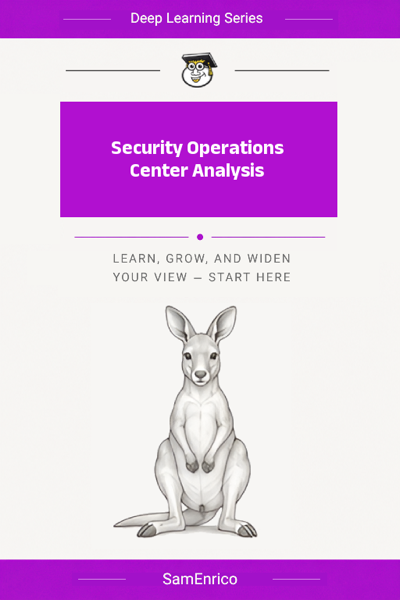
Security Operations Center Analysis eBook
A Coursebook on Security Operations Center Analysi
by Kemp Janella
A Coursebook on Security Operations Center Analysis
Formats
Free sample
Chapter 1: The 3am Question...--– The phone rang at 3:14am. Not the gentle chime of a scheduled alert, but the urgent, sharp insistence of the red phone—the one that only rings when something is already on fire. For Jenna, a Level 1 analyst six weeks into her first SOC role, this was the moment training had warned her about. She grabbed the headset, heart pounding, and opened the dashboard. Five thousand alerts.
Five thousand blinking yellow and red boxes, each screaming for attention. The senior analyst was on another call. Her shift lead was in a different time zone. She had sixty seconds to answer the question that defines every SOC analyst's existence: Is this nothing, or is this everything?She made a choice. She clicked "false positive" and went back to sleep.By morning, ransomware had encrypted three critical servers.
The cost of her decision—made in isolation, without process, without understanding—was $2.3 million. The security team traced the initial access to an alert that fired at 3:14am. An alert that Jenna closed because no one had ever taught her the difference between triage and guessing.This chapter exists so that never happens to you.The SOC Is Not a Room When most people imagine a Security Operations Center, they picture something out of a movie: a dark room with floor-to-ceiling screens, glowing world maps with animated attack lines, and rows of hoodie-wearing geniuses typing furiously. That image is wrong. It is not just aesthetically wrong—it is dangerously wrong because it implies that security is about technology and spectacle rather than about process and judgment.A Security Operations Center is not a room.
It is a system.Specifically, the SOC is a closed-loop system that transforms raw, chaotic, noisy data into three things: detection of threats, response to incidents, and improvement of future outcomes. Like any system, it has inputs (logs, alerts, intelligence feeds), processes (triage workflows, escalation paths, investigation procedures), and outputs (contained incidents, eradicated threats, lessons learned). And like any system, it fails when any component breaks—not just when the technology fails.This is the single most important concept in this entire book: Technology is the easiest part of a SOC to buy and the hardest part to make work. You can purchase a world-class SIEM, deploy endpoint detection on every device, and subscribe to every threat intelligence feed on the market. If your people don't know how to write a query, if your processes don't define who does what when an alert fires, or if your data is garbage—you will still get breached.Jenna's story is not a technology failure.
It is a system failure. The technology worked perfectly: an alert fired exactly when it should have. The failure was in the process (no defined triage escalation path for overnight shifts) and in the people (a junior analyst trained only on dashboards, not on judgment). Fixing either would have prevented the breach. Fixing both would have made the SOC exceptional.The Four Pillars: People, Process, Technology, Data Every SOC, regardless of size, budget, or industry, rests on four interdependent pillars.
If any pillar is weak, the entire SOC collapses. If you remember nothing else from this chapter, remember these four words and their order: People, Process, Technology, Data. The order matters. It is not alphabetical. It is not random.
It is a deliberate ranking of importance.People: The Irreplaceable Component No machine learning model, no artificial intelligence, no automated playbook can replicate human judgment in a SOC. This is not sentimentality; it is a technical fact. Malware authors adapt too quickly. Business context varies too widely. False positives are too creative.
A junior analyst who understands why an alert might be a false positive (that specific server always generates that specific error at 3am due to a legitimate backup job) is worth more than a SIEM with unlimited storage.The people pillar includes not just individual competence but team structure, shift scheduling, training programs, and—often overlooked—mental health support. SOC analysts burn out faster than almost any other cybersecurity role. The average tenure in a pure SOC position is less than eighteen months. High turnover destroys institutional knowledge, creates dangerous gaps in coverage, and ensures that every new hire repeats the same mistakes the last person made.Throughout this book, we will refer to three levels of analysts:Level 1 (L1) – Triage and Alert Validation. The first line of defense.
L1 analysts receive all alerts, determine if they are true positives or false positives, and escalate confirmed incidents. This role requires pattern recognition, familiarity with the environment, and the discipline to follow process even at 3am.Level 2 (L2) – Investigation and Incident Lead. When an alert is confirmed as a true positive, L2 analysts take over. They pivot across data sources, reconstruct the attack timeline, determine scope, and coordinate containment. This role requires deep technical knowledge of operating systems, networks, and attacker behavior.Level 3 (L3) – Threat Hunting and Engineering.
L3 analysts do not wait for alerts. They proactively search for threats that have evaded detection, build new detection logic, tune existing rules, and mentor junior analysts. This role requires creativity, adversarial thinking, and the ability to write complex queries that find the unknown.These levels are not just job titles. They are a division of cognitive labor. L1 handles high-volume, low-complexity decisions.
L2 handles medium-volume, medium-complexity investigations. L3 handles low-volume, high-complexity hunts. When this division breaks down—when L1 analysts are expected to conduct deep investigations or L3 analysts spend their time triaging phishing emails—the system fails.Process: The Invisible Architecture Process is the set of rules, workflows, and decision criteria that govern how work gets done in a SOC. Good process is invisible; it just works. Bad process is also invisible—until it fails catastrophically.The most critical processes in any SOC are:Alert triage.
Who decides that an alert is worth investigating? What criteria do they use? How much time do they have to decide? What happens when they escalate?Incident response. Once an incident is confirmed, who does what?
Who has authority to contain? Who communicates with legal, PR, and executives? How are lessons learned captured?Shift handoff. What information must be passed between shifts? How is incomplete work tracked?
What happens when an incident spans two shifts?Rule tuning. Who is allowed to modify detection rules? How are false positives tracked and addressed? How often are rules reviewed?Training and certification. How do analysts improve?
What skills are required for promotion? How is performance measured?Without documented, practiced, and continuously improved processes, a SOC is not a system. It is a collection of well-intentioned individuals hoping for the best. And hoping is not a strategy.Technology: The Force Multiplier Technology is third on this list for a reason. It is not unimportant—far from it.
But technology cannot fix broken people or processes. A SIEM with perfect data ingestion will still miss attacks if analysts don't know how to query it. An EDR with flawless behavioral detection will still generate false positives if no one tunes it. Automation can execute a playbook perfectly and still destroy evidence if the playbook was designed wrong.The core technologies in a modern SOC…
This is the end of the free sample. Get the eBook to keep going. Buy now
About this book
Details
- Author
- Kemp Janella
- Publisher
- SamEnrico
- Language
- English
- Genre
- Non-Fiction, Informative, Educational
- Released
- 2026-05-08
- Pages (approx.)
- 153
- Available as
- eBook, Audiobook

Read better in the ZLOADR app
Your eBooks on your phone or tablet. Sign in with your SamEnrico account and start reading.
More by Kemp Janella
 Meeting Agenda Priority GuideKemp Janella$11.99
 Generous Networker ApproachKemp Janella$11.99
 Hair Loss and Thyroid DiseaseKemp Janella$11.99
 Celeste Golden Strawberry FixKemp Janella$11.99
 Self Esteem for Seniors with DisabilityKemp Janella$11.99
 Sun Tzu: The Strategist Who Shaped War ForeverKemp Janella$11.99
 Understanding Mental Retardation Microcephaly Phalangeal FacialKemp Janella$17.99
 UN Logistics and Supply Chain GuideKemp Janella$12.99
 Promotion Business Case VisualizationKemp Janella$12.99
 How to Become a Sponge ClipperKemp Janella$11.99