
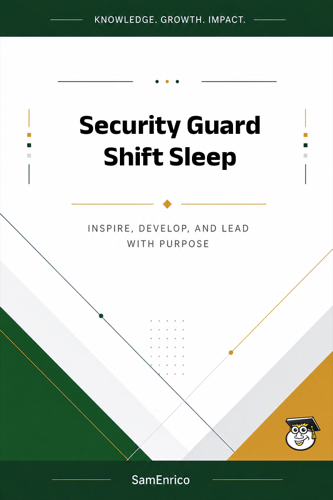
Security Guard Shift Sleep eBook
Stays alert during overnight patrols while protect
by Ponder Peg
Stays alert during overnight patrols while protecting sleep.
Formats
Free sample
Chapter 1: The Silent Epidemic...--–- Marcus had been a security guard for eleven years. He had never fallen asleep on duty. Not once. He was proud of that fact, wore it like a badge of honor. But at 3:47 AM on a Tuesday in February, behind the wheel of his 2015 Honda Civic, six minutes from his driveway after a twelve-hour overnight shift, Marcus did something he would never remember doing.
He closed his eyes for four seconds. When he opened them, his car was straddling the center line of a two-lane road, a semi-truck's headlights filling his windshield. He swerved. The truck swerved. Metal did not touch metal.
But something inside Marcus changed permanently. He pulled over, hands shaking, and sat in the silence of his idling car for twenty minutes before he could drive again. He never told his supervisor. He never told his wife. He told himself it would never happen again.
But it did. Not the swerve—the microsleep. Three weeks later, at 4:12 AM, he was watching a bank of CCTV monitors when his head dipped forward for six seconds. When he snapped back, nothing had happened. No alarm.
No intrusion. No one had seen him. But Marcus knew. And for the first time in eleven years, he was afraid of his own body.This is not a book about lazy security guards. This is not a book about weak willpower or poor discipline.
This is a book about biology. Specifically, this is a book about the war between your biology and your job description—a war that you are currently losing, through no fault of your own. The security industry has a sleep problem, and pretending otherwise has cost billions of dollars in property damage, hundreds of injuries, and more lives than anyone wants to count. The problem is not that security guards are uniquely flawed. The problem is that security guards are uniquely human, and human beings were not designed to be vigilant at 3:00 AM.The Contradiction You Live Every Night Let us name the contradiction plainly.
You are paid to be the most alert person on the premises. You are responsible for detecting threats, monitoring cameras, patrolling perimeters, and responding to emergencies. Your employer, your client, and the law all expect you to maintain a level of vigilance that would be impressive at noon. And they expect you to do it at 3:00 AM, when your body is biologically programmed to be at its lowest ebb of wakefulness since you were an infant.This is not an opinion. This is a measurable, replicable, biological fact.
Every human being on the planet has a circadian rhythm—an internal 24-hour clock embedded in the suprachiasmatic nucleus of the hypothalamus. This clock regulates your body temperature, hormone release, digestion, and—most relevant to you—your alertness. Around 2:00 PM most people experience a small dip in alertness, the classic "afternoon slump." But the real trough, the deep valley of the circadian cycle, occurs between approximately 2:00 AM and 5:00 AM. During these hours, your core body temperature drops to its daily minimum. Your pineal gland floods your system with melatonin, the hormone of sleep.
Your reaction time slows by as much as 20-30% compared to your peak daytime performance. Your ability to detect subtle changes in your environment—a door left ajar, a shadow that shouldn't be there, a monitor flicker—degrades significantly.And someone expects you to be a hero during these hours.The security industry has largely responded to this contradiction with a combination of denial and punishment. "Don't fall asleep" is the rule. "If you fall asleep, you're fired" is the enforcement. But here is the uncomfortable truth that no supervisor wants to admit: telling a night shift worker not to get sleepy is like telling someone in a rainstorm not to get wet.
The physiology is not optional. The question is not whether you will experience periods of reduced alertness during your shift. The question is what you will do about them, and whether you will have the tools to catch yourself before those periods become dangerous.The Myth of "Just Sleep When You Can"Before we go any further, we need to demolish a piece of advice that sounds reasonable but is actually useless: "Just sleep when you can."This phrase is uttered by well-meaning supervisors, exhausted spouses, and security veterans who have internalized the impossible. It sounds practical. It sounds adaptable.
It is, in fact, a recipe for chronic sleep deprivation and the gradual erosion of your health.Here is why "sleep when you can" fails. Human sleep is not a single, uniform state. It is a carefully orchestrated sequence of stages—light sleep (NREM stage 1 and 2), deep slow-wave sleep (NREM stage 3), and REM sleep (dreaming). These stages occur in cycles of approximately 90 minutes, and the composition of each cycle changes across the night. Early in a sleep period, deep sleep dominates.
Later in the sleep period, REM sleep dominates. Both are essential. Deep sleep restores your body and clears metabolic waste from your brain. REM sleep consolidates memory, processes emotion, and restores cognitive function.When you "sleep when you can"—snatching two hours here, three hours there, napping at irregular intervals—you rarely complete full 90-minute cycles, and you almost never get the correct proportion of deep and REM sleep. The result is a phenomenon called sleep fragmentation.
You may accumulate seven total hours of sleep across a 24-hour period, but those seven hours are broken into pieces, and the pieces lack the architecture of healthy sleep. You wake up feeling unrested. Your cognitive performance declines as if you had slept only four or five hours. Over time, the sleep debt accumulates, and your baseline alertness drops permanently.The security industry has a name for this, though most guards have never heard it. It is called occupational insomnia—a distinct clinical condition separate from general insomnia.
General insomnia is difficulty falling or staying asleep despite having the opportunity to sleep. Occupational insomnia is difficulty getting sufficient, high-quality sleep because your work schedule conflicts with your biological clock. The treatment for general insomnia is behavioral therapy and sometimes medication. The treatment for occupational insomnia is not pills or therapy. The treatment is a complete re-engineering of how you approach sleep, alertness, and the transition between the two.That re-engineering is what this book provides.What the Data Actually Says About Night Shift Performance Let us talk about numbers, because numbers do not lie and they do not make excuses.Multiple occupational health studies have compared the performance of workers on different shift schedules.
The findings are consistent across industries—healthcare, manufacturing, transportation, and security. When researchers measure attention lapses, reaction time, and error rates, a clear pattern emerges.Workers on 8-hour day shifts (typically 7:00 AM to 3:00 PM) have a baseline error rate of approximately 2-3% during their shift. Workers on 8-hour evening shifts (3:00 PM to 11:00 PM) have an error rate of approximately 4-5%. Workers on 8-hour night shifts (11:00 PM to 7:00 AM) have an error rate of approximately 8-10%, with the highest concentration of errors occurring between 2:00 AM and 5:00 AM.Now consider 12-hour shifts. Guards on 12-hour non-rotating night shifts—the most…
This is the end of the free sample. Get the eBook to keep going. Buy now
About this book
Details
- Author
- Ponder Peg
- Publisher
- SamEnrico
- Language
- English
- Genre
- Non-Fiction, Health & Wellness, Security Work
- Released
- 2026-06-06
- Pages (approx.)
- 123
- Available as
- eBook, Audiobook

Read better in the ZLOADR app
Your eBooks on your phone or tablet. Sign in with your SamEnrico account and start reading.
More by Ponder Peg
 Community Service PurposePonder Peg$11.99
 Team Charter CreationPonder Peg$11.99
 Design Thinking for EvaluationPonder Peg$11.99
 Teresas Laughter at the DevilPonder Peg$11.99
 NVC Cheat Sheet GuidePonder Peg$11.99
 Parent Evening Wind DownPonder Peg$11.99
 COPD and Smoking Cessation HandbookPonder Peg$11.99
 The Rune Carver's Curse: Secrets of the Viking KingsPonder Peg$11.99
 The Kabaddi Kings of the 19th Century: How a Village Game Became a Global PhenomenonPonder Peg$11.99
 Service Providers Guide to Intensive CarePonder Peg$11.99
 How to Produce Toy FootballsPonder Peg$11.99
 Research Supervision Models ComparedPonder Peg$12.99