
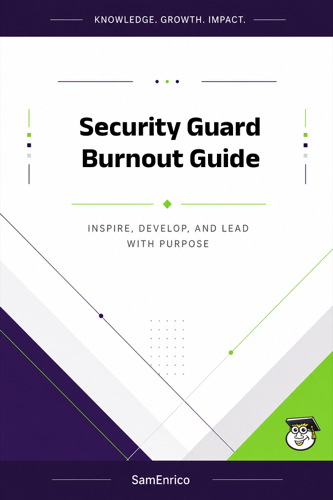
Security Guard Burnout Guide eBook
Handle boredom, shift work, and risk of violent co
by Hanley Royal
Handle boredom, shift work, and risk of violent confrontation.
Formats
Free sample
Chapter 1: More Than Furniture...--–- The security guard at the art museum stood so still, for so long, that a visiting schoolgirl asked her teacher if he was a statue. He was not a statue. He was a forty-three-year-old former marine named Dennis who had worked the same gallery post for eleven years. Dennis had perfected the art of standing motionless for hours. His uniform was immaculate.
His posture was textbook. His eyes, if you looked closely, were scanning the room in a slow, methodical pattern. But the schoolgirl saw what everyone saw: a man who might as well have been made of bronze. Dennis was not a statue. But he had been treated like one for so long that he had begun to feel like one.
Inert. Immovable. Unseen.Dennis was not burned out in the dramatic sense. He had not snapped at a visitor or fallen asleep on duty or quit in a rage. He had simply...
faded. The museum loved him. His supervisor praised his reliability. He never called in sick, never complained, never asked for a different post. He was, by every metric, the perfect warm body.
But Dennis had not had a conversation longer than "the restroom is down the hall to your left" in six months. He had not used his training in de-escalation or first aid or crowd control in over a year. He had become a piece of the furniture. And the furniture, no matter how polished, does not have a soul.This chapter is for Dennis. It is for every security guard who has ever wondered if anyone notices them beyond the uniform.
It is for every guard who has been told, directly or indirectly, that their only job is to exist in a specific location for a specific number of hours. It is for every guard who has felt the slow, creeping realization that they are valued not for their skills, their judgment, or their humanity, but for their ability to occupy space.The Invisible Profession Security work occupies a strange place in the hierarchy of American labor. On one hand, it is everywhere. There are more than 1.1 million security guards in the United States, according to the Bureau of Labor Statistics—more than police officers, more than firefighters, more than paramedics. On any given day, security guards are watching over hospitals, schools, office buildings, construction sites, shopping malls, airports, museums, power plants, and apartment complexes.
They are the invisible infrastructure of public safety, the first line of defense against theft, vandalism, trespassing, and violence.On the other hand, security work is nowhere. It is not celebrated in movies or television shows, except as comic relief or tragic incompetence. It is not discussed in policy debates about public safety, except as a cheap alternative to policing. It is not unionized at the same rate as other blue-collar professions. It is not respected by the public, who often mistake the guard for a rent-a-cop with delusions of grandeur.
It is not even respected by many of the clients who hire security companies, who see guards as a necessary expense—like insurance or janitorial services—rather than as skilled professionals.This invisibility is not accidental. It is structural. Security guards are most effective when they are unnoticed by the people they are watching. A visible guard deters crime; an invisible guard who sees everything and is seen by no one is even more effective. But there is a difference between professional invisibility—the tactical choice to blend into the background—and social invisibility, the experience of being treated as if you do not exist.
Professional invisibility is a tool. Social invisibility is a wound. And too many security guards suffer from the latter.Consider the daily experience of the average guard. You arrive at your post. You put on your uniform.
You check in with your supervisor, who may or may not acknowledge you as an individual. You stand or sit at your assigned location. Members of the public walk past you without making eye contact. Employees of the client company walk past you without saying hello. Your supervisor checks on you occasionally, usually to confirm that you have not left your post.
Your shift ends. You go home. You repeat. Day after day, week after week, month after month.In this environment, it is easy to start feeling like a piece of furniture. Like a statue.
Like a warm body occupying a chair. And once you start feeling that way, it is only a short step to acting that way. Your posture slumps. Your uniform gets wrinkled. Your radio stays in your pocket.
Your eyes stop scanning. You become the thing they already believed you were: interchangeable, disposable, replaceable.The Myth of the Passive Guardian One of the most damaging assumptions in the security industry is the idea that a guard's primary value is passive presence. The theory is simple: criminals are less likely to commit crimes when they know someone is watching. Therefore, the guard's job is simply to be seen. No active intervention required.
No critical thinking necessary. No judgment or discretion needed. Just show up, stand there, and be visible.This theory is not entirely wrong. Visible presence does deter some crimes. But it is dangerously incomplete.
A guard who is present but not paying attention is not deterring anyone. A guard who is present but not trained to recognize pre-incident indicators is not preventing anything. A guard who is present but not empowered to act is not protecting anyone. The passive guardian is a placebo. And placebos, by definition, have no real effect.The passive guardian myth persists because it is convenient for the contract security industry.
Passive guards require less training, less supervision, and less pay. They are less likely to use force, which means less liability for the contracting company. They are less likely to quit, because passive guards have lower expectations. The passive guardian is the ideal warm body: present, docile, and cheap.But the passive guardian myth is disastrous for guards themselves. When you are told, day after day, that your only value is your physical presence, you begin to believe it.
You stop developing your skills. You stop seeking challenges. You stop caring about the quality of your work. You become passive not because you are lazy, but because the system has trained you to be passive. And once you are passive, you are vulnerable—to boredom, to fatigue, to fear, to the slow erosion of your professional identity.This book rejects the passive guardian myth entirely.
You are not a piece of furniture. You are not a statue. You are not a warm body. You are a professional observer, a trained communicator, a skilled de-escalator, and a potential first responder. The fact that your employer may not recognize these roles does not make them any less real.
The fact that your post orders may not list these responsibilities does not make them any less important. You bring your full humanity to every shift, whether your employer acknowledges it or not. And that humanity—your attention, your judgment, your presence of mind—is your greatest asset.The Three Silent Killers Before we go any…
This is the end of the free sample. Get the eBook to keep going. Buy now
About this book
Details
- Author
- Hanley Royal
- Publisher
- SamEnrico
- Language
- English
- Genre
- Non-Fiction, Self-Help, Security
- Released
- 2026-06-09
- Pages (approx.)
- 142
- Available as
- eBook, Audiobook

Read better in the ZLOADR app
Your eBooks on your phone or tablet. Sign in with your SamEnrico account and start reading.
More by Hanley Royal
 Sacred Silence Training ManualHanley Royal$11.99
 Oil Gas FCPA ViolationsHanley Royal$11.99
 Imposter Visualization MasteryHanley Royal$11.99
 Bedtime Battle SolutionHanley Royal$11.99
 Pelvic Floor TherapyHanley Royal$11.99
 The Catholic Revival ArtHanley Royal$11.99
 Visual Impairment ListeningHanley Royal$11.99
 Ho Chi Minh TrailHanley Royal$11.99
 The Silk Road Swindle: How a Teenage Hacker Duped the Dark WebHanley Royal$11.99
 The Silent Coup: How a Tech Giant Swallowed a Media EmpireHanley Royal$11.99
 The Forgotten Cartographer: Gertrude Bell and the Mapping of the Middle EastHanley Royal$11.99
 Google Analytics and GA4 MasteryHanley Royal$11.99
You may also like
 Hong Kong Handover 1997Dunn Johnnie$11.99
 Zumba For Postnatal Recovery CourseNeal Christian$11.99
 Zumba for BeginnersLadner Nikia$11.99
 YouTube Comment Mining GuideHumes Pandora$12.99
 Worry Box MeditationCarlin Rudy$11.99
 Workplace Stress MeditationNguyen Lynn$11.99
 Workplace Stress and Sleep RepairHawley Ivory$11.99
 Workplace Perfectionism CureDelaney Jeffry$11.99
 Workplace Injustice Anger GuideWallen Isabelle$11.99
 Work Addiction and Burnout LinkGreenwood Ester$11.99
 Women in Yoga and WellnessBeattie Galina$11.99
 Women in Stand Up ComedyChun Evangeline$11.99