
Non-FictionInformativeEducational
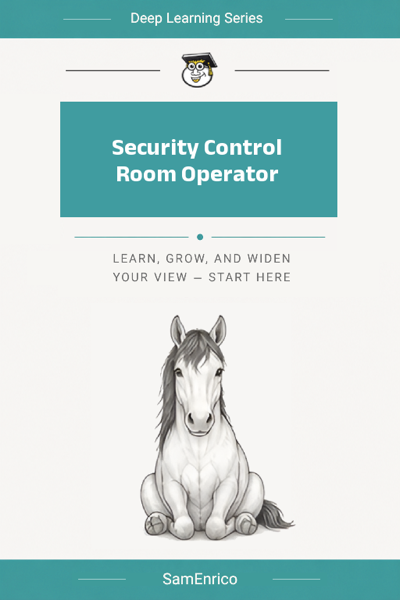
Security Control Room Operator eBook
A Coursebook on Security Control Room Operator
A Coursebook on Security Control Room Operator
Formats
Free sample
Chapter 1: The Nerve Center...--The hum of cooling fans, the soft glow of multiple monitors, and the distant crackle of a radio scanner—this is the sensory landscape of the modern Security Control Room (SCR). For the uninitiated visitor, it might resemble a television studio or a small trading floor. For the trained operator, however, this environment is something far more profound: it is the central nervous system of the entire organization. Every access card swipe, every motion sensor trigger, every emergency call, and every security camera feed converges here, in this room, at this moment. The person sitting in the operator’s chair does not merely watch screens; they hold a fiduciary and moral responsibility for the safety of people, the protection of assets, and the continuity of operations.
Welcome to the nerve center.Before we delve into the technical skills of surveillance, the protocols of communication, or the psychology of crisis management, we must first understand the landscape in which the Security Control Room Operator operates. This chapter establishes the strategic importance of the SCR, moving beyond outdated perceptions of a passive "security booth" or a "camera watcher." It traces the evolution of security monitoring from reactive observation—watching after something has gone wrong—to proactive situation management, where data is interpreted to predict and influence outcomes before incidents escalate. We will clearly define what an SCR is and is not, differentiate it from related concepts like the Cybersecurity SOC, and introduce the growing convergence of physical and cyber threats. Most importantly, this chapter will provide you, the future operator, with the foundational framework of Key Performance Indicators (KPIs) and professional mindset that will be built upon throughout this book. By the end of this chapter, you will no longer see a control room as a room full of screens.
You will see it as a strategic asset, and yourself as its most critical component.The Evolution of Security Monitoring To understand where the SCR is today, we must briefly look at where it came from. For most of the 20th century, security monitoring was a reactive, fragmented, and often paper-based function. A single guard might walk a patrol route, checking doors and windows, and sign a paper log at each checkpoint. Alarms were local—a loud bell that might scare off an intruder but did little to inform anyone outside earshot. The closest thing to a "control room" was often a small desk near the main entrance, cluttered with keys, a telephone, and possibly a single black-and-white monitor connected to a single camera pointed at the parking lot.The digital revolution of the 1980s and 1990s began to change this.
Closed-circuit television (CCTV) moved from analog tape to digital recording. Access control systems shifted from metal keys to magnetic stripe cards. Alarms could be transmitted over telephone lines to remote monitoring stations. However, these systems remained largely siloed. The camera system did not talk to the access control system.
The alarm panel did not share data with the video recorder. An operator might have multiple screens, keyboards, and interfaces, but each required separate attention and provided separate streams of information. The risk of missing a critical connection—for example, that a door forced alarm occurred at the same time a specific person swiped into a sensitive area—was high.The modern era, beginning around 2010 and accelerating rapidly today, is defined by integration and intelligence. Physical Security Information Management (PSIM) platforms and advanced Video Management Systems (VMS) now aggregate data from dozens of subsystems into a single common operating picture. Artificial intelligence (AI) and machine learning algorithms analyze video feeds in real-time, distinguishing between a person and a shadow, detecting loitering, and recognizing license plates.
Access control logs, visitor management data, and even weather alerts and social media feeds can be correlated automatically. The operator is no longer a passive viewer but an active analyst, managing a flow of information that arrives faster than any human could process manually. The role has shifted from "watchman" to "situation manager."This evolution is not merely technological; it is philosophical. The old model assumed that security incidents were rare, obvious, and binary—either nothing was happening, or a burglar was breaking in. The modern model recognizes that threats are continuous, variable, and often ambiguous.
A slow data leak, an employee working odd hours, a tailgater entering behind a legitimate badge holder—these are not dramatic events, but they are the early indicators of larger problems. The proactive operator hunts for these weak signals. The reactive operator waits for the alarm to scream. The difference in outcomes is often measured in prevention versus response, and sometimes in lives.The SCR Defined: More Than a Room Full of Screens Let us establish a clear, operational definition. A Security Control Room (SCR) is a centralized physical facility from which security personnel monitor, manage, and coordinate security operations across an enterprise.
It serves as the primary point of communication for security-related incidents, alarms, and requests for assistance. The SCR houses the technical infrastructure—displays, servers, communication equipment—necessary to maintain situational awareness of the protected environment. However, the SCR is not defined by its hardware. It is defined by its function: the fusion of data into actionable intelligence and the direction of response resources.It is helpful to contrast the SCR with related concepts to avoid confusion. First, a traditional security booth or guard shack is typically a static checkpoint at a single entry point.
Its occupant may check IDs, log vehicles, and perhaps watch a single camera feed of the gate. Communication is usually limited to a handheld radio. Decision-making authority is narrow. By contrast, an SCR oversees multiple sites or an entire campus, integrates data from hundreds of sensors, coordinates multiple response teams, and has direct communication with emergency services and executive management.Second, a Cybersecurity SOC (Security Operations Center) focuses exclusively on digital threats: network intrusions, malware, data exfiltration, and denial-of-service attacks. Its operators watch firewalls, intrusion detection systems, and server logs.
Historically, physical and cyber SOCs operated in complete isolation. However, as we will explore later, that separation is dangerously outdated. A hacker who compromises a building's access control system can disable electronic locks, allowing physical intruders to enter unchallenged. Conversely, a physical intruder who plugs a compromised device into a network port can bypass cyber defenses. The modern SCR must be aware of both domains, even if the technical monitoring remains separate, and this book will introduce the concept of convergence from the operator's perspective.Third, an Emergency Operations Center (EOC) is typically a temporary or activatable facility used during major crises—natural disasters, active shooter events, terrorist attacks.
An EOC coordinates multi-agency response at a strategic level, often involving police, fire, medical, and government officials. An SCR, by contrast, operates 24/7/365, handling both routine events (door forced alarms, lost ID badges) and escalating to crisis response when thresholds are exceeded. In many large organizations, the SCR serves as the initial notification point that then activates the EOC.Thus, the SCR is a permanent, always-on facility dedicated to continuous monitoring and response coordination. It is the first line of defense, the daily manager of security data, and the bridge between routine…
This is the end of the free sample. Get the eBook to keep going. Buy now
About this book
Details
- Author
- Kingsley Larita
- Publisher
- SamEnrico
- Language
- English
- Genre
- Non-Fiction, Informative, Educational
- Released
- 2026-05-04
- Pages (approx.)
- 156
- Available as
- eBook, Audiobook

Read better in the ZLOADR app
Your eBooks on your phone or tablet. Sign in with your SamEnrico account and start reading.
More by Kingsley Larita
 Senior Friendship Apps GuideKingsley Larita$11.99
 Post Hypnotic Suggestion for SleepKingsley Larita$11.99
 Electrosmog Home GuideKingsley Larita$11.99
 Parenting Anger ButtonsKingsley Larita$11.99
 The Last Broadcast: The Titan’s Final TransmissionKingsley Larita$11.99
 How to Produce CitrusKingsley Larita$11.99
 A Beginners Guide to 16 Inch (Volume 1)Kingsley Larita$11.99
 Shea Butter Aflatoxin ControlKingsley Larita$12.99
You may also like
 Hong Kong Handover 1997Dunn Johnnie$11.99
 Zumba For Postnatal Recovery CourseNeal Christian$11.99
 Zumba for BeginnersLadner Nikia$11.99
 YouTube Comment Mining GuideHumes Pandora$12.99
 Worry Box MeditationCarlin Rudy$11.99
 Workplace Stress MeditationNguyen Lynn$11.99
 Workplace Stress and Sleep RepairHawley Ivory$11.99
 Workplace Perfectionism CureDelaney Jeffry$11.99
 Workplace Injustice Anger GuideWallen Isabelle$11.99
 Work Addiction and Burnout LinkGreenwood Ester$11.99
 Women in Yoga and WellnessBeattie Galina$11.99
 Women in Stand Up ComedyChun Evangeline$11.99