
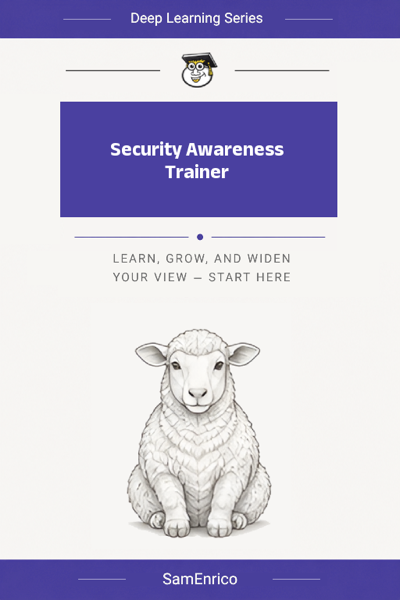
Non-FictionInformativeEducational
Security Awareness Trainer eBook
A Coursebook on Security Awareness Trainer
A Coursebook on Security Awareness Trainer
Formats
Free sample
Chapter 1: The Human Sensor Lie--–- The first thing you need to understand is that you have been sold a myth. Not a small, harmless exaggeration—a full-blown, expensive, counterproductive lie that has wasted billions of dollars and burned out an entire generation of security professionals. The myth is this: your employees are the weakest link in your security chain, and if you could just train them better, scare them more, or punish them harder, they would become a "human firewall"—a perfect, static, impenetrable defense against cyber threats. This image is seductive in its simplicity. A firewall does not get tired on a Monday morning.
A firewall does not have a sick child at home. A firewall does not check its bank account while waiting for a file to download. A firewall does not make mistakes. But your employees are not firewalls. They are human beings.
And the sooner you stop trying to turn them into machines, the sooner you can actually start reducing risk.The statistic that haunts our industry appears in every conference keynote, every vendor webinar, and every compliance audit: 91% of cyber incidents involve human error. This number is cited like a curse, a proof of original sin that no amount of training can erase. But here is what most trainers miss—and what this book will reframe from the very first page. That 91% statistic is not a condemnation of human nature. It is an opportunity map.
If 91% of incidents involve human action, then improving human behavior can prevent 91% of incidents. The problem is not that people are error-prone. The problem is that we have been teaching them entirely the wrong things in entirely the wrong ways. We have been training for compliance when we should have been training for behavior. We have been measuring clicks when we should have been measuring seconds.
And we have been punishing mistakes when we should have been learning from them.This chapter exists to shatter the false foundation upon which most security awareness programs are built. By the time you finish reading, you will understand why your current training probably fails, why the blame game is both cruel and counterproductive, and what actually works to change human behavior under pressure. You will learn the difference between awareness and behavior—two concepts that most trainers treat as identical but are, in fact, worlds apart. You will be introduced to the Just Culture model from aviation and medicine, where honest mistakes are investigated for systemic causes rather than individual blame. And you will begin to see your employees not as vulnerabilities to be patched, but as sensors to be empowered.
The human firewall is a lie. But the human sensor network is very, very real—and it can save your company millions.The 91% Problem: Reframing the Inevitable Let us start with the number that keeps you up at night. The 91% figure comes from decades of breach analysis, most recently from Verizon's Data Breach Investigations Report, which has tracked human involvement in incidents across thousands of organizations worldwide. It is a robust, defensible statistic. And it is also, if you are not careful, a weapon you will use against your own people.
The standard approach to this statistic goes something like this: "91% of breaches start with a user mistake. Therefore, users are the problem. Therefore, we must train users harder, test them more frequently, and punish them when they fail." This logic chain has produced an entire industry of shame-based training. You have seen it. The cartoon videos with ominous music.
The phishing simulations designed to trick rather than teach. The emails from IT that read, "Three people clicked on yesterday's test. Please be more careful." This is fear, uncertainty, and doubt weaponized as pedagogy. And it does not work.The neuroscience is clear and will be explored in depth in Chapter 3. But the short version is this: when you trigger a fear response, you flood the brain with cortisol.
The amygdala—the brain's alarm system—takes over. The prefrontal cortex, which handles complex reasoning and long-term planning, effectively shuts down. An employee who clicks a phishing link and then receives a threatening email from IT is not learning secure behavior. They are learning to fear IT. They are learning to hide their mistakes.
They are learning that security is something that happens to them, not something they participate in. This is the opposite of what you want.So let us reframe the 91% statistic, explicitly and deliberately, before we go any further. This book is not citing 91% to scare you. We are citing 91% to show you the opportunity. If nearly every breach requires a human action, then humans are not the problem—they are the solution.
Your employees are the only ones who can catch a phishing email that passes every technical filter. They are the only ones who can notice a tailgater at the office door. They are the only ones who can question an urgent wire transfer request from the "CEO." No firewall can do any of those things. Your people can. But only if you stop treating them like the enemy and start treating them like partners.Consider the alternative framing.
Imagine standing in front of a group of new hires and saying, "You are about to become the most important security sensors in this organization. Last year, our technical controls stopped 99.9% of attacks. But the 0.1% that got through—the truly dangerous ones—require your eyes, your judgment, and your voice. When you report a suspicious email, you are not bothering IT. You are doing the most important security work there is." That is an empowerment narrative.
That is a message that activates the prefrontal cortex, not the amygdala. And that is the kind of training that actually changes behavior. The 91% statistic, used correctly, is not a threat. It is an invitation.The Perfection Trap: Why Zero Errors Is the Wrong Goal Here is another myth that needs to die: the idea that you can train your way to zero human error. This is the Perfection Trap, and it is responsible for more trainer burnout and employee resentment than any other single factor.
The Perfection Trap says that any click on a phishing simulation is a failure. Any tailgating incident is a failure. Any forgotten password reset is a failure. And because the goal is zero failures, every failure must be addressed with more training, more testing, and more punishment. This creates a doom loop.
Employees are tested on unrealistic scenarios, they fail at predictable rates, and the response is to double down on the same broken methods. Trainers wonder why their metrics never improve. Employees wonder why security seems designed to make their jobs harder. Everyone loses.The Perfection Trap is seductive because it feels rigorous. It feels like holding people accountable.
But it is fundamentally incompatible with how human beings actually operate. Humans make errors. This is not a bug; it is a feature of our cognition. We take shortcuts. We get distracted.
We trust patterns. These tendencies evolved over millions of years because they were, on balance, adaptive. The hunter who assumed every rustle in the bushes was a predator died of starvation. The brain that…
This is the end of the free sample. Get the eBook to keep going. Buy now
About this book
Details
- Author
- Delgado Faith
- Publisher
- SamEnrico
- Language
- English
- Genre
- Non-Fiction, Informative, Educational
- Released
- 2026-06-02
- Pages (approx.)
- 134
- Available as
- eBook, Audiobook

Read better in the ZLOADR app
Your eBooks on your phone or tablet. Sign in with your SamEnrico account and start reading.
More by Delgado Faith
 Personal Ing For Success Competitive AnalysisDelgado Faith$11.99
 The Global Talent Mobility ROIDelgado Faith$11.99
 Intuitive Eating For Orthorexia Recovery HandbookDelgado Faith$11.99
 Pain Medication Side Effect ManualDelgado Faith$11.99
 Continuing Personal Inventory Step Ten GuideDelgado Faith$11.99
 The Last Whale Hunter: A Voyage Through Time and IceDelgado Faith$11.99
 Shadows of the Iron Phoenix: The Untold Story of Admiral Yi Sun-sinDelgado Faith$11.99
 Bootcamp Portfolio That WinsDelgado Faith$12.99
 Funding Your Non Resident LLCDelgado Faith$12.99
 Ultimate Handbook Guide to Rajkot : (India) Travel GuideDelgado Faith$11.99
 Understanding Biotin DeficiencyDelgado Faith$17.99
You may also like
 Hong Kong Handover 1997Dunn Johnnie$11.99
 Zumba For Postnatal Recovery CourseNeal Christian$11.99
 Zumba for BeginnersLadner Nikia$11.99
 YouTube Comment Mining GuideHumes Pandora$12.99
 Worry Box MeditationCarlin Rudy$11.99
 Workplace Stress MeditationNguyen Lynn$11.99
 Workplace Stress and Sleep RepairHawley Ivory$11.99
 Workplace Perfectionism CureDelaney Jeffry$11.99
 Workplace Injustice Anger GuideWallen Isabelle$11.99
 Work Addiction and Burnout LinkGreenwood Ester$11.99
 Women in Yoga and WellnessBeattie Galina$11.99
 Women in Stand Up ComedyChun Evangeline$11.99