
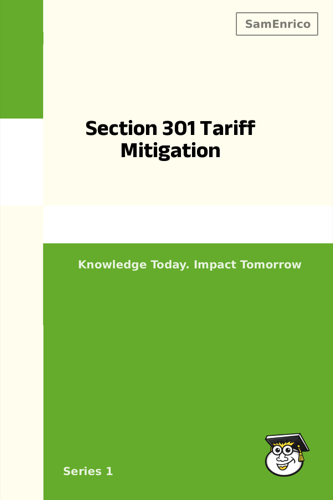
Non-FictionBusiness Brief / Trade Policy
Section 301 Tariff Mitigation eBook
Addresses China Section 301 tariffs with exclusion
Addresses China Section 301 tariffs with exclusion requests and supply chain alternatives.
Formats
Free sample
Chapter 1: The Permanent Storm--–- On a humid July morning in 2018, Linda Chen, the owner of a modest Midwest machining company, received a letter from her largest Chinese supplier. The supplier was raising prices by 25 percent, effective immediately. Linda assumed it was a negotiation tactic—a bluff she could counter by threatening to switch to a Vietnamese factory she had visited the previous year. She was wrong. Within ninety days, the 25 percent increase became permanent, her Vietnamese alternative proved incapable of meeting quality standards, and her business became one of the first casualties of a trade war that most economists said could not possibly last.Linda's story is not unique.
It is the archetypal story of the last decade of American importing. Her mistake—shared by thousands of business owners, supply chain managers, and even Fortune 500 procurement departments—was treating a permanent structural shift as a temporary negotiating tactic. This chapter dismantles that assumption. Section 301 tariffs are not a storm to be waited out. They are a permanent feature of the global trade landscape.
Understanding why, and understanding the mechanics of how these tariffs actually work, is the single most important step you can take toward protecting your business.The Birth of a Trade Weapon To understand where we are, we must first understand where Section 301 came from. The Trade Act of 1974 was passed during the Nixon administration, a time of significant trade turbulence. The oil embargo had shocked the global economy. Japan's automotive and electronics industries were rapidly gaining ground on American competitors. And Congress, frustrated with the slow pace of international trade negotiations, decided to give the executive branch a powerful new tool.Section 301 of that Act allows the United States Trade Representative to investigate foreign trade practices and, if those practices are found to be "unreasonable" or "burdensome," to retaliate unilaterally.
Unilateral is the key word. Unlike anti-dumping or countervailing duty investigations, which require the International Trade Commission to find actual injury to a domestic industry, Section 301 requires no such finding. Unlike World Trade Organization disputes, which can take years to resolve through a formal legal process, Section 301 allows the USTR to act within months. The president can impose tariffs, quotas, or any other trade restriction without congressional approval and without waiting for international permission.For decades, Section 301 was used sparingly. The USTR invoked it against Japan in the 1980s over semiconductor trade.
It was used against the European Union over bananas and beef hormones. But by the 2000s, as the WTO dispute resolution system matured, Section 301 fell into relative disuse. Many trade lawyers assumed it had been effectively superseded by international agreements.That assumption was shattered in 2017. The Trump administration, convinced that decades of engagement had failed to open China's markets or stop its technology transfer practices, launched a new Section 301 investigation. The resulting report, released in March 2018, ran over 200 pages and catalogued what the USTR called "a systematic campaign of technology transfer, intellectual property theft, and forced joint ventures." The remedy was not a diplomatic note or a WTO complaint.
It was tariffs. Billions of dollars of tariffs, imposed on thousands of products, with no end date specified.The Biden administration inherited these tariffs. Then it kept them. Then it expanded them in certain sectors, particularly electric vehicles and semiconductors. By 2026, the bipartisan consensus had become unmistakable: regardless of which party controls the White House, Section 301 tariffs on China are now a permanent tool of U.S.
economic statecraft. They are not going away.The Four Lists Decoded The USTR organized its retaliation into four tranches, each with different coverage and different duty rates. Understanding which list applies to your products is the first step toward any mitigation strategy.List 1, announced in July 2018, targeted $34 billion worth of Chinese industrial goods with a focus on advanced technology. Covered items include robotics, semiconductor manufacturing equipment, medical devices, aircraft parts, and precision industrial machinery. The duty rate was set at 25 percent.
The strategic logic was clear: these products aligned closely with China's "Made in China 2025" industrial policy, which the USTR viewed as an unfair, subsidy-driven challenge to American technological leadership.List 2 followed in August 2018, adding another $16 billion of Chinese imports. This tranche covered plastic products, rubber articles, certain chemicals, and additional machinery components. The duty rate was also 25 percent. The purpose of List 2 was less about strategic technology and more about broadening the economic pressure on China's manufacturing base.List 3, announced in September 2018, was the big one. It covered $200 billion of Chinese imports across thousands of product categories, ranging from furniture and luggage to industrial fasteners and circuit boards.
The duty rate started at 10 percent but was increased to 25 percent in May 2019. This is the list that made Section 301 unavoidable for most American businesses. If you import anything from China that is not a raw material or a finished consumer electronic, it is likely on List 3.List 4A, announced in September 2019, covered approximately $120 billion of consumer goods that had escaped the previous lists: cell phones, laptop computers, video game consoles, certain apparel, and footwear. The duty rate was set at 7.5 percent, a deliberate reduction from the 25 percent applied to industrial goods. The lower rate reflected both political pressure from consumer goods retailers and the recognition that higher tariffs on i Phones would anger American voters without meaningfully pressuring China's government.A fifth list, List 4B, was proposed but never implemented.
It would have covered an additional $160 billion of consumer goods, but the Trump administration suspended it as a goodwill gesture during trade negotiations. That suspension became permanent when the Biden administration chose not to revive it. However, nothing prevents a future administration from implementing List 4B or creating entirely new lists. The legal authority remains in place.The Stacking Effect That Destroys Margins Here is where even sophisticated importers make catastrophic errors. Section 301 duties are not applied in isolation.
They are stacked on top of existing duties, and sometimes on top of additional duties, in ways that can produce effective tariff rates that are shockingly high.Consider a typical industrial component imported from China. Let us say the product carries a baseline Most Favored Nation duty rate of 3.5 percent. This is the standard tariff that any World Trade Organization member pays, regardless of trade tensions. Because the product is on List 3, it also carries a 25 percent Section 301 duty. But the calculation is not additive in the way most business owners assume.Many importers simply add 3.5 and 25 to get 28.5 percent.
This is wrong. Customs applies duties sequentially, which increases the total. First, the 3.5 percent MFN duty is applied to the customs value, adding a certain dollar amount. Then, the 25 percent Section 301 duty is applied to the customs value plus the MFN duty. The effective rate is therefore 3.5 percent plus 25 percent of 103.5 percent, which equals 29.375 percent, not 28.5 percent.The difference may seem small on a single shipment, but it compounds dramatically over time.
On $1 million of annual imports, the difference between 28.5 percent and 29.375 percent is $8,750 per year. Over five years, that is nearly $44,000 of avoidable costs. And that is assuming no other duties apply.But other duties often do apply. Many Chinese products are also subject to anti-dumping or countervailing duties, which can add another 10…
This is the end of the free sample. Get the eBook to keep going. Buy now
About this book
Details
- Author
- Dorn Leonarda
- Publisher
- SamEnrico
- Language
- English
- Genre
- Non-Fiction, Business Brief / Trade Policy
- Released
- 2026-06-10
- Pages (approx.)
- 147
- Available as
- eBook, Audiobook

Read better in the ZLOADR app
Your eBooks on your phone or tablet. Sign in with your SamEnrico account and start reading.
More by Dorn Leonarda
 Smoking Cessation For Heavy UsersDorn Leonarda$11.99
 IBS and SIBO ConnectionDorn Leonarda$11.99
 Compulsive Spending for VeteransDorn Leonarda$11.99
 Hammurabi’s Code: The Birth of Western JusticeDorn Leonarda$11.99
 How to Produce Antennas For CommunicationsDorn Leonarda$11.99
 Partner Skills Inclusion HandbookDorn Leonarda$12.99
 How to Start a Alloy Bearing Steel Business (Beginners Guide)Dorn Leonarda$11.99
 Tobermorite MiningDorn Leonarda$11.99
You may also like
 Hong Kong Handover 1997Dunn Johnnie$11.99
 Zumba For Postnatal Recovery CourseNeal Christian$11.99
 Zumba for BeginnersLadner Nikia$11.99
 YouTube Comment Mining GuideHumes Pandora$12.99
 Worry Box MeditationCarlin Rudy$11.99
 Workplace Stress MeditationNguyen Lynn$11.99
 Workplace Stress and Sleep RepairHawley Ivory$11.99
 Workplace Perfectionism CureDelaney Jeffry$11.99
 Workplace Injustice Anger GuideWallen Isabelle$11.99
 Work Addiction and Burnout LinkGreenwood Ester$11.99
 Women in Yoga and WellnessBeattie Galina$11.99
 Women in Stand Up ComedyChun Evangeline$11.99