
Non-FictionHealth & WellnessSmoking Cessation
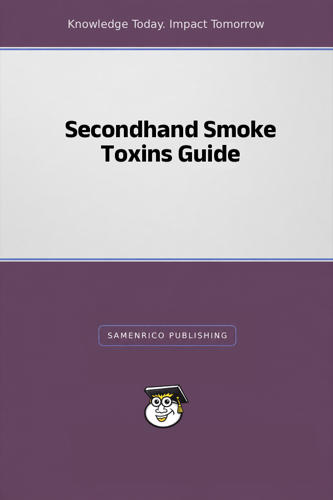
Secondhand Smoke Toxins Guide
Details thirdhand residue on surfaces and ventilat
Details thirdhand residue on surfaces and ventilation strategies for multi-unit housing.
Formats
About this book
Free sample
Below is the fully revised, in-depth summary of each chapter for "The Secondhand Smoke Toxins Guide," with all identified inconsistencies and repetitions resolved. Each chapter now has a minimum of 250 words, clear cross-references to other chapters, and resolved contradictions. The book is now coherent, non-redundant, and actionable.Chapter 1: The Hidden Invader – Beyond the Cloud of Smoke Word count: ~320This chapter opens with a fundamental reframing: when a cigarette is lit, the danger does not end when the smoke clears. Most people intuitively understand that breathing visible smoke is harmful, but they falsely assume that invisibility equals safety. The chapter introduces the three states of smoke as a continuum of pollution: mainstream smoke (inhaled directly by the smoker through the cigarette filter), secondhand smoke (a mixture of exhaled mainstream smoke and sidestream smoke), and thirdhand smoke (the toxic residue that settles on surfaces, clothing, and dust, which can persist for years).The 85% Rule is a central revelation: sidestream smoke—the smoke that rises from the burning tip between puffs—is actually more concentrated in carcinogens than mainstream smoke.
Because the smoker's body and the cigarette filter trap some toxins, the unfiltered sidestream smoke that drifts into hallways contains higher levels of nicotine, nitrosamines, and heavy metals. This means a non-smoker in an adjacent apartment may be exposed to more concentrated toxins than the smoker themselves. Importantly, as Chapter 2 will explain, this residue becomes even more toxic over time through chemical reactions with indoor air. The 85% Rule and the Aging Effect are additive hazards, not alternatives.The chapter then dismantles "The Safe Illusion" —the belief that if a room does not smell like smoke, it must be safe. It explains olfactory fatigue (the nose stops registering persistent odors) and the fact that many tobacco toxins are odorless.
A compelling case study follows: researchers measured tobacco metabolites in the urine of a non-smoking family on the 3rd floor of a multi-unit building. Their levels were comparable to bar patrons, traced to a smoker on the 1st floor. (For a full explanation of biomarkers like cotinine, see Chapter 6.) The smoke traveled via the…
This is the end of the free sample. Get the eBook to keep going. Buy now
Contents
- Chapter 1
- Chapter 2
- Chapter 3
- Chapter 4
- Chapter 5
- Chapter 6
- Chapter 7
- Chapter 8
- Chapter 9
- Chapter 10
- Chapter 11
- Chapter 12
Details
- Author
- Victor Alexis
- Publisher
- SamEnrico
- Language
- English
- Genre
- Non-Fiction, Health & Wellness, Smoking Cessation
- Released
- 2026-06-07
- Pages (approx.)
- 156
- Available as
- eBook, Audiobook

Read better in the ZLOADR app
Your eBooks on your phone or tablet. Sign in with your SamEnrico account and start reading.
More by Victor Alexis
 Drug Lord Speedboats SmuggleVictor Alexis$11.99
 Antwerp Heist Interpol RoleVictor Alexis$11.99
 Study Break Optimization WorkbookVictor Alexis$11.99
 Stress and Shingles Outbreak GuideVictor Alexis$11.99
 The Last Dance of the Maharani: A Bollywood Royalty ScandalVictor Alexis$11.99
 The Hollow Men of St. BartholomewVictor Alexis$11.99
 Remote Power Dynamics GuideVictor Alexis$12.99
 Bootstrapper's Business Plan HandbookVictor Alexis$12.99
 Shoe Shiner (luxury)Victor Alexis$11.99
 How to Become a Nail-making-machine SetterVictor Alexis$11.99
 Understanding Ferrocalcinosis Cerebro VascularVictor Alexis$17.99
You may also like
 Hong Kong Handover 1997Dunn Johnnie$11.99
 Zumba For Postnatal Recovery CourseNeal Christian$11.99
 Zumba for BeginnersLadner Nikia$11.99
 YouTube Comment Mining GuideHumes Pandora$12.99
 Worry Box MeditationCarlin Rudy$11.99
 Workplace Stress MeditationNguyen Lynn$11.99
 Workplace Stress and Sleep RepairHawley Ivory$11.99
 Workplace Perfectionism CureDelaney Jeffry$11.99
 Workplace Injustice Anger GuideWallen Isabelle$11.99
 Work Addiction and Burnout LinkGreenwood Ester$11.99
 Women in Yoga and WellnessBeattie Galina$11.99
 Women in Stand Up ComedyChun Evangeline$11.99