
Non-FictionHealth & WellnessSmoke Exposure
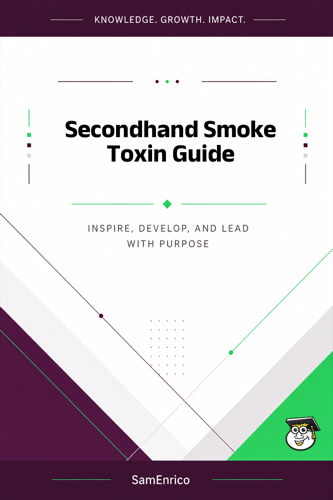
Secondhand Smoke Toxin Guide eBook
Protect family from thirdhand residue on surfaces
Protect family from thirdhand residue on surfaces and ventilate after any indoor smoking.
Formats
Free sample
Chapter 1: The Ghost That Lingers...–- The late afternoon sun slanted through the kitchen window as Sarah lifted her two-year-old daughter, Emma, onto the counter to wash sticky hands. The house was quiet. The smell of coffee mingled with the faint, almost imperceptible sweetness of old wood. Sarah’s father, a lifelong smoker, had moved out six months ago. He had always been careful—never lighting up inside, always stepping onto the back porch, even in the rain.
The air in the house had felt fresh for months. The faint yellow tinge on the walls had been painted over. Life had moved on.But Emma had been coughing for three weeks. Not a deep, scary cough, but a persistent, dry little hack that appeared at night and lingered into the morning. The pediatrician had ruled out allergies, asthma, and infection.
“Has anyone smoked in the home?” she had asked. “No,” Sarah had replied, honestly. “Not for six months.”What Sarah did not know—what no one had told her—was that the absence of smoke does not mean the absence of danger. The man who had stood on her back porch, exhaling into the open air, had left behind an invisible legacy. The nicotine from his cigarettes had hitched a ride on his clothes, his skin, his breath.
It had settled into the drywall of the hallway he walked through. It had soaked into the sofa cushions where he sometimes napped. It had adhered to the fabric of Emma’s favorite stuffed bunny, left on the living room floor. And over the past six months, that residue had been quietly, silently, poisoning the air and the surfaces of Sarah’s home.This chapter is for Sarah. It is for every parent, grandparent, landlord, and renter who believes that “smoking outside” or “waiting for the smell to clear” is enough.
It is for the millions of families living in homes where someone once smoked, unaware that the ghost of that cigarette still lingers on every wall, every carpet, and every finger that touches a child’s cheek. We are going to dismantle the most dangerous myth about tobacco smoke: the myth that when the smoke clears, the danger is gone.The Myth of the Open Window Let us begin with an experiment you can visualize. Imagine two identical living rooms. In the first, a person smokes a single cigarette while standing next to an open window with a fan blowing outward. The smoke visibly drifts outside.
Within thirty minutes, the room smells clean again. In the second, the same person smokes a single cigarette with all windows closed. The room smells strongly for hours. Which room is safer?If you said the first room, you have just fallen victim to the most common and dangerous misunderstanding about thirdhand smoke. The open window does remove some of the airborne particles—the visible, heavy components of smoke that your nose can detect.
But it does almost nothing to address the invisible, sticky, semi-volatile compounds that behave not like smoke, but like a fine chemical mist. These compounds settle onto surfaces within minutes, long before the window fan has done its work. In fact, the airflow from the fan can accelerate this settling by pushing particles against walls and fabrics.Researchers at Lawrence Berkeley National Laboratory have quantified this effect. In a controlled experiment, a single cigarette smoked in a 30-cubic-meter room with an open window still deposited detectable levels of nicotine on every surface in that room within ninety minutes. The concentration of surface nicotine was reduced by only about 40 percent compared to a closed room—far from the “safe” condition that most people assume.
The open window did not eliminate the residue; it merely diluted the airborne concentration while the surfaces continued to absorb toxins as a sponge absorbs water.The myth of the open window persists because our senses deceive us. We evolved to detect immediate threats: the smell of smoke, the sight of a flame, the taste of spoiled food. But thirdhand smoke is a slow poison. It does not smell strongly once it has settled. In fact, the characteristic “old cigarette smell” that you might notice in a former smoker’s car or apartment is not the smell of fresh residue—it is the smell of chemical reactions already underway, as nicotine reacts with indoor air to form new, more dangerous compounds.
By the time you smell that stale odor, the residue has already been aging for hours or days.The smell-fade trap is therefore one of the most insidious features of thirdhand smoke. The danger does not fade with the smell. It transforms and persists. And because humans are terrible at detecting invisible, odorless threats, we walk into contaminated rooms every day believing we are safe.Defining the Triad: Smoke, Secondhand, and Thirdhand To understand where Sarah’s family went wrong, we need a precise vocabulary. The medical and scientific literature distinguishes among three distinct forms of tobacco exposure, and confusing them is the root of most household mistakes.Active smoke is what the smoker inhales directly from the cigarette.
It is called mainstream smoke, and it is the hottest, most concentrated form of tobacco combustion products. When a smoker takes a drag, the temperature at the tip of the cigarette exceeds 800 degrees Celsius, producing thousands of chemical compounds. The smoker’s lungs absorb about 70 to 80 percent of these compounds; the rest are exhaled.Secondhand smoke is the mixture of two sources: the smoke that drifts from the burning tip of the cigarette between puffs (called sidestream smoke) and the smoke that the smoker exhales. Secondhand smoke is what you smell when you stand near a smoker. It contains many of the same toxins as active smoke, though in different proportions.
Sidestream smoke, interestingly, has higher concentrations of some carcinogens than mainstream smoke because it burns at a lower temperature and undergoes less complete combustion. This is why being near a smoker is not merely unpleasant—it is measurably harmful, increasing the risk of lung cancer and heart disease in nonsmokers by 20 to 30 percent.Thirdhand smoke is the residue that remains after the secondhand smoke has cleared. It is what settles onto surfaces, soaks into materials, and slowly off-gasses back into the air over days, months, or even years. Thirdhand smoke is not a single chemical but a complex mixture of nicotine, heavy metals, carcinogens, and their chemical reaction products. It is sticky, semi-volatile, and persistent.
It cannot be removed by opening a window, running a fan, or simply waiting for it to dissipate. In fact, waiting makes it worse, because as the residue ages, it transforms into more toxic compounds.The critical insight—and the one that changes everything for families like Sarah’s—is that thirdhand smoke is not a smaller version of secondhand smoke. It is a different hazard altogether, with different chemistry, different exposure pathways, and different health effects. You can protect yourself from secondhand smoke by moving away from a smoker or opening a window. You cannot protect yourself from thirdhand smoke by avoiding the smoker in real time, because the smoker has already deposited the residue onto your home’s surfaces hours or days earlier.The Reversible Sink…
This is the end of the free sample. Get the eBook to keep going. Buy now
About this book
Details
- Author
- Comstock Danika
- Publisher
- SamEnrico
- Language
- English
- Genre
- Non-Fiction, Health & Wellness, Smoke Exposure
- Released
- 2026-06-09
- Pages (approx.)
- 127
- Available as
- eBook, Audiobook

Read better in the ZLOADR app
Your eBooks on your phone or tablet. Sign in with your SamEnrico account and start reading.
More by Comstock Danika
 The Imposter Cure HandbookComstock Danika$11.99
 Sarcopenia Resistance GuideComstock Danika$11.99
 Physical Abuse Trigger HealingComstock Danika$11.99
 Alcohol Recovery for AtheistsComstock Danika$11.99
 Biotech Capital PlaybookComstock Danika$11.99
 Net Promoter Score GuideComstock Danika$11.99
 Bodyweight Strength BibleComstock Danika$11.99
 Dreaming for Financial ProblemsComstock Danika$11.99
 The Forgotten Navigator: The Medieval Voyages of Ma’afu and the Pacific’s Lost KingdomsComstock Danika$11.99
 The Last Broadcast: The Unheard Final Words of Challenger’s CrewComstock Danika$11.99
 The Leopard’s Whisper: Dr. George Washington Carver and the Secrets of the WildComstock Danika$11.99
 Global Option Valuation GuideComstock Danika$12.99
You may also like
 Hong Kong Handover 1997Dunn Johnnie$11.99
 Zumba For Postnatal Recovery CourseNeal Christian$11.99
 Zumba for BeginnersLadner Nikia$11.99
 YouTube Comment Mining GuideHumes Pandora$12.99
 Worry Box MeditationCarlin Rudy$11.99
 Workplace Stress MeditationNguyen Lynn$11.99
 Workplace Stress and Sleep RepairHawley Ivory$11.99
 Workplace Perfectionism CureDelaney Jeffry$11.99
 Workplace Injustice Anger GuideWallen Isabelle$11.99
 Work Addiction and Burnout LinkGreenwood Ester$11.99
 Women in Yoga and WellnessBeattie Galina$11.99
 Women in Stand Up ComedyChun Evangeline$11.99