
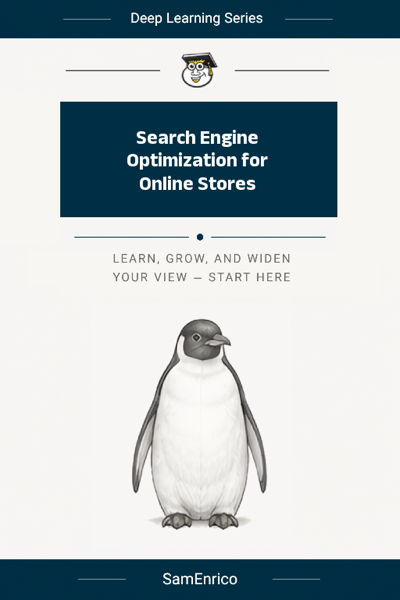
Non-FictionInformativeEducational
Search Engine Optimization for Online Stores eBook
A Coursebook on Search Engine Optimization for Onl
A Coursebook on Search Engine Optimization for Online Stores
Formats
Free sample
Chapter 1: The Traffic Trap--– Every morning, Maria opened her laptop and stared at the same dashboard. Google Analytics showed 10,000 visitors to her online store last month. Her heart jumped a little each time she saw that number. Ten thousand people. That was more than the population of her entire hometown.
She had built something that people actually visited. The problem was printed on the next line of the dashboard: thirty-seven sales. Thirty-seven. From ten thousand people. That was a conversion rate of 0.37 percent.
Maria was not running an online store. She was running a very expensive digital museum where people browsed, admired, and then left without buying anything.She had done everything the generic SEO blogs told her to do. She wrote blog posts. She optimized her titles. She built a handful of backlinks.
She even paid for a fancy SEO tool that sent her weekly reports showing her rankings were improving. Her keywords were climbing. Her traffic was growing. Her sales were not. The disconnect between traffic and revenue was not a bug in her strategy.
It was the central feature of how most e-commerce SEO advice fails.This chapter dismantles the single most destructive myth in online retail: the belief that more traffic equals more sales. For a content publisher running an ad-supported blog, traffic is the product. For an online store, traffic is only the raw material. What matters is what you do with it. The difference between a blog and a store is the difference between a highway billboard and a cash register.
One gets seen. The other gets used. Most SEO advice was written for the billboard people. This book was written for the cash register people.The Myth of More Traffic Let me tell you about a client I once worked with named David. David sold handmade leather wallets.
Beautiful things. Stitched by artisans in a small workshop. He came to me with what he thought was a good problem. His traffic had doubled in six months. He was getting fifteen thousand visitors a month.
His sales had stayed flat at about two hundred wallets. He was confused. He was frustrated. He was losing money because his hosting bills had increased but his revenue had not.We opened his Google Search Console together. I asked him to show me the top ten keywords driving traffic to his site.
He pulled up the report with pride. Number one: “how to condition leather.” Number two: “leather vs synthetic wallet.” Number three: “best wallet for minimalist.” Number four: “handmade leather goods.” Number five: “leather care tips.” You can see the pattern. His site ranked beautifully for informational queries. People wanted to learn about leather. They wanted advice.
They wanted education. They did not want to buy a wallet. At least not yet, and not from his product pages.David had fallen into what I call the Traffic Trap. He assumed that all visitors were created equal. They are not.
The person searching for “how to condition leather” is probably sitting on their couch with an old wallet they already own, looking for maintenance advice. The person searching for “buy handmade leather wallet under one hundred dollars” has their credit card out and is ready to purchase. Those two searches look similar in a keyword research tool. They are both about leather wallets. But they represent completely different psychological states.
One is curiosity. One is commerce.This distinction is not academic. It is the difference between Maria’s 0.37 percent conversion rate and a healthy three to five percent. It is the difference between hosting bills that eat your profits and a business that grows. The first step to fixing e-commerce SEO is not learning a new technical trick.
It is learning to see the world through the eyes of a shopper, not a publisher.Transactional Intent vs. Informational Intent Every search query contains a hidden signal about what the user wants to do next. Linguists and search engineers call this search intent. For e-commerce, we care about two primary categories.Transactional intent means the user wants to complete a transaction. They want to buy, order, reserve, or subscribe.
The language of transactional intent includes words like “buy,” “order,” “purchase,” “shop,” “deal,” “coupon,” “discount,” “shipping,” “price,” and “in stock.” When someone types “buy Nike Air Max size 10,” they are not researching. They are shopping. They have already decided on the product. They are deciding where to buy it. Your job is to be the answer.Informational intent means the user wants to learn something.
They want to understand, compare, discover, or solve a problem. The language of informational intent includes words like “how,” “what,” “why,” “best,” “review,” “vs,” “guide,” “tips,” “care,” “difference between,” and “should I.” When someone types “how to clean leather boots,” they are learning. They may never buy anything from you. Or they might buy six months from now after reading twenty blog posts. But right now, in this moment, they are not a buyer.Here is where most e-commerce SEO goes wrong.
Store owners see a high-volume keyword like “best running shoes for flat feet” and think, “That is perfect. I sell running shoes.” What they miss is that “best” is an informational signal. The user is comparing. They are researching. They are not ready to buy.
If you send that user to a product page that says “Add to Cart,” you have created a mismatch. The user feels pressured. The page feels wrong. They bounce.The correct approach is to match intent to page type. Informational queries belong on blog posts, guides, comparison articles, and educational content.
Transactional queries belong on product pages, category pages optimized for commerce, and checkout flows. When you mix them, everyone loses. The user does not find what they want. The search engine learns that your page does not satisfy the query. Your conversion rate collapses.The E-Commerce Sales Funnel Reimagined Traditional marketing teaches the sales funnel as Awareness, Consideration, and Action.
That model is correct but often misapplied to SEO. Let me show you how it maps to your store in a way that drives sales, not just traffic.At the top of the funnel, Awareness, your goal is to attract people who do not yet know they have a problem you can solve. These users have informational intent. They search for “how to prevent blisters when running” or “why does my back hurt after sitting.” They are not shopping. They are learning.
The right content for this stage is blog posts, videos, infographics, and guides. You are not selling here. You are helping. You are building trust. You are earning the right to be remembered later.At the middle of the funnel, Consideration, your goal is to convince people that your specific product is the solution to their now-identified problem.
These users have commercial investigation intent. They search for “best running shoes for flat feet” or “Dyson vs Shark vacuum.” They know they need a product. They are comparing options. The right content for this stage is product comparison guides, detailed category pages, specification sheets, video reviews, and user-generated content like testimonials. This is where you make your case.
This is where you earn the click to your product page.At the bottom of the funnel, Action, your goal is…
This is the end of the free sample. Get the eBook to keep going. Buy now
About this book
Details
- Author
- Maas Christal
- Publisher
- SamEnrico
- Language
- English
- Genre
- Non-Fiction, Informative, Educational
- Released
- 2026-05-18
- Pages (approx.)
- 128
- Available as
- eBook, Audiobook

Read better in the ZLOADR app
Your eBooks on your phone or tablet. Sign in with your SamEnrico account and start reading.
More by Maas Christal
 Traffic Anger TriggersMaas Christal$11.99
 Jealousy Self Esteem Fix GuideMaas Christal$11.99
 Meditation Nap Hybrid GuideMaas Christal$11.99
 The School Presentation GuideMaas Christal$11.99
 Imposter Syndrome For Graduate StudentsMaas Christal$11.99
 Cardiac Arrest SurvivorMaas Christal$11.99
 Fibromyalgia and Interstitial CystitisMaas Christal$11.99
 Nightmare Processing HandbookMaas Christal$11.99
 Henry Kissinger RealpolitikMaas Christal$11.99
 The Phantom of Monaco: The Unstoppable Heist of the 1962 Ferrari 250 GTOMaas Christal$11.99
 The Electric Muse: How a Teenage Prodigy Reinvented Classical MusicMaas Christal$11.99
 The Ballad of the Bard: How Chaucer Wove England’s SoulMaas Christal$11.99
You may also like
 Hong Kong Handover 1997Dunn Johnnie$11.99
 Zumba For Postnatal Recovery CourseNeal Christian$11.99
 Zumba for BeginnersLadner Nikia$11.99
 YouTube Comment Mining GuideHumes Pandora$12.99
 Worry Box MeditationCarlin Rudy$11.99
 Workplace Stress MeditationNguyen Lynn$11.99
 Workplace Stress and Sleep RepairHawley Ivory$11.99
 Workplace Perfectionism CureDelaney Jeffry$11.99
 Workplace Injustice Anger GuideWallen Isabelle$11.99
 Work Addiction and Burnout LinkGreenwood Ester$11.99
 Women in Yoga and WellnessBeattie Galina$11.99
 Women in Stand Up ComedyChun Evangeline$11.99