
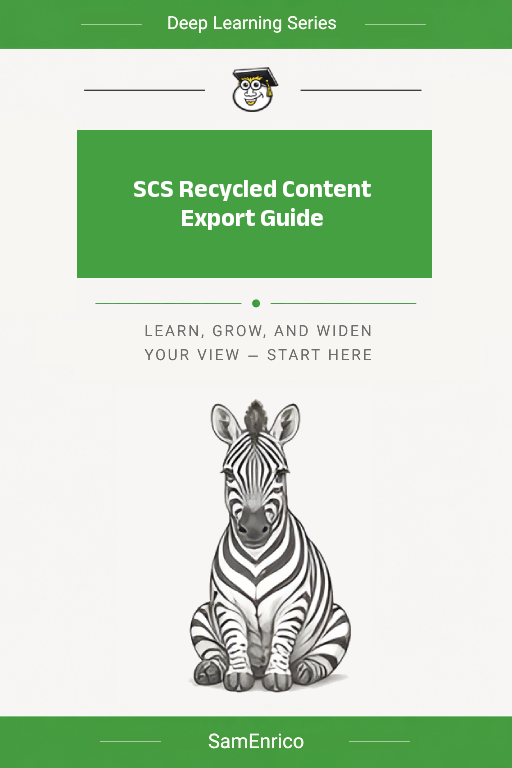
SCS Recycled Content Export Guide eBook
Certify recycled content under SCS Global Services
by Frazer Lon
Certify recycled content under SCS Global Services for plastics and metals, meeting US EPA procurement standards and California recycling laws.
Formats
Free sample
Chapter 1: The $10,000 Mistake--–- The fluorescent lights of the GSA contracting office hummed quietly as Margaret Chen, supply chain director for a Taiwanese PET recycling firm, stared at the rejection letter in disbelief. Her company had spent six months preparing a bid for a $2.3 million contract to supply recycled-content plastic trash liners to the US Department of Veterans Affairs. The price was competitive. The quality was excellent. The delivery timeline was aggressive but achievable.
Yet the bid had been rejected without a single technical review. The reason, listed in a single cold sentence: *"Bidder failed to provide third-party certification of recycled content as required by FAR 52.223-4."* Margaret’s company had a valid SCS Global Services certificate for its facility. The problem was that someone in the shipping department had attached an outdated version—expired by just eleven days. Eleven days. Two million dollars.
That is the cost of treating recycled content certification as an administrative afterthought rather than a strategic asset.This chapter is designed to ensure you never receive that letter. It provides a comprehensive overview of the US federal government's "Buy-Recycled" program, explaining not just what the rules are, but why they exist, how they are enforced, and exactly what you need to do to win contracts. By the end of this chapter, you will understand the legal architecture of RCRA Section 6002, the 54+ categories of the Comprehensive Procurement Guideline (CPG), the enforcement power of Affirmative Procurement Programs (APPs), and the economic thresholds that determine whether your bid is reviewed or rejected. You will also learn the single most important operational rule for exporters: never let your certification lapse, even for eleven days.The Legal Foundation: RCRA Section 6002The story of the US "Buy-Recycled" program begins not with a recycling law, but with a waste management law. The Resource Conservation and Recovery Act (RCRA) of 1976 was originally designed to regulate the disposal of solid and hazardous waste.
But buried within its dense statutory language is Section 6002, a provision that would fundamentally reshape the market for recycled materials. Section 6002 mandates that any federal agency procuring an item designated in the Environmental Protection Agency's Comprehensive Procurement Guideline must purchase that item made with recovered materials to the maximum extent practicable.Let us parse that language carefully because every word has been litigated. "Any federal agency" includes the Department of Defense, the General Services Administration, the Department of Veterans Affairs, the Department of Homeland Security, the Postal Service, and every other executive branch agency that buys products. "Designated item" refers to the CPG list, which we will explore in detail shortly. "Recovered materials" includes both post-consumer and pre-consumer recycled content, though as we will discuss, post-consumer content is strongly preferred.
And "to the maximum extent practicable" means that unless the recycled-content product is unavailable, fails to meet performance standards, or costs significantly more (a term defined later in this chapter), the agency must buy it.What makes Section 6002 powerful is not its aspirational language but its enforcement mechanism. The law does not simply encourage agencies to buy recycled products. It requires them to do so, and it requires them to document their compliance. Every federal agency must submit an annual report to the EPA detailing its recycled-content purchases, including the dollar value, the percentage of recycled content, and the reasons for any non-compliance. These reports are public.
They are audited. And when agencies fail to meet their targets, they face scrutiny from Congress, the Government Accountability Office, and environmental advocacy groups.For the exporter, the implication is clear. The US federal government is not a voluntary buyer of recycled content. It is a mandated buyer with a budget of over $600 billion in annual procurement. And it has been actively seeking certified recycled-content products for nearly three decades.
The companies that understand this legal architecture—and position themselves accordingly—win contracts. The companies that ignore it, like Margaret Chen's firm, lose millions.The Comprehensive Procurement Guideline (CPG): The 54+ Categories The Comprehensive Procurement Guideline is the operational heart of the Buy-Recycled program. First issued by the EPA in 1995 and updated several times since, the CPG is a list of product categories for which federal agencies must purchase recycled-content versions. The current CPG includes over 54 designated items, ranging from the obvious (recycled paper, plastic trash bags) to the less obvious (recycled-content re-refined lubricating oil, recycled-content traffic cones, recycled-content park benches).The CPG is organized into eight major categories, each with specific recycled-content minimums. Understanding these categories is essential because your product may qualify under multiple categories, and you should bid on all relevant contracts.Category 1: Construction Products.
This is the largest category by dollar value. It includes building insulation (minimum 30% recycled content for fiberglass, 20%–100% for cellulose), carpet (minimum 10% post-consumer content for face fiber, or 40% post-industrial for backing), cement and concrete (using fly ash or slag), and structural steel (minimum 16%–50% recycled content depending on the product type). For aluminum construction products—window frames, siding, gutters—the CPG requires a minimum of 30% recycled content for most applications, with higher thresholds for specific products. (Cross-reference Chapter 8 for a detailed discussion of aluminum recycling and certification.)Category 2: Paper and Paper Products. This includes printing and writing paper (minimum 30% post-consumer content), newsprint (minimum 40% post-consumer), corrugated cardboard (minimum 50% recycled content overall, with no specific post-consumer requirement), and tissue products (minimum 20% post-consumer for toilet paper, 40% for paper towels).
While this book focuses on plastics and metals, many exporters who handle plastic-coated paper or cardboard hybrids will need to understand these requirements (see Chapter 11 for hybrid product certification).Category 3: Vehicle Products. This includes re-refined lubricating oil (minimum 25% re-refined content), retread tires (mandated for all federal non-emergency vehicles), and vehicle batteries (minimum 50% recycled lead). For plastic vehicle components—bumpers, dashboards, interior trim—the CPG does not set a specific percentage but requires agencies to give preference to products with recycled content wherever feasible.Category 4: Park and Recreation Products. This includes plastic playground equipment (minimum 25% recycled content), park benches (minimum 50% recycled content for plastic lumber), and traffic control devices (minimum 25% recycled content for cones, barricades, and delineators).Category 5: Non-Paper Office Products. This includes plastic trash bags (minimum 20% post-consumer content for standard sizes; 10% for small bags), office recycling containers (minimum 25% recycled content for plastic), and binders and presentation folders (minimum 20% recycled content for plastic components).Category 6: Landscaping Products.
This includes compost (minimum 25% recycled organic material) and mulch (minimum 50% recycled wood or yard waste). For plastic landscaping products—edging, pots, trays—the CPG requires a minimum of 25% recycled content.Category 7: Transportation Products. This includes reconstructed asphalt (minimum 10% recycled asphalt pavement) and traffic cones (as noted in Category 4).Category 8: Miscellaneous. This includes plastic shipping pallets (minimum 40% recycled content for plastic pallets, with a preference for post-consumer content) and re-refined antifreeze (minimum 50% re-refined content).For each of these categories, the CPG provides a "recovered materials content" recommendation, expressed as a percentage range or a minimum. These numbers are not suggestions.
Federal agencies are required to purchase products that meet or exceed these percentages unless they can document that such products are unavailable, fail to meet performance standards, or cost significantly more (more than 15% higher, as we will discuss later).The CPG is updated periodically, typically every two to four years. At the time of this writing, the EPA…
This is the end of the free sample. Get the eBook to keep going. Buy now
About this book
Details
- Author
- Frazer Lon
- Publisher
- SamEnrico
- Language
- English
- Genre
- Non-Fiction, Business Brief
- Released
- 2026-05-30
- Pages (approx.)
- 160
- Available as
- eBook, Audiobook

Read better in the ZLOADR app
Your eBooks on your phone or tablet. Sign in with your SamEnrico account and start reading.
More by Frazer Lon
 Costa Rica Rentista VisaFrazer Lon$11.99
 Postpartum Hormone ShiftFrazer Lon$11.99
 Ayurvedic Nail DiagnosisFrazer Lon$11.99
 Petrochemical Sector Deal GuideFrazer Lon$11.99
 Alcohol and AntidepressantsFrazer Lon$11.99
 Walter Hagen Showman LifeFrazer Lon$11.99
 The Car Wash SurvivorFrazer Lon$11.99
 Training Police to Reduce ErrorsFrazer Lon$11.99
 The Quantum Leap That Changed Everything: How 1997’s ‘Spooky Action’ Became RealityFrazer Lon$11.99
 The Gold Rush Gambit: Burke and Wills' Daring ExpeditionFrazer Lon$11.99
 A Collector's Handbook to the Ford Zephyr 6 Mk Iii 213eFrazer Lon$11.99
 Blizzard Remote Internship GuideFrazer Lon$12.99
You may also like
 Hong Kong Handover 1997Dunn Johnnie$11.99
 Zumba For Postnatal Recovery CourseNeal Christian$11.99
 Zumba for BeginnersLadner Nikia$11.99
 YouTube Comment Mining GuideHumes Pandora$12.99
 Worry Box MeditationCarlin Rudy$11.99
 Workplace Stress MeditationNguyen Lynn$11.99
 Workplace Stress and Sleep RepairHawley Ivory$11.99
 Workplace Perfectionism CureDelaney Jeffry$11.99
 Workplace Injustice Anger GuideWallen Isabelle$11.99
 Work Addiction and Burnout LinkGreenwood Ester$11.99
 Women in Yoga and WellnessBeattie Galina$11.99
 Women in Stand Up ComedyChun Evangeline$11.99