
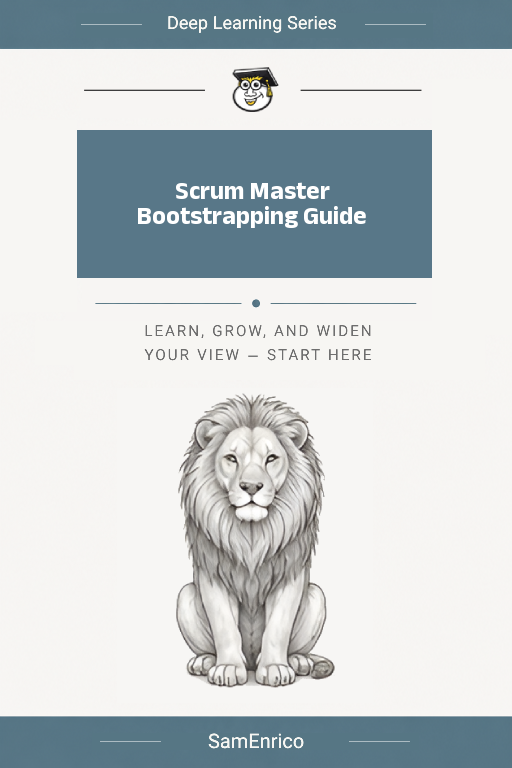
Scrum Master Bootstrapping Guide eBook
Implement Scrum ceremonies without expensive tools
Implement Scrum ceremonies without expensive tools for early-stage startups. Use free Jira alternatives and optimize two-week sprints for small distributed teams.
Formats
Free sample
Chapter 1: The Ceremony Trap--It was a Tuesday morning, and the five-person startup had been running "Agile" for exactly four weeks. Their CEO had hired a certified Scrum consultant who charged $5,000 to teach them the official Scrum Guide. The team now held a fifteen-minute daily standup that somehow always ran thirty. They had a two-day sprint planning session every other week. They spent Wednesday afternoons on backlog refinement, meticulously estimating story points for features that might never be built.
And they had hired a dedicated Scrum Master—a lovely person with a certificate on their wall—whose only job was to facilitate meetings and move sticky notes.The result? In thirty days, they shipped exactly two small bug fixes. Their velocity, as measured by their new Jira dashboard, was "too low to predict." The developers were exhausted, not from coding, but from talking about coding. One engineer put it bluntly in the anonymous retro: "I spend more time explaining what I'm going to build than actually building it. I'm a meeting participant who sometimes writes code."This story is not an exception.
It is the rule.Welcome to the Ceremony Trap.The Accidental Scrum Master If you are reading this book, you are likely an accidental Scrum Master. Perhaps you are a technical founder whose team has grown from two people to eight, and now you cannot keep track of who is doing what. Perhaps you are a lead developer who was told, "Congratulations, you are now the process person." Perhaps you are a product manager trying to bring order to a distributed team that spans three time zones and four Slack channels of chaos.You have no budget for Jira Enterprise. No money for an Agile coach. And definitely no desire to become a full-time meeting facilitator.
But you have heard that Scrum works. You have read blog posts about velocity, sprints, and backlogs. And you are afraid that if you don't implement "proper Agile," your startup will descend into madness.Here is the truth that the certified consultants will never tell you: Corporate Agile will kill your startup.The version of Scrum taught in certification courses, written in the Scrum Guide, and implemented at Fortune 500 companies was designed for a reality that does not exist in an early-stage startup. It assumes stable teams that do not change composition month to month. It assumes product roadmaps that stretch six to twelve months into the future.
It assumes dedicated roles—Product Owner, Scrum Master, Development Team—that are not also answering customer support emails, fixing the CI pipeline, and writing the investor update. It assumes that the most valuable thing you can do is follow a process, not learn from customers.None of these assumptions hold when you have five people, three months of runway, and a product that is still searching for product-market fit.The False Prophet: Why Corporate Agile Seduces Startups Before we dismantle corporate Agile, let us first understand why startups fall for it in the first place.The seduction is real. You are a founder or a lead engineer. Your team is growing. Chaos is increasing.
Tickets fall through the cracks. Someone builds a feature that no one asked for. Someone else spends three days on a bug that could have been fixed in an hour if anyone had known about it. You feel, in your gut, that you need process. But you do not know what kind.
So you Google "Agile project management." You find articles about Scrum, Jira workflows, burndown charts, and something called "velocity." You read that Google uses Agile. That Spotify uses Agile. That every successful software company uses Agile.And then a consultant—or a well-meaning senior engineer who just completed a certification—tells you that the solution is to implement Scrum "by the book." You will have a Product Owner who maintains the backlog. A Scrum Master who facilitates. Two-week sprints.
Daily standups. Sprint planning. Sprint review. Sprint retrospective. Backlog refinement.
And you will measure everything with story points and velocity.It sounds so rational. So professional. So scalable.Here is what the consultants do not tell you: The companies that successfully use "full Scrum" are not five-person startups with three months of runway. They are established organizations with dozens or hundreds of engineers, stable product lines, and dedicated support teams. When Google or Spotify runs a daily standup, it takes fifteen minutes because everyone has clear, narrow responsibilities.
When they do sprint planning, they have historical data from twenty previous sprints to inform their estimates. When they refine their backlog, they have a product roadmap that was agreed upon by marketing, sales, and engineering leadership.You have none of those things. And pretending that you do will not create them. It will only create meetings.The startup in our opening story fell into the Ceremony Trap because they confused process with progress. They believed that if they followed the rituals of Agile, the outcomes would follow automatically.
But Agile is not a checklist. It is a set of principles. And the most important principle—the one that the Scrum Guide buries on page four—is this: "Our highest priority is to satisfy the customer through early and continuous delivery of valuable software."Notice that the principle does not mention standups, story points, or sprint planning. It mentions delivery and value.Shippable Increment vs. Validated Learning The core unit of corporate Agile is the "shippable increment." At the end of every sprint, the team should have produced a potentially shippable product increment—a piece of working software that could theoretically be deployed to production.This concept makes perfect sense for a mature company.
If you are building the next version of Gmail, you absolutely want every sprint to produce something that could ship. But for an early-stage startup, the concept is actively harmful. Here is why:Startups do not know what to build.You are searching for product-market fit. You have hypotheses, not requirements. You do not know if the feature you are building today will be used, loved, or ignored tomorrow.
The most valuable thing you can produce in a sprint is not a shippable feature. It is knowledge.This is the insight at the heart of the Lean Startup movement. Eric Ries, in his book The Lean Startup, argues that startups exist not to build products, but to learn how to build a sustainable business. Every feature, every experiment, every line of code is a way of testing a hypothesis. The unit of progress is not "features shipped." It is "validated learning."So let us propose a replacement for the shippable increment: the validated learning increment.
At the end of every sprint, you should be able to answer one question: "What did we learn about our customers or our product that we did not know two weeks ago?"This shifts everything. It changes how you prioritize work (we will cover that in Chapter 6). It changes how you demo to stakeholders (Chapter 7). And it changes which ceremonies you actually need.Because if the goal is learning, not shipping, then many of the traditional Scrum ceremonies become optional. You do not need a two-day sprint planning session to plan learning.
You do not need a backlog refinement meeting to prioritize experiments. You do not need a dedicated Scrum Master to…
This is the end of the free sample. Get the eBook to keep going. Buy now
About this book
Details
- Author
- Hinojosa Annmarie
- Publisher
- SamEnrico
- Language
- English
- Genre
- Non-Fiction, Startup Guide, Agile Methods
- Released
- 2026-06-01
- Pages (approx.)
- 156
- Available as
- eBook, Audiobook

Read better in the ZLOADR app
Your eBooks on your phone or tablet. Sign in with your SamEnrico account and start reading.
More by Hinojosa Annmarie
 Short Interest SentimentHinojosa Annmarie$11.99
 High Performance Self CareHinojosa Annmarie$11.99
 Caregiver Stress and Respite FundingHinojosa Annmarie$11.99
 Resentment About LuckHinojosa Annmarie$11.99
 Stonewall Jackson's Valley Campaign: The Phantom General Who Defied OddsHinojosa Annmarie$11.99
 How to Become a Lumber SorterHinojosa Annmarie$11.99
 How to Produce Baby and Toddler SwimwearHinojosa Annmarie$11.99
 Privacy by Design AdvocateHinojosa Annmarie$11.99
You may also like
 Two Pizza Team ScrumHammett Diamond$12.99Two Pizza Team ScrumHammett Diamond$12.99Two Pizza Team ScrumHammett Diamond$12.99Two Pizza Team ScrumHammett Diamond$12.99Two Pizza Team ScrumHammett Diamond$12.99Two Pizza Team ScrumHammett Diamond$12.99Two Pizza Team ScrumHammett Diamond$12.99Two Pizza Team ScrumHammett Diamond$12.99
 Story Points EstimationLindgren Trinh$12.99
 Spotify Engineering Model WorkbookBonds Nakita$12.99
 Shape Up vs ScrumBarbour Randy$12.99
 Shape Up vs KanbanMcfadden Sun$12.99