
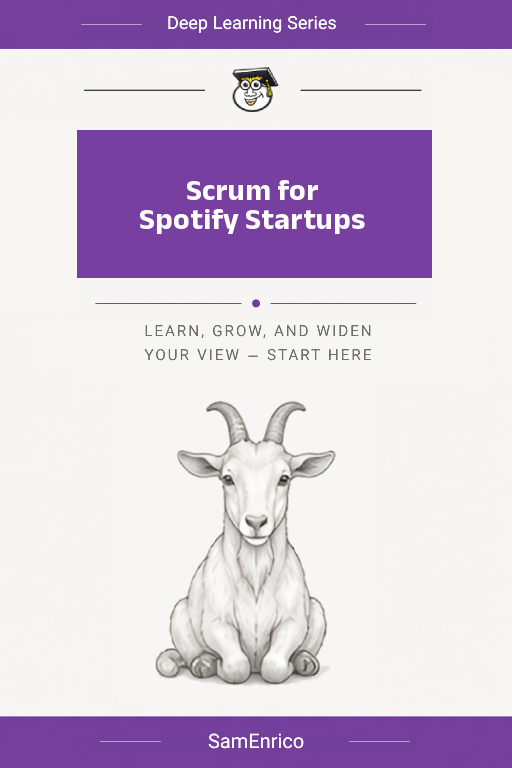
Non-FictionStartup GuideAgile Methods
Scrum for Spotify Startups eBook
Implement Spotify's squad model using Scrum to org
Implement Spotify's squad model using Scrum to organize autonomous teams for rapid music tech innovation.
Formats
Free sample
Chapter 1: The Spotify Trap--–- Maya Chen had printed the org chart on A3 paper, using six different colors, and pinned it to the wall of Conference Room B with more ceremony than the moment deserved. It was 9:47 AM on a Tuesday, exactly nine months after she had raised $12 million in Series A funding for Chordify—a music tech startup that was supposed to reinvent how independent artists distributed their work. The org chart showed five Squads, two Tribes, eight Chapters, and four Guilds. It was beautiful. It was also a lie.The lie revealed itself at 10:03 AM, when her CTO, Javier, burst through the door holding his laptop like a defusing technician carrying a bomb.
"The build is broken," he said. "Again. But this time, we can't fix it."Maya didn't understand what "can't fix it" meant. She was a founder, not an engineer. She had studied economics at Stanford and spent five years in music licensing before starting Chordify.
She knew the difference between mechanical royalties and performance royalties. She knew why indie artists hated Spotify's payout model. But she did not know what a merge conflict was, and she definitely did not know how forty-seven engineers had arrived at a state where no one could deploy code without breaking something else."Explain it to me like I'm five," she said.Javier sat down. He had dark circles under his eyes that hadn't been there three months ago. "We copied the Spotify model," he said.
"Exactly. To the letter. We read every blog post, watched every talk by Henrik Kniberg. We have Squads that own missions. We have Chapters for career growth.
We even have Guilds, for God's sake. And it's killing us."He pulled up a different document on his laptop. It was a dependency map—a spiderweb of arrows connecting boxes with names like "Playback Squad," "Social Squad," "Payments Squad," and "Recommendations Squad." The arrows were so numerous and so tangled that the document looked like a plate of spaghetti dropped on a floor."In the last two weeks," Javier said, "we have attempted six releases. Two succeeded. Three were rolled back.
One caused a production outage that wiped out twelve thousand user playlists. We spent the entire weekend restoring from backups."Maya felt the blood drain from her face. "Twelve thousand?""Twelve thousand. And the worst part? No single person made a mistake.
Every squad did exactly what they were supposed to do. The Playback Squad improved audio buffering. The Social Squad added sharing to stories. The Payments Squad fixed a latency issue. And when we tried to merge all of that together, the whole thing exploded."This, right here, was the Spotify Trap.
And Maya had walked into it with her eyes wide open, believing that because it worked for a company with forty million lines of code and two hundred million users, it would work for her fifty-person startup.The Seduction of the Blueprint The Spotify Trap has a name now, but in 2013, when Henrik Kniberg first published his now-famous blog posts and videos on Spotify's engineering culture, it looked like salvation. The agile world had been struggling with a painful problem: Scrum worked beautifully for a single team of seven people, but what happened when you had seventy? Or seven hundred? The Scaled Agile Framework (SAFe) existed, but it was heavy, prescriptive, and felt like waterfall dressed in agile clothing.Then came Spotify's "Squad" model. Squads were autonomous, cross-functional teams of five to nine people.
They owned a mission, not a project. They could choose their own tools, their own release cadence, their own way of working. Above them, Tribes aligned up to forty people toward a common goal. Chapters maintained technical standards across squads. Guilds spread knowledge informally.
It was beautiful, inspiring, and—most importantly—presented as a case study, not a prescription.But somewhere along the way, the tech industry stopped treating it as a case study and started treating it as a blueprint. Consulting firms began selling "Spotify Model transformations" as off-the-shelf products. Startups hired "agile coaches" who had never worked at Spotify but had memorized the terminology. CEOs like Maya read a few blog posts and decided that Squads, Tribes, Chapters, and Guilds were the answer to their scaling problems.They were wrong.The research on this is now definitive. Alvar Lundberg's 2020 study of companies attempting to implement the Spotify model found that over 70% experienced significant organizational dysfunction within the first year.
The most common failure mode was not technical—it was structural. Companies copied the form of Spotify's organization without understanding the conditions that made it work.What were those conditions? First, Spotify already had a mature agile practice before they introduced Squads and Tribes. They had been running Scrum successfully for years. They understood transparency, inspection, and adaptation at a gut level.
Second, their engineering culture was unusually mature. They had continuous delivery, feature flags, and a "release when ready" mentality long before most companies. Third—and this is crucial—they never stopped changing. The model you see in Kniberg's 2013 videos was already obsolete by 2015. Spotify treated their own structure as a living experiment, not a sacred text.Maya had none of these conditions.
Her engineers were talented but had only been doing Scrum for four months. They still struggled with basic Sprint Planning. Their Definition of Done was aspirational, not operational. And she had frozen her org chart on day one of the transformation, treating it as a destination rather than a starting point.The Math of Coordination To understand why the Spotify Trap kills startups, you need to understand coordination math. When a single team of seven people works on a product, the number of communication channels is manageable: n(n-1)/2, or 21 channels.
Each channel is a potential point of misunderstanding, but with daily standups, a shared backlog, and a common Definition of Done, most teams can handle it.Now add a second team. You now have two teams of seven each—fourteen people total. The number of within-team channels remains 21 per team. But the number of between-team channels grows exponentially. Every decision about shared code, shared APIs, shared environments, shared release schedules, and shared product vision creates new dependencies.
With two teams, you have roughly 50 coordination points per week. With three teams, it's over 100.The Spotify model is supposed to reduce this coordination overhead by giving each Squad clear ownership of a bounded mission. In theory, if the Playback Squad owns everything related to audio playback, and the Social Squad owns everything related to sharing, they should never need to coordinate except at well-defined interfaces.In practice, at a startup, those boundaries are never clean. The Playback Squad's audio buffer touches the Social Squad's sharing feature because sharing a song requires capturing the current playback position. The Payments Squad's licensing logic touches the Playback Squad's streaming logic because royalties depend on how much of a song was played.
The Recommendations Squad's AI models touch every other squad because they need data from everywhere.Maya's dependency map was not a sign of failure. It was a sign that her squads were working on a real, integrated product. But she had organized them as if they…
This is the end of the free sample. Get the eBook to keep going. Buy now
About this book
Details
- Author
- Benedict Amira
- Publisher
- SamEnrico
- Language
- English
- Genre
- Non-Fiction, Startup Guide, Agile Methods
- Released
- 2026-05-30
- Pages (approx.)
- 145
- Available as
- eBook, Audiobook

Read better in the ZLOADR app
Your eBooks on your phone or tablet. Sign in with your SamEnrico account and start reading.
More by Benedict Amira
 Face Pattern Recognition GuideBenedict Amira$11.99
 The Anger Breathwork GuideBenedict Amira$11.99
 Self Hypnosis Arm Levitation Technique WorkbookBenedict Amira$11.99
 Fitness Accountability PartnerBenedict Amira$11.99
 Email Interruption Batching GuideBenedict Amira$11.99
 The Great British Spy Swap: Cold War Secrets ExposedBenedict Amira$11.99
 The Silk Road's Last Emperor: A Silk Road Trade SecretBenedict Amira$11.99
 How to Start a Precious Metal Ores Mining and Preparation Business (Beginners Guide)Benedict Amira$11.99
 DALL E Redbubble GuideBenedict Amira$12.99
 Fraud SpecialistBenedict Amira$11.99
 Understanding Enchondromatosis Dwarfism CalfnessBenedict Amira$17.99
You may also like
 Hong Kong Handover 1997Dunn Johnnie$11.99
 Zumba For Postnatal Recovery CourseNeal Christian$11.99
 Zumba for BeginnersLadner Nikia$11.99
 YouTube Comment Mining GuideHumes Pandora$12.99
 Worry Box MeditationCarlin Rudy$11.99
 Workplace Stress MeditationNguyen Lynn$11.99
 Workplace Stress and Sleep RepairHawley Ivory$11.99
 Workplace Perfectionism CureDelaney Jeffry$11.99
 Workplace Injustice Anger GuideWallen Isabelle$11.99
 Work Addiction and Burnout LinkGreenwood Ester$11.99
 Women in Yoga and WellnessBeattie Galina$11.99
 Women in Stand Up ComedyChun Evangeline$11.99