
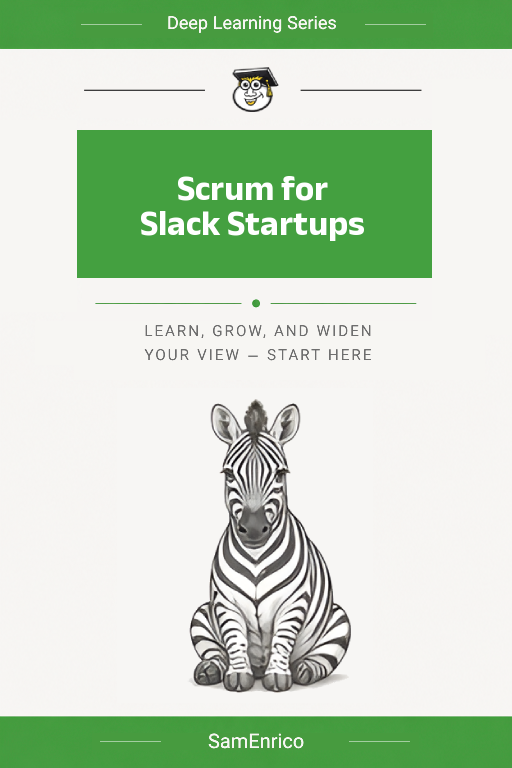
Non-FictionStartup GuideScrum Remote
Scrum for Slack Startups eBook
Implement Slack's communication-heavy Scrum with a
Implement Slack's communication-heavy Scrum with async standups for remote-first startup teams.
Formats
Free sample
Chapter 1: The Meeting Tax--–- It is 9:04 AM in Austin, Texas, and Maria, the lead developer at a 14-person fintech startup, has just opened Zoom for the daily standup. She is the Scrum Master. In the gallery view, she sees six faces: two engineers in Lisbon (where it is 3:04 PM and their focus is fading), one designer in Bangalore (where it is 8:34 PM and she has already worked a full day), a product owner in New York (well-caffeinated), and the CTO in San Francisco (still in workout clothes). Maria takes a deep breath and says, "Let's go around. What did everyone work on yesterday?"Forty-seven minutes later, the call ends.
The Lisbon engineers have lost their entire afternoon deep-work block. The Bangalore designer has missed her evening family time. The CTO spent most of the call muted, answering emails. And when Maria looks at the sprint board, exactly zero tickets have changed status during that 47 minutes. The team accomplished nothing of value in that time except sharing information that will be forgotten by tomorrow morning.This is not a failure of the team.
It is a failure of the process. Traditional Scrum, designed for co-located teams sitting in the same room, assumes that synchronous communication is cheap, efficient, and natural. In a remote-first startup, it is none of those things. It is expensive, exhausting, and actively harmful to productivity.Welcome to the Meeting Tax.The Hidden Cost of Synchronous Scrum Let us define our terms before we go further. For the purposes of this book, a "startup" means a team of two to fifty people, less than five years old, operating under high uncertainty, with limited management layers and a bias toward speed over process.
The advice that follows may not scale to five-hundred-person enterprises. That is intentional. Startups need agility, not bureaucracy.Now, let us examine the math of the Meeting Tax. A typical two-week sprint in a traditional Scrum shop includes: a daily standup (fifteen minutes, but often running forty-five), a sprint planning meeting (two to four hours), a sprint review (one to two hours), a retrospective (one hour), backlog refinement (one hour), and various ad-hoc syncs. Add it up, and a single developer spends roughly eight to twelve hours per sprint in meetings.
For a team of ten, that is eighty to one hundred twenty hours of meeting time every two weeks.In a co-located office, those meetings have friction, but they also have benefits. Side conversations happen. Whiteboards get filled. Problems get solved in real time. The cost is balanced by the value.In a remote environment, the equation changes.
The same meeting now includes: the Time Zone Tax (someone always attends at a suboptimal hour), the Zoom Fatigue Multiplier (video calls demand 100% attention, exhausting participants), the Context-Switching Crisis (Slack notifications interrupt deep work constantly), and the Documentation Void (verbal agreements vanish into the ether).Let us examine each of these in detail.The Time Zone Tax Consider a team with developers in four time zones: Pacific, Eastern, Central European, and India Standard Time. A daily standup scheduled for 9 AM Pacific is 6 PM Central European (end of day, tired) and 9:30 PM India (after dinner, not ideal). A standup scheduled for 9 AM Eastern is 6 AM Pacific (too early) and 6:30 PM India (again, end of day). There is no perfect time. Someone always loses.The cost is not just inconvenience.
It is cognitive capacity. A developer attending a meeting at 6 PM after a full day of work is not bringing their best brain. A developer attending at 6 AM has not yet had coffee or context. The quality of communication degrades, which leads to misunderstandings, which leads to more meetings, which leads to more fatigue. It is a death spiral.The Zoom Fatigue Multiplier In a physical room, a meeting allows for peripheral attention.
You can glance at your notebook, look out the window, or have a quiet side conversation. Your brain gets micro-breaks. The cognitive load is distributed.On Zoom, the camera expects your full face. Every participant is watching you watch them. The social performance is constant.
There is no escape. Researchers have documented that video calls increase cognitive load by reducing non-verbal cues, requiring more deliberate processing of tone and intent. After two hours of back-to-back Zoom calls, your brain is as tired as if you had run a mental marathon.And yet, many remote startups insist on keeping every Scrum ceremony on video. They mistake attendance for engagement. They confuse seeing faces with building culture.
They are wrong.The Context-Switching Crisis Every time a developer receives a Slack notification, it takes an average of ten to fifteen minutes to fully regain focus. This is well-documented in cognitive psychology. The cost of switching from deep work to a notification and back again is not zero. It is substantial.Now, consider a typical day for a remote developer. A standup reminder ping.
A thread about a retro comment. A product owner asking a "quick question" in a DM. A Git Hub notification about a PR review. A mention in #general about a deployment. By 11 AM, the developer has switched contexts eight times.
By 3 PM, fifteen times. By the end of the day, they have accomplished perhaps two hours of actual deep work.The tragedy is that most of these interruptions are unnecessary. The standup reminder could have been automated. The retro comment could have been asynchronous. The product owner's question could have waited for office hours.
The PR review could have been batched.The Documentation Void In a physical office, when a decision is made in a meeting, anyone present can recall it. The information lives in the room. In a remote environment, if a decision is made on a Zoom call, it lives only in the memory of the attendees. That memory degrades within days. Within weeks, it is gone entirely.The result is a hidden tax of re-explanation.
A developer spends an hour solving a problem. Three months later, a new hire encounters the same problem. There is no written record of the solution. The new hire spends another hour solving it again. This repeats with every new hire, every time a team member forgets, every time a decision is made without documentation.We call this "tribal knowledge." In a remote startup, tribal knowledge is a liability.
It creates bottlenecks. It slows onboarding. It rewards the few people who remember things and punishes everyone else.The Daily Standup Is Not Sacred Here is the provocative claim that underpins this entire book: the daily standup is not a sacred ritual. It is a communication protocol.Scrum was created in the 1990s for co-located teams. The daily standup was designed as a fifteen-minute, standing-only meeting where developers answered three questions: What did I do yesterday?
What will I do today? What is blocking me? It worked well in that context because the cost of gathering the team was low and the value of real-time coordination was high.In a remote-first startup, the cost has skyrocketed and the value has plummeted. The same information can be shared asynchronously, in writing, with less disruption and greater permanence. The three questions can be answered in Slack in under five minutes, at…
This is the end of the free sample. Get the eBook to keep going. Buy now
About this book
Details
- Author
- Cobb Lorraine
- Publisher
- SamEnrico
- Language
- English
- Genre
- Non-Fiction, Startup Guide, Scrum Remote
- Released
- 2026-05-29
- Pages (approx.)
- 134
- Available as
- eBook, Audiobook

Read better in the ZLOADR app
Your eBooks on your phone or tablet. Sign in with your SamEnrico account and start reading.
More by Cobb Lorraine
 Chunking for InnovationCobb Lorraine$11.99
 Remote Onboarding PlaybookCobb Lorraine$11.99
 The Anger Journaling ProtocolCobb Lorraine$11.99
 Student Support Network BuildingCobb Lorraine$11.99
 Money Scarcity Mindset CourseCobb Lorraine$11.99
 The Sapphire Serpent Heist: A Thief, a Legend, and a Vanishing CrownCobb Lorraine$11.99
 Icebound Secrets: The Scientists Who Solved Franklin's Arctic MysteryCobb Lorraine$11.99
 How to Start a Automobile Racing Team BusinessCobb Lorraine$11.99
 GlidingCobb Lorraine$11.99
 Redbubble AI Art Group BoardsCobb Lorraine$12.99
 Understanding EnterobiasisCobb Lorraine$17.99
You may also like
 Hong Kong Handover 1997Dunn Johnnie$11.99
 Zumba For Postnatal Recovery CourseNeal Christian$11.99
 Zumba for BeginnersLadner Nikia$11.99
 YouTube Comment Mining GuideHumes Pandora$12.99
 Worry Box MeditationCarlin Rudy$11.99
 Workplace Stress MeditationNguyen Lynn$11.99
 Workplace Stress and Sleep RepairHawley Ivory$11.99
 Workplace Perfectionism CureDelaney Jeffry$11.99
 Workplace Injustice Anger GuideWallen Isabelle$11.99
 Work Addiction and Burnout LinkGreenwood Ester$11.99
 Women in Yoga and WellnessBeattie Galina$11.99
 Women in Stand Up ComedyChun Evangeline$11.99