
Free sample
Chapter 1: The Meeting Autopsy--Most group failures are not people failures. They are design failures.Let me prove this to you with a simple experiment. Think back to the worst meeting you attended in the last month. Not the one that was merely boring—the one that left you genuinely angry. The one where you walked out thinking, "That was fifty-three minutes of my life I will never get back." The one where decisions were made that made no sense, where the loudest voice won, where problems were identified but not solved, where you silently vowed to never attend another meeting run by that person again.Now ask yourself: Was the problem the people in the room?Probably not.
The people in that room were likely intelligent, capable professionals. They had opinions. They had expertise. They wanted to do good work. And yet, collectively, they produced something worse than the sum of their parts.
They produced confusion, frustration, and wasted time.Here is what actually happened: they were following a bad script.Every group follows a script. You have never seen it written down. No one voted on it. It was not designed intentionally. But it is there, running in the background of every interaction, dictating who speaks when, whose opinion matters, what silence means, how decisions get made, and what happens when someone disagrees.Most of these scripts are terrible.The Script You Didn't Know You Were Running Let me name the script that runs in most organizations.
I call it The Default Presentation Script. It goes like this:Someone with authority calls a meeting. They have an agenda—usually a list of topics sent fifteen minutes before the meeting starts. The meeting opens with someone presenting slides. The presenter talks for twenty minutes while everyone else tries to stay awake.
Then the presenter says, "Any questions?" Three seconds of silence. Someone asks a clarifying question. The presenter answers. Another question. Another answer.
Eventually, the person with the highest status says something like, "I think we should move forward with Option A." There is a murmur of agreement. The meeting ends. Everyone leaves confused about what actually got decided, who is doing what, and why they were there in the first place.You know this script. You have lived this script hundreds of times. You probably ran this script yourself last week.Here is what you did not realize: you had a choice.The Default Presentation Script is not the only way groups can work.
It is not even a particularly good way. It is just the default—the path of least resistance, the script that requires no thought, no design, no courage to deviate from. And it is quietly destroying your team's productivity, creativity, and morale.The Anatomy of a Script Before we go further, I need to be precise about what I mean by "script."In everyday language, a script is something an actor reads from. It is fixed. It is written in advance.
It tells you exactly what to say and when to say it. That is one kind of script—what I will call a rigid script. Courtroom proceedings follow a rigid script. The judge speaks, then the lawyer, then the witness. Deviation is not permitted.But there is another kind of script.
Think of a jazz band. No one tells the saxophonist exactly what notes to play at exactly what moment. But the band is absolutely following a script—a set of rules about key changes, rhythm, call-and-response, when to solo and when to lay back. The script is flexible, but it is still a script. Deviation is permitted, even celebrated, but only within boundaries.This book is about both kinds of scripts.
You will learn rigid scripts for situations that require consistency and predictability—training simulations, decision-making protocols, conflict de-escalation. And you will learn flexible scripts for situations that require creativity and adaptation—brainstorming sessions, strategy discussions, cross-functional collaboration.The key insight—the one that will change how you lead every meeting from now on—is this: every group already follows a script. Your job is not to invent a script from nothing. Your job is to notice the script you are already running, diagnose whether it is working, and consciously replace it with a better one.The Two Meetings Let me show you what I mean with a real case study. I have changed the names and some details, but the essential facts are true.Two product teams at the same software company.
Both teams had the same goal: decide on the feature set for the next release. Both teams had the same resources: eight people, ninety minutes, a product manager, a whiteboard. Both teams had the same constraints: a deadline, a budget, a set of customer requests.The first team's meeting was agonizing. I have the transcript. It opens with the product manager, let us call him Marcus, saying, "Alright everyone, let's go around and share our thoughts on the roadmap." This is a classic script invitation—vague, unstructured, guaranteed to produce low-quality input.One by one, the team members spoke.
The senior engineer went first, as senior people usually do. He talked for seven minutes about technical debt. The designer went next, talked for five minutes about user research that contradicted the engineer's priorities. The junior developer spoke for ninety seconds, mostly agreeing with the senior engineer. The sales lead spoke for four minutes about a customer who would churn if a specific feature was not included.By the time the last person finished speaking, twenty-eight minutes had passed.
The team had generated a list of competing priorities with no framework for resolving them. Marcus then said, "Okay, sounds like we have some trade-offs to discuss. Any ideas?"Cue another twenty minutes of unstructured conversation. People talked over each other. The loudest voices dominated.
The quietest voices said nothing. Two people started a side conversation about a technical implementation detail that only they understood. The rest of the team checked their phones.At the fifty-minute mark, Marcus said, "We need to wrap this up. Let me propose we focus on the features the sales team is hearing about." The senior engineer sighed audibly. The designer looked at the ceiling.
The junior developer nodded. The meeting ended with a decision that no one actually supported and that would be silently ignored by the time the team started building.That team's script was: status-driven turn-taking, followed by unstructured open discussion, followed by authority-based decision. It is a terrible script. It produces the illusion of collaboration without the reality of it.The second team's meeting was electric. Same company, same goal, different script.That team's product manager, let us call her Elena, opened with a very different invitation.
She said, "We have ninety minutes to decide on our feature set. Here is our script for the first fifteen minutes."She projected a simple timer and a set of instructions:Minutes 0-3: Write down every feature you think we should build. One idea per sticky note. No talking.Minutes 3-8: In pairs, combine your sticky notes. Discard duplicates.
Keep disagreements.Minutes 8-12: Each pair joins another pair. As a foursome, sort the combined sticky notes into three columns: Must…
This is the end of the free sample. Get the eBook to keep going. Buy now
About this book
Details
- Author
- Crittenden Mechelle
- Publisher
- SamEnrico
- Language
- English
- Genre
- Non-Fiction, Self-Help / Group
- Released
- 2026-06-08
- Pages (approx.)
- 152
- Available as
- eBook, Audiobook

Read better in the ZLOADR app
Your eBooks on your phone or tablet. Sign in with your SamEnrico account and start reading.
More by Crittenden Mechelle
 Laci Peterson Jewelry DetailCrittenden Mechelle$11.99
 Geo Arbitrage for PodiatristsCrittenden Mechelle$11.99
 IBS Qigong Energy GuideCrittenden Mechelle$11.99
 Managing Interruptions for Managers CourseCrittenden Mechelle$11.99
 Loss Aversion PersuasionCrittenden Mechelle$11.99
 The Freelance Equipment DeductionCrittenden Mechelle$11.99
 Achilles Tendon Rupture Rehab WorkoutCrittenden Mechelle$11.99
 Sam Walton AmericanCrittenden Mechelle$11.99
 The Storm Chaser of the Silk Road: How a Persian Scholar Tamed the SkyCrittenden Mechelle$11.99
 The Golden Quill of Timbuktu: How African Scholars Lit the Torch of KnowledgeCrittenden Mechelle$11.99
 The 1985 Chicago Bulls' Unbreakable Streak: A 30-Game MiracleCrittenden Mechelle$11.99
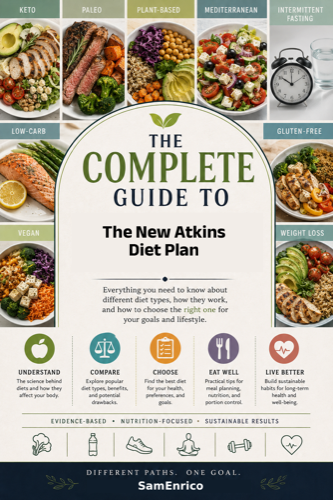 The Complete Guide to the New Atkins Diet PlanCrittenden Mechelle$11.99