
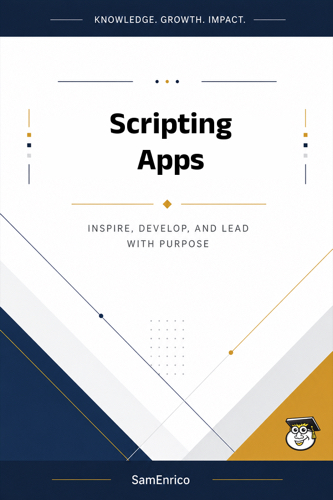
Free sample
Chapter 1: The Automation Awakening...--–- Every single day, you perform the same series of actions. You open the same three applications. You copy data from one window and paste it into another. You rename files, convert documents, reply to similar emails, and run reports that require fifteen clicks and a coffee break before they finish. You have become a human script — executing predictable routines with mechanical precision.
And yet, you have never once asked yourself the question that could save you hundreds of hours this year: What if the machine did this instead?This is not a book about learning to code for the sake of coding. It is not a dry textbook filled with abstract algorithms or theoretical computer science concepts that you will never use outside a classroom. This is a book about power — the power to make your computer work for you, rather than the other way around. It is about transforming your relationship with technology from one of passive consumption to active creation. And it begins with a single, radical shift in perspective: scripting is not a lesser form of programming reserved for amateurs and system administrators.
Scripting is the fastest, most practical path from idea to working application.The landscape of software development has changed dramatically over the past decade. The old hierarchy that placed compiled languages like C++ and Java on a pedestal while relegating scripting languages to the status of "glue code" has crumbled. Today, the applications that run your world — from the websites you browse to the automation tools that power your workplace — are built increasingly with scripting languages. Java Script, once dismissed as a toy for animating browser status bars, now powers entire companies through Node.js. Python, the darling of scripters, drives artificial intelligence, scientific computing, and billion-dollar infrastructure.
Power Shell has become the backbone of Windows enterprise management. Even Apple Script, quirky as it may be, still automates creative workflows that save publishing houses and design studios millions annually.So what exactly is a scripting language, and why should you care about the distinction? At its core, a scripting language is designed for rapid development and execution without a separate compilation step. When you write a script, you save a text file and run it immediately. The computer reads your code line by line, interprets it on the fly, and executes the instructions.
There is no waiting for a compiler to translate your human-readable code into machine language. There is no linking step where you wrestle with missing libraries. There is just you, a text editor, and instantaneous feedback.This immediacy changes everything about how you approach problem-solving. When you can see the result of your code within milliseconds, you experiment more. You iterate faster.
You learn through doing rather than through memorizing. The barrier between thought and action dissolves. Compare this to traditional compiled languages: you write code, save it, run a compiler that translates everything into binary, link it with external libraries, and only then can you execute the program. A simple syntax error might not even be discovered until halfway through this process. The feedback loop stretches from seconds to minutes or even hours.
That delay fundamentally alters your psychology as a developer. You become cautious. You avoid experiments. You stay within the narrow channels of what you already know works.This is why scripting languages have become the preferred tool for automation, prototyping, and increasingly for production applications. They lower the cost of experimentation to nearly zero.
They invite you to try things, fail quickly, and try again. And perhaps most importantly, they are designed to interact with other systems. A script can launch an application, wait for it to open, send it keystrokes, read its output, process that data, and then launch a second application to do something entirely different. This ability to "glue" different systems together is not a weakness; it is the superpower that makes scripting indispensable in the modern world of specialized tools that refuse to talk to one another.The Business Case for Learning to Script Before we write a single line of code, let me show you the concrete, measurable reasons why scripting will change your professional life. According to a 2023 survey by the IT automation platform Puppet, knowledge workers who can script save an average of 7.3 hours per week compared to those who cannot.
That is nearly an entire working day returned to you every week. Over a year, that amounts to 380 hours — or nine and a half 40-hour work weeks. You could learn a new language, start a side business, or simply leave work at 3 PM every Friday for the rest of the year.Where do these savings come from? Not from building massive applications or writing complex algorithms from scratch. They come from eliminating the small, repetitive tasks that collectively consume your attention and fragment your focus.
The five-minute report that you run every morning becomes a one-second script launch. The thirty seconds you spend renaming a batch of files becomes a double-click on a script that renames all four hundred files in the time it takes you to blink. The fifteen minutes you spend copying data from a spreadsheet into a web form becomes a script that does it perfectly, without typos, in three seconds.But the benefits go far beyond time savings. Scripting reduces errors. Human beings are terrible at repetitive precision tasks.
We get bored, our minds wander, and we make mistakes. A script never gets bored. It will perform the exact same sequence of actions ten thousand times without a single deviation. When you automate a critical process, you are not just saving time; you are guaranteeing consistency and eliminating the risk of costly human errors.Scripting also democratizes automation. In the past, if you wanted to automate a business process, you had to go through your IT department.
You had to write a formal request, wait for approval, wait for a developer to be assigned, wait for them to understand the problem, wait for them to write code, wait for testing, wait for deployment. A two-hour automation task could take six months if it happened at all. With scripting, you become your own IT department. You identify a repetitive task, write a script, test it, and deploy it in the same afternoon. You are no longer dependent on scarce developer resources for the small automations that make your daily work easier.The Three Pillars of Scripting Success Throughout this book, we will build your skills across three interconnected domains.
I call these the Three Pillars of Scripting Success, and they will guide every chapter from here to the end.The first pillar is Foundation. This is the raw syntax and mechanics of scripting: variables, data types, conditionals, loops, functions, and the other building blocks that every script uses. You cannot build anything without understanding these fundamentals. But unlike other books that spend hundreds of pages on abstract exercises, we will learn each concept in the context of solving real problems. You will not just learn what a variable is; you will use variables to store user input, calculate totals, and remember state across script executions.
The foundation is not an end in itself; it is the toolkit you will carry into every subsequent chapter.The second…
This is the end of the free sample. Get the eBook to keep going. Buy now
About this book
Details
- Author
- Dias Codi
- Publisher
- SamEnrico
- Language
- English
- Genre
- Non-Fiction, Self-Help / Technology
- Released
- 2026-06-07
- Pages (approx.)
- 159
- Available as
- eBook, Audiobook

Read better in the ZLOADR app
Your eBooks on your phone or tablet. Sign in with your SamEnrico account and start reading.
More by Dias Codi
 The Freelance Website SeparationDias Codi$11.99
 Child Actor Financial Ruin GuideDias Codi$11.99
 Assertive Communication in RelationshipsDias Codi$11.99
 The Interruption Scripting for Managers CourseDias Codi$11.99
 Laci Peterson Jury SelectionDias Codi$11.99
 The Persuasion ChallengeDias Codi$11.99
 UK VAT Threshold and Compliance PrimerDias Codi$11.99
 Buffett NetJetsDias Codi$11.99
 The Unstoppable Comeback: How a 1990s Pop Icon Reclaimed Her ThroneDias Codi$11.99
 Frozen Quantum: The Arctic Adventures of Chien-Shiung Wu and the Hunt for Cosmic TruthsDias Codi$11.99
 Global Web ProducerDias Codi$11.99
 Zoom Scrum For Distributed TeamsDias Codi$12.99
You may also like
 Parent Time Apps GuideWoodruff Shiela$11.99
 Chunking Apps GuideSingleton Ada$11.99
 Notification Management GuideYamamoto Mui$11.99
 Loneliness and TechnologyEdmiston Isreal$11.99
 Caregiver Technology SolutionsCone Dorcas$11.99
 Habit Apps GuideTejada Dina$11.99
 Resilience Apps GuideFerris Carmelina$11.99
 Remote Work Tool StackHolland Kathy$11.99
 Pain Meditation AppsCroteau Elin$11.99
 Gratitude for TechnologyArreola Brenna$11.99
 Virtual Memory PalacesBillingsley Fe$11.99
 Senior Technology ConfidenceGallant Tonie$11.99