
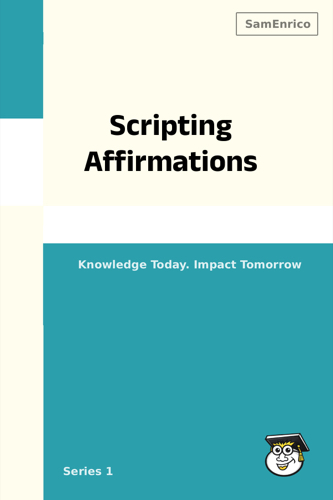
Scripting Affirmations eBook
undefined
by Chapa Logan
undefined
Formats
Free sample
Chapter 1: The Ink Deception--–- Every morning, millions of people stand in front of bathroom mirrors and lie to themselves. They say things like “I am confident” while their stomach churns with anxiety. They whisper “I am worthy of love” while scrolling through dating apps that confirm the opposite. They recite “I am successful” while dreading another day at a job they settled for. And then they wonder why affirmations don’t work.
The answer is not that affirmations are useless. The answer is that you have been using the wrong tool for the job. Your mouth is a poor sculptor of the subconscious mind. Your hand, however, is a master craftsman. This book exists to prove that claim—and to teach you exactly how to wield the pen as the most powerful instrument of personal transformation you will ever own.The Great Affirmation Lie You have been told, probably by well-meaning self-help books and social media influencers, that repeating positive statements aloud will rewire your brain.
The formula sounds simple: say it until you believe it. Fake it until you make it. Speak it into existence. The problem is that this advice ignores a fundamental truth about how the human brain processes information. The mouth moves fast—approximately one hundred fifty words per minute for the average speaker.
The subconscious mind, however, does not operate on speed. It operates on repetition combined with emotional weight and sensory richness. Speaking is a shallow act. Writing is a deep one.Consider what happens when you speak an affirmation aloud. Your auditory cortex processes the sound.
Your motor cortex directs your lips and tongue. And then the information is gone, dissipated into the air like smoke. Unless you repeat that same phrase hundreds of times with genuine emotional engagement, the spoken word barely scratches the surface of your neural architecture. This is not opinion. This is neuroscience.
The brain is wired to prioritize information that arrives through multiple sensory channels simultaneously, especially when that information is paired with physical action and emotional intensity.Now consider what happens when you write an affirmation by hand. Your visual cortex processes the shapes of the letters. Your motor cortex coordinates the fine movements of your fingers, hand, and wrist. Your proprioceptive system tracks the position of the pen against the page. Your somatosensory system feels the texture of the paper and the pressure of the writing implement.
Multiple regions of your brain—the prefrontal cortex for planning, the parietal lobe for spatial processing, the temporal lobe for language, the cerebellum for fine motor control—all activate at once. And crucially, writing is slower than speaking. That slowness is not a bug. It is the entire point.The Slowness Principle Here is a paradox that will define everything in this book: the slower you go, the faster you rewire your brain. When you write by hand, you force your brain to process each word individually, to convert abstract thought into concrete motor memory, to embed the affirmation into the physical architecture of your neural pathways.
Speaking an affirmation is like throwing a tennis ball against a brick wall and hoping it sticks. Writing an affirmation is like carving that same message into the stone of the wall with a chisel. One is temporary. The other is permanent.This is not metaphor. This is the Slowness Principle, and it is grounded in decades of cognitive science research.
Studies on handwriting versus typing have consistently shown that handwriting engages the brain more deeply because it requires the synthesis of multiple cognitive processes simultaneously. When you type, you are essentially pressing buttons that correspond to letters. When you write, you are drawing each letter, constructing it from scratch, and in doing so, you are building a neural representation of the meaning behind the word. This is why children who learn to write by hand develop better reading comprehension than those who learn only to type. This is why journaling by hand has been shown to reduce symptoms of anxiety and depression more effectively than typing.
And this is why scripting—the deliberate, handwritten repetition of affirmations—is neurologically superior to spoken affirmations by every measurable metric.The RAS: Your Brain’s Gatekeeper To understand why scripting works, you must first understand the Reticular Activating System. The RAS is a bundle of neurons located at the brainstem, roughly the size of your little finger, and it serves as the gatekeeper for every piece of information that enters your conscious awareness. Every second, your senses are bombarded with approximately eleven million bits of information. Your conscious mind can process only about fifty bits per second. The RAS is the filter that decides which fifty bits you actually notice.Think of the RAS as a bouncer at an exclusive nightclub.
Millions of potential stimuli are waiting in line outside your awareness. The RAS decides who gets in. And here is the critical fact: the RAS does not know the difference between information that comes from the outside world and information that comes from your own imagination. When you vividly imagine an event, your RAS treats it as if it actually happened. When you write an affirmation by hand, you are not just hoping for a change.
You are programming your RAS to look for evidence that your affirmation is already true.This is the mechanism behind every successful goal achievement strategy ever developed. Athletes visualize their performance before competitions because visualization activates the same neural pathways as physical practice. Entrepreneurs write their goals daily because the written word instructs the RAS to filter for opportunities that align with those goals. And this is why scripting works even when spoken affirmations fail. Speaking is too fast for the RAS to register deeply.
Writing is slow, deliberate, and physically embodied—exactly the kind of input the RAS treats as real.Hopeful Thinking Versus Neurological Programming One of the most destructive misconceptions in the personal development world is the conflation of hopeful thinking with neurological programming. Hopeful thinking is passive. It is the act of wishing for a better future while doing nothing to change your internal wiring. Hopeful thinking sounds like “I hope things get better” or “I wish I were more confident.” It is the cognitive equivalent of staring at a closed door and hoping it will open by itself.Neurological programming, by contrast, is active. It is the deliberate, systematic rewiring of your neural pathways through repeated, emotionally engaged, physically embodied action.
Neurological programming sounds like a specific script written twenty times every morning while recalling a memory of genuine confidence. It is the cognitive equivalent of building a key, inserting it into the lock, and turning it yourself.This book is not about hopeful thinking. You will find no vague advice about “trusting the universe” or “letting go and letting God” within these pages. This book is about neurological programming grounded in cognitive science, neuroplasticity, and the proven mechanisms of the Reticular Activating System. You are not here to hope for a better life.
You are here to write one into existence—one stroke of the pen at a time.The Experiment That Changed Everything Before we go any further, you need to…
This is the end of the free sample. Get the eBook to keep going. Buy now
About this book
Details
- Author
- Chapa Logan
- Publisher
- SamEnrico
- Language
- English
- Genre
- Non-Fiction, Self-Help / Affirmations
- Released
- 2026-06-06
- Pages (approx.)
- 141
- Available as
- eBook, Audiobook

Read better in the ZLOADR app
Your eBooks on your phone or tablet. Sign in with your SamEnrico account and start reading.
More by Chapa Logan
 EV Charging Wait RageChapa Logan$11.99
 Geo Arbitrage for Course CreatorsChapa Logan$11.99
 Battle Of Leipzig NationsChapa Logan$11.99
 Persuasion For TeachersChapa Logan$11.99
 The Urgent vs Important Filter GuideChapa Logan$11.99
 Disc Herniation Recovery ExercisesChapa Logan$11.99
 The Household Chore BlockChapa Logan$11.99
 The Freelance Performance ReviewChapa Logan$11.99
 The Crimson Code: How a Single Dye Changed the WorldChapa Logan$11.99
 The Billionaire Who Bought a Country: The Untold Story of Michael Bloomberg’s Island ExperimentChapa Logan$11.99
 Blackheart & Compass: The Pirate-Explorer Who Charted the UnknownChapa Logan$11.99
 Sales Tax Calculation AI GuideChapa Logan$12.99
You may also like
 Interruption AffirmationsBrunner Alysa$11.99
 Habit AffirmationsSanderson Belkis$11.99
 Goal Setting AffirmationsAviles Pattie$11.99
 Spending Affirmations GuideBrandt Zelda$11.99
 Divorce Affirmations AudioMccarter Gianna$11.99
 Child Loss AffirmationsYu Tori$11.99
 Remote Work AffirmationsSegura Lina$11.99
 Pain AffirmationsHoff Connie$11.99
 Anticipatory Grief AffirmationsKirby Catarina$11.99
 Job Loss AffirmationsHarden Ayesha$11.99
 Gratitude AffirmationsLenz Amira$11.99
 Financial Stress Audio AffirmationsYarbrough Flor$11.99