
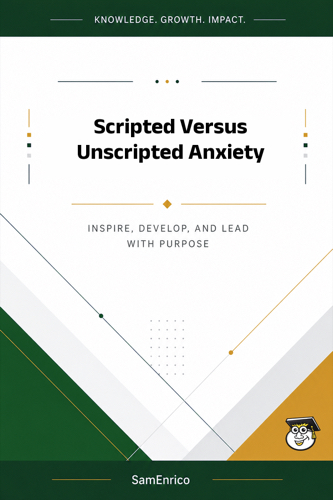
Scripted Versus Unscripted Anxiety eBook
Choose between memorized or natural delivery based
by Colby Rosena
Choose between memorized or natural delivery based on your anxiety type.
Formats
Free sample
Chapter 1: The Forgetting Curve--–- The email arrived at 11:47 on a Tuesday morning. "Your TEDx talk has been accepted. You'll be speaking third, right after lunch. Please send your full script by Friday." I read it seven times, each reading sending a fresh wave of adrenaline through my chest. This was the opportunity I had been chasing for three years.
A red dot. A real stage. Thousands of people watching online. And I had exactly seventy-two hours to prepare the speech that would define my career.I did what any rational, terrified person would do. I wrote a script.
Then I rewrote it. Then I rewrote it again. By Thursday night, I had seventeen pages of perfectly crafted prose. Every transition was polished. Every metaphor was tested.
Every pause was marked. I printed the script, taped it to my bathroom mirror, and began the process of memorization that every public speaking book had recommended.I said the words in the shower. I said them while brushing my teeth. I said them in the car, at my desk, walking the dog. By Friday afternoon, I had it.
Every word. Every inflection. I could recite the entire seventeen-minute speech without looking at the page. I was ready.The day of the talk arrived. I walked backstage.
The audience was a sea of faces I could not quite focus on. The speaker before me finished to polite applause. I heard my name. I walked to center stage. I looked at the lights.
I opened my mouth.And nothing came out.Not a single word. The seventeen-minute script that I had practiced eighty-three times had vanished. Not forgotten. Not delayed. Gone.
Completely and utterly absent. I stood there for what felt like minutes—later I was told it was about six seconds—and then I said something that was not in my script. Something I had never rehearsed. Something I did not plan.I said, "Well, that wasn't supposed to happen."The audience laughed. The laugh broke something open inside me.
I took a breath. And then, without a script, without notes, without any of the preparation I had spent seventy-two hours perfecting, I talked. I told them about the idea that had mattered enough to make me want to give a TEDx talk in the first place. I stumbled. I repeated myself.
I forgot the brilliant metaphor I had crafted at 2 AM. But I kept going. And when I finished, the applause was louder than any of the rehearsed speakers who had gone before me.Afterward, a woman came up to me. She said, "That was the most authentic thing I have ever seen." She did not know that I had frozen. She did not know that I had failed at the one thing I had worked hardest to accomplish.
She only knew that I had stood on a stage and spoken like a human being.That day changed everything. Not because I succeeded despite my anxiety, but because I discovered something that most public speaking advice gets exactly backwards. The memorization I had been taught to rely on was not my safety net. It was the trap that almost destroyed me.The Myth of Perfect Preparation We have been told a story about public speaking for so long that most of us believe it without question. The story goes like this: Great speakers prepare meticulously.
They write every word. They memorize every sentence. They rehearse until the delivery becomes automatic. The more you prepare, the less you will fear. The more you memorize, the less you will forget.This story is a lie.
Not an exaggeration. Not a simplification. A dangerous, counterproductive lie that has caused more speaking disasters than stage fright ever has.The lie persists because it feels true. When you are sitting at your desk, alone, with a cup of coffee and a quiet room, memorization feels like control. The words go in.
They stay there. You can recite them back. You feel prepared. You feel safe. But the desk is not the stage.
The quiet room is not the audience. And the memory that works when you are calm is not the same memory that works when you are terrified.I learned this the hard way. But I am not alone. Research on public speaking anxiety has produced a number that every speaker should know and every speaking coach should be required to post on their wall. In controlled studies comparing different preparation methods, speakers who rely on rote memorization for presentations longer than two minutes experience significant memory failure seventy-five percent of the time.
Three out of four memorized speakers freeze, stumble, or lose their place at some point during their presentation.Speakers who use structured notes—key words, short phrases, a basic outline—freeze only thirty percent of the time.Let me say that again. Memorization makes you more than twice as likely to freeze as using notes.This statistic applies to memorizing entire speeches, presentations, or any continuous monologue longer than approximately two minutes. There is a crucial distinction here that we will return to throughout this book. Memorizing a thirty-second toast is different. Memorizing your opening sixty seconds as part of a hybrid strategy is different.
But if you are standing in front of an audience planning to recite a memorized ten-minute speech, the science says you have a seventy-five percent chance of experiencing a moment of catastrophic forgetting.Why Your Brain Betrays You To understand why memorization fails under pressure, you need to understand a basic fact about how your brain works. Your working memory—the part of your consciousness that holds and manipulates information in real time—has a strictly limited capacity. Psychologists have known this for decades. The classic formulation is Miller's Law: the average person can hold about seven items in working memory at once. More recent research suggests the number may be closer to four.But here is what the classic research missed.
Anxiety consumes working memory capacity. When your brain detects a threat—and public speaking is processed by your brain as a threat, just like a predator would be—it diverts resources away from your prefrontal cortex and toward your amygdala. Your brain literally shifts blood flow away from the areas you need for complex thought, memory retrieval, and language generation, and toward the areas you need for fight-or-flight responses.This is not a metaphor. This is measurable biology. Functional MRI studies of anxious speakers show decreased activation in the prefrontal cortex and increased activation in the amygdala.
Your brain is not malfunctioning when you freeze. It is functioning exactly as evolution designed it to function. The problem is that evolution did not anticipate that you would need to deliver a quarterly earnings report while your brain was preparing to run from a saber-toothed tiger.Now here is where memorization becomes actively harmful. When you memorize a speech word-for-word, you are creating a single, narrow pathway to retrieve that information. You are essentially building a very thin bridge from your memory to your mouth.
Under normal conditions, that bridge works fine. But under anxiety—when your brain is already struggling to allocate resources—that thin bridge is the first…
This is the end of the free sample. Get the eBook to keep going. Buy now
About this book
Details
- Author
- Colby Rosena
- Publisher
- SamEnrico
- Language
- English
- Genre
- Non-Fiction, Mental Wealth, Scripting, Spontaneity
- Released
- 2026-06-10
- Pages (approx.)
- 146
- Available as
- eBook, Audiobook

Read better in the ZLOADR app
Your eBooks on your phone or tablet. Sign in with your SamEnrico account and start reading.
More by Colby Rosena
 From Side Hustle to Full TimeColby Rosena$11.99
 Hausa Wall Painting StoriesColby Rosena$11.99
 The Teen Body Scan MeditationColby Rosena$11.99
 The Understanding Alcoholism ScienceColby Rosena$11.99
 The Fall of Richard Perkins: Shakespeare’s Forgotten StarColby Rosena$11.99
 HARO Rejection Recovery GuideColby Rosena$12.99
 Broadband Internet GuideColby Rosena$12.99
 Understanding Portuguese Type AmyloidosisColby Rosena$17.99
 Cleaning AssociateColby Rosena$11.99
 How to Become a CementerColby Rosena$11.99