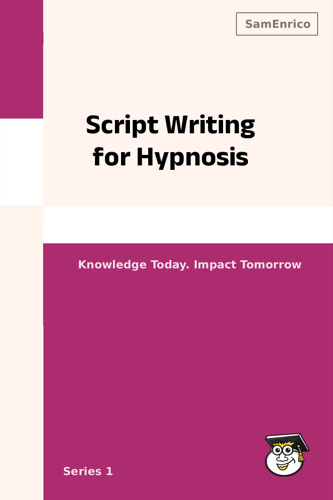
Script Writing for Hypnosis eBook
Craft effective trance inductions and suggestions
by Cobb Vincent
Craft effective trance inductions and suggestions for recordings.
Formats
Free sample
Chapter 1: The Permission Protocol...--–- Most hypnosis script books teach you what to say. This book teaches you how to craft words specifically for the recording studio, and the journey begins with a single, counterintuitive truth: the most powerful words in any hypnosis script are not the ones that command, but the ones that ask for permission.Consider the difference between these two openings. The first is the authoritarian model that has dominated stage hypnosis for a century: "Close your eyes. Take a deep breath. Relax your shoulders.
You are now entering a trance." The second is what we call the Permission Protocol: "And you might find that you are ready to close your eyes now... or perhaps you already have... and as you breathe, you can simply allow your shoulders to release... and you may notice that a sense of trance is already beginning to unfold, in your own time, in your own way."The first script works beautifully on a stage, where volunteers have self-selected for high suggestibility and the expectation of being commanded. The second script works in headphones, where the listener is alone, possibly skeptical, possibly anxious, and absolutely in control of the off button.
The first script triggers defiance in a subset of listeners. The second script invites cooperation from nearly everyone.This chapter dismantles the authoritarian model that still dominates amateur hypnosis recordings and replaces it with a Neo-Ericksonian orientation specifically adapted for the recording studio. You will learn why indirect suggestion is your default approach, how to write "permissive imperatives" that guide without commanding, and how to establish the single most important element of any audio hypnosis script: permission. By the end of this chapter, you will have written a complete Permission Protocol script that establishes safety, consent, and therapeutic rapport within the first sixty seconds of your recording.The Failure of the Authoritarian Model in Recorded Hypnosis The authoritarian model of hypnosis—characterized by direct commands, imperative language ("you will," "you must," "do this now"), and an implied power differential between hypnotist and subject—has deep historical roots. James Braid, the Scottish physician who coined the term "neuro-hypnotism" in the 1840s, initially used direct, commanding language with his patients.
Milton Erickson, the psychiatrist who revolutionized clinical hypnosis in the mid-twentieth century, observed that direct commands often triggered what he called "conscious resistance"—a psychological defense mechanism where the listener pushes back against perceived control.In a live clinical setting, an experienced hypnotherapist can work with resistance. When a client says "I don't think I was hypnotized" or "I felt like I was fighting it," the therapist can adjust, using utilization to incorporate the resistance into the trance. ("And you may notice that even that feeling of fighting... that effort itself... can become a signal to let go even more deeply...")In a recorded setting, you cannot adjust.
You cannot see the listener's brow furrow with resistance. You cannot hear them mutter "this is stupid" under their breath. You cannot ask what they are experiencing. Your script must either trigger resistance or bypass it from the very first sentence. The authoritarian model triggers resistance in a significant percentage of listeners.
Research on psychological reactance—the motivational state triggered when a person perceives their freedom is being threatened—shows that direct commands can reduce compliance by 30-40 percent in individuals with high trait reactance. These are precisely the people who might benefit most from hypnosis: analytical thinkers, trauma survivors, and anyone with a strong need for autonomy.The authoritarian model fails for three additional reasons when adapted to recorded audio. First, the listener is alone. There is no social pressure to comply with commands when nobody is watching. Second, the listener has no prior relationship with the voice.
A stage hypnotist has built rapport through entertainment; a clinical hypnotherapist has built rapport through a pre-talk. A recording has none of that unless it is built into the script. Third, the listener can leave instantly. The off button is always available. Direct commands that feel even slightly coercive trigger the off button.The Neo-Ericksonian Alternative: Indirect Suggestion as Default Milton Erickson's great insight was that indirect suggestion—language that guides without commanding, invites without demanding, and bypasses the critical factor by speaking directly to the subconscious—could achieve therapeutic results that direct suggestion could not.
Erickson's famous "handshake induction" is a masterclass in indirectness: he would shake a client's hand, then subtly change the handshake pattern, creating confusion that interrupted conscious processing and opened a gateway to trance.For recorded hypnosis, indirect suggestion takes the form of carefully crafted linguistic patterns that work with the listener's natural mental processes rather than against them. The foundational patterns, drawn from the work of Havens and Walters (2002) and adapted for audio, include:Truisms. Statements that are undeniably true for the listener, used to establish rapport and create a "yes set." Examples: "You are listening to a voice. You are breathing. You are aware of the space around you." The listener cannot argue with any of these statements.
Each agreement creates a micro-trance of agreement.Open loops. Statements that the listener's mind must complete, creating a state of internal searching that resembles trance. Example: "I wonder how long it will take for you to notice that feeling of relaxation spreading..." The listener's mind automatically searches for the feeling, generating it in the process.Presuppositions. Linguistic structures that assume the desired outcome has already occurred or is inevitable. Example: "As you go deeper into that comfortable trance..." presupposes that the listener is going deeper.
The conscious mind is too busy processing the sentence structure to object.Utilization. Incorporating the listener's current state or environment into the suggestion, rather than asking them to ignore it. Example: "As you notice the sounds around you—perhaps a distant car, or the hum of a refrigerator—you can use those sounds as signals to go even deeper..." This technique transforms potential distractions into trance anchors.Indirect suggestion is not a single technique but a family of techniques united by a common principle: the listener's subconscious is always listening, and it responds best to language that respects the conscious mind's need for autonomy while bypassing its defenses.When Indirect Suggestion Is Not Enough A responsible guide must acknowledge that indirect suggestion is not universally superior. The claim that "indirect is always better" is as misleading as the claim that "direct is always better." Both approaches have their place, and knowing which to use when is the mark of a skilled hypnotic copywriter.Direct suggestion works better than indirect in three specific scenarios. First, when the listener has explicitly requested direct guidance.
Some analytical listeners find indirect language frustrating or confusing; they want clear instructions they can follow. Second, when the therapeutic goal requires unambiguous commands. Pain management scripts for acute pain often use direct suggestion ("Your hand is now numb... completely numb... as if you were wearing a thick anesthetic glove") because indirect language does not provide the necessary clarity.
Third, when the listener has prior experience with hypnosis and has developed positive associations with direct suggestion.For recorded audio, the safe approach is to default to indirect while building in the possibility of direct…
This is the end of the free sample. Get the eBook to keep going. Buy now
About this book
Details
- Author
- Cobb Vincent
- Publisher
- SamEnrico
- Language
- English
- Genre
- Non-Fiction, Self-Help, Script Writing
- Released
- 2026-06-06
- Pages (approx.)
- 155
- Available as
- eBook, Audiobook

Read better in the ZLOADR app
Your eBooks on your phone or tablet. Sign in with your SamEnrico account and start reading.
More by Cobb Vincent
 Child Loss And Phone NumberCobb Vincent$11.99
 Self Hypnosis for SupplementCobb Vincent$11.99
 Coroner Death Investigation StressCobb Vincent$11.99
 Self Hypnosis for Fear of CommitmentCobb Vincent$11.99
 The DBT Emotion JournalCobb Vincent$11.99
 Herd Immunity Explained WorkbookCobb Vincent$11.99
 Alcohol Recovery for LawyersCobb Vincent$11.99
 The Timbuktu Codebreakers: Cracking the Cosmos with NumbersCobb Vincent$11.99
 The Unseen War: How a Tiny Swiss Town Took Over the Global Watch IndustryCobb Vincent$11.99
 Sealyham Terrier: Rare TerrierCobb Vincent$11.99
 How to Produce Security and Protection ProductsCobb Vincent$11.99
 Transportation Climate Risk GuideCobb Vincent$12.99