
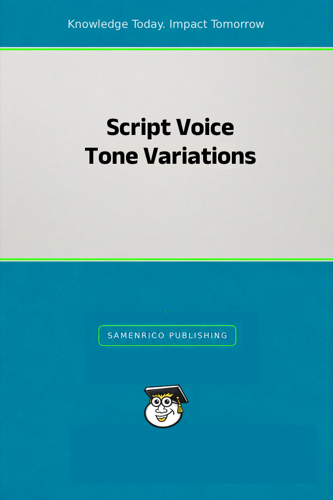
Script Voice Tone Variations eBook
Teaches using tonal shifts for deepening and sugge
by Staples Etta
Teaches using tonal shifts for deepening and suggestion emphasis.
Formats
Free sample
Chapter 1: The Eight-Second War--–- Let me tell you something that will make you uncomfortable. You have approximately eight seconds. That is not a metaphor. That is not a motivational slogan to hang on a coffee mug. That is the measured, tested, brutal reality of human attention in the world you are trying to communicate with right now.
Eight seconds. That is how long a listener gives you before their brain decides whether you are worth hearing, whether you are telling the truth, whether you have authority, whether you are trustworthy, whether you are interesting, and—most painfully—whether you are a person or just background noise.In eight seconds, you will not have finished your first paragraph. You will not have made your key point. You will not have delivered the data that proves you are right. The words you spent hours crafting, the careful arguments, the elegant phrasing—none of it will have reached their conscious mind yet.
And yet, the decision about whether they will listen to the rest has already been made. Not by their logic. Not by their reasoning. By something much faster, much older, and much more powerful than their conscious thought.This is not a problem of charisma. It is not a problem of being an introvert or an extrovert.
It is not a problem of having the right vocabulary or the right credentials. It is a problem of tone. Specifically, it is a problem of what happens to your voice when you read from a script—when you look down at words on a page or a screen and attempt to deliver them as if they were your own spontaneous thoughts. For most people, the moment they begin reading, their voice flattens. The music drains out.
The human being disappears, replaced by a competent, professional, utterly forgettable robot.This book exists to fix that. And it starts with a promise: by the time you finish this chapter, you will understand why your voice sounds the way it does when you read, and you will have the first concrete tool to change it. Not a theory. Not an aspiration. A tool you can use today.The Twenty Percent Problem Let us start with a number that should shock you.
In face-to-face communication, the actual words you say account for approximately twenty percent of the emotional message the listener receives. Twenty percent. The remaining eighty percent comes from tone, pace, pitch, volume, and the tiny micro-shifts between them. This is not self-help speculation. It is the conclusion of decades of communication research, most famously the work of psychologist Albert Mehrabian, who demonstrated that when words and tone conflict, the listener believes the tone every single time.Think about what this means.
You can say "I am confident in this decision" with a voice that rises at the end like a question, and your listener will hear uncertainty regardless of your words. You can say "I completely trust you" with a nasal, pinched resonance, and your listener will hear judgment. You can say "This is urgent" with a slow, legato pace, and your listener will hear calm. The words are not the message. The words are the excuse for the message.
The message lives in your tone.Here is where the problem becomes acute for anyone who reads from a script. When you speak spontaneously—when you are just talking to a friend, telling a story, arguing a point you care about—your tone naturally rises and falls. You speed up when you are excited. You slow down when you are emphasizing something important. You drop your voice when you are sharing something private.
You pause before a punchline. You do all of this without thinking about it because your brain is focused on the feeling, not the words.The moment you pick up a script, something changes. Your brain shifts from "feeling mode" to "decoding mode." Suddenly, you are looking at symbols on a page—black marks on white background—and translating them into sounds. Your cognitive load spikes. Your working memory fills up with the task of getting the words right.
And your tone, which was previously automatic and expressive, becomes secondary. It becomes the thing you will attend to after you are sure you are saying the correct words. Except that after never comes. By the time you finish the sentence, you are already on to the next one. The result is what we will call, throughout this book, The Digital Flatline—a robotic, monotone delivery that communicates competence but never connection.The Amygdala Hijack To understand why tone matters more than words, you need to understand a small but powerful structure in your listener's brain called the amygdala.
The amygdala is the brain's rapid-response threat detection system. It does not think. It does not reason. It reacts. And it reacts approximately three tenths of a second faster than the parts of the brain responsible for language processing.Three tenths of a second does not sound like much.
But in the economy of human attention, it is an eternity. It is the difference between a first impression and a second thought. It is the gap between "I trust this person" and "let me consider what they just said." By the time your listener has processed the meaning of your first sentence, their amygdala has already decided whether your voice sounds safe or threatening, confident or uncertain, warm or cold.This is what we call the Amygdala Hijack. Not because it is dramatic or violent, but because it bypasses the listener's conscious control. They do not decide to trust you based on your tone.
They feel trust or suspicion, and then their conscious mind looks for reasons to justify that feeling. If your tone signaled authority, they will find reasons to believe your words. If your tone signaled uncertainty, they will find reasons to doubt you. The words become evidence for a conclusion that was already reached.Here is the practical implication for anyone reading a script. If you sound flat and robotic in those first eight seconds, the listener's amygdala does not register "competent professional." It registers "unfamiliar pattern." And the brain's default response to an unfamiliar pattern is caution.
The listener does not turn off. They do not walk away. They just... drift. They check their phone.
They think about what they are going to say next. They let your words wash over them without landing. You are speaking, but you are not being heard.The solution is not to become a theatrical performer. The solution is to understand that your tone is the first channel of communication—the one that opens the door for your words to enter. No tone, no entry.
Flat tone, closed door. Expressive, varied, intentional tone, door wide open.The Script Trap Let me tell you a story. Years ago, I watched a highly competent executive—someone with twenty years of industry experience, someone whose expertise was unquestionable—deliver a presentation to a room of potential investors. She had prepared meticulously. Her slides were beautiful.
Her data was irrefutable. Her argument was airtight. And she read every word from a script on the lectern.She did not…
This is the end of the free sample. Get the eBook to keep going. Buy now
About this book
Details
- Author
- Staples Etta
- Publisher
- SamEnrico
- Language
- English
- Genre
- Non-Fiction, Self-Help, Voice
- Released
- 2026-06-11
- Pages (approx.)
- 141
- Available as
- eBook, Audiobook

Read better in the ZLOADR app
Your eBooks on your phone or tablet. Sign in with your SamEnrico account and start reading.
More by Staples Etta
 OCD and ADHDStaples Etta$11.99
 Liquidation Preference GuideStaples Etta$11.99
 Rainy Window RelaxationStaples Etta$11.99
 Ericksonian Self Trance PrimerStaples Etta$11.99
 Time Blocking For Shift WorkersStaples Etta$11.99
 The Moderator HandbookStaples Etta$11.99
 The Paramedic Shift Stress GuideStaples Etta$11.99
 Women And Anger GuiltStaples Etta$11.99
 The Havana Syndrome: Shadows Over DiplomacyStaples Etta$11.99
 The Forge of Progress: How Western Ingenuity Tamed the Volcano’s FuryStaples Etta$11.99
 The Navigators of the Indian Ocean: The Swahili Mariners and Their Maritime EmpireStaples Etta$11.99
 The 101 Handbook: Engineering ChemistryStaples Etta$11.99
You may also like
 Breath Awareness For SingersFlorez Tabatha$11.99
 The Aggressive Voice Tone FixPeachey Alona$11.99
 Remote Voice and Tone GuideBrowning Chantal$11.99
 Affirmation Voice Tone GuideCallender Dolly$11.99
 Voice Tone Nonverbal GuideDiaz Freddie$11.99
 Voice Pacing for HypnosisShipley Monet$11.99
 Voice Tone Confidence GuideSalcedo Nicolasa$11.99
 Recording Your Own VoiceApplegate Ula$11.99
 Voice Recording Dream JournalPaxton Samara$11.99
 Voice Confidence HypnosisRangel Audry$11.99
 Vocal Delivery for SpeakersHuber Maragaret$11.99