
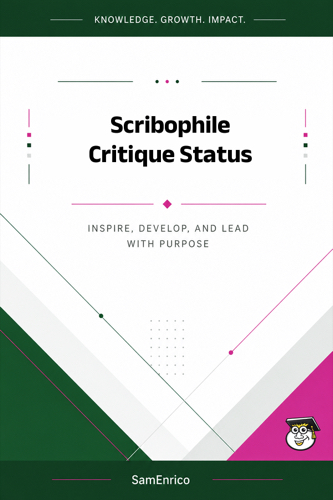
Scribophile Critique Status eBook
Examines writing feedback as social currency.
by Penn Voncile
Examines writing feedback as social currency.
Formats
Free sample
Chapter 1: The Visibility Paradox--–- The email arrived at 11:47 PM on a Tuesday. I had been staring at the same paragraph for three hours, convinced it was either genius or garbage, unable to tell the difference. The subject line read: "Your manuscript has been in the Spotlight for 14 days. It has received 0 critiques."Fourteen days. Zero responses.
Not a single pair of eyes had touched the five thousand words I had spent six months polishing in secret. I had joined Scribophile three weeks earlier, full of hope, and immediately done the one thing the platform warns against: I posted my work before critiquing anyone else's. I had treated feedback as something I deserved, not something I traded. The result was a digital ghost town—my chapter sitting in the queue like a neglected storefront, accumulating virtual dust while other writers exchanged lively, upvoted critiques that I could only watch from the sidelines.That email was my wake-up call. But it took me another six months to understand what it really meant: I had fallen victim to the Visibility Paradox.The Myth That Keeps Writers Stuck The romanticized image of the solitary writer is one of the most destructive myths in creative culture.
We picture Hemingway at his standing desk in Cuba, whiskey within reach, wrestling with prose in glorious isolation. We imagine J.K. Rowling in that Edinburgh café, pouring Harry Potter onto napkins while the world left her alone. We fantasize about the garret, the cabin in the woods, the locked study where genius happens without interruption.This fantasy is a lie. And it is killing your writing career.The truth, drawn from Austin Kleon's essential work Show Your Work!, is that creativity is fundamentally a social act.
Kleon argues that the old model—hide in your studio until you produce a masterpiece, then unveil it to a waiting world—has been replaced by a new reality: the process itself must be visible. Feedback loops are not interruptions to the real work of writing; they are the engine of improvement. Every draft refined in isolation is a draft that could have been better if exposed to another reader's eyes.The Visibility Paradox is simple yet brutal: you cannot improve what you refuse to show. A manuscript kept hidden is a manuscript that remains flawed, because flaws only become visible under the light of another reader's attention. You might sense that something is wrong—a scene that drags, a character who feels flat, dialogue that clunks—but without external feedback, you are diagnosing your own illness without any medical training.
You are both patient and doctor, and you are not qualified for the latter role.Consider the research on the "illusion of explanatory depth." Psychologists have found that people believe they understand complex systems—how a toilet works, how a bicycle stays upright, how a zipper functions—until they are asked to explain those systems step by step. At that moment, the gaps in their knowledge become painfully apparent. Writing is no different. You believe you know why a paragraph isn't working until you have to explain it to someone else, or until someone else points out a problem you never noticed. The solitary writer operates in a hall of mirrors, seeing only their own reflection.
The networked writer operates in a room full of windows, each one revealing a different angle on the same text.The Psychological Shift: From Validation to Trade Scribophile is not a social network in the traditional sense. It is not Facebook for writers, where you post your work and hope for likes. It is an economy—a marketplace where attention is the most valuable commodity and critiques are the currency. Understanding this distinction requires a fundamental psychological shift that most new users fail to make.The validation-seeking mindset sounds like this: "I have written something beautiful. Please read it and tell me I am talented.
Please confirm that my hours of labor were worthwhile. Please make me feel seen." This mindset treats feedback as a gift that the community owes you simply for showing up. It is the emotional equivalent of a child bringing a crayon drawing to a parent and demanding praise. The problem is that other writers on Scribophile are not your parents. They have their own manuscripts, their own anxieties, their own desperate need for attention.
They owe you nothing.The value-trading mindset sounds very different: "I will read your work carefully. I will spend thirty minutes writing a thoughtful critique that identifies specific strengths and weaknesses. I will give you my attention, and in exchange, you will give me yours." This mindset treats feedback as a transaction—not cold or cynical, but mutual. Both parties benefit. Both parties grow.
Both parties leave the exchange richer than they arrived.The platform's mechanics enforce this shift whether you like it or not. You cannot post your own work until you have earned Karma by critiquing others. This is not a bug; it is the central feature. Scribophile forces you to become a giver before you can become a receiver. And in doing so, it reveals the hidden truth about all creative communities: the people who receive the best feedback are not the most talented writers.
They are the most generous critics.I learned this the hard way. After my embarrassing fourteen-day silence, I deleted my manuscript from the Spotlight and started over. I spent two weeks doing nothing but critiquing other people's work. I read bad poetry, mediocre short stories, and a handful of genuinely brilliant novel chapters. I wrote detailed feedback for each one, even when I had to force myself to find something constructive to say.
My Karma slowly climbed from zero to fifty to two hundred. And then something magical happened: writers whose work I had critiqued began showing up on my profile. They returned the favor. They read my resurrected manuscript. They offered insights I never could have generated alone.The shift from validation-seeking to value-trading is not easy.
It requires swallowing your ego, accepting that your work is not a precious gift to the world, and admitting that you need other people to see what you cannot see. But it is the only path that leads to growth.The Safety Signal Problem: Why Writers Hide If the Visibility Paradox is true—if exposure is necessary for improvement—then why do so many writers hide their work? Why do we hoard half-finished manuscripts in password-protected folders, share only with our most trusted friends, or never share at all?The answer lies in what Daniel Coyle, in The Culture Code, calls "safety signals." Coyle studied the most successful groups in the world—from the Navy SEALs to improvisational comedy troupes—and found that high-performing cultures are built on a foundation of psychological safety. Members need to believe that they can take risks, ask questions, and admit mistakes without being punished. When safety signals are present, people open up.
When they are absent, people retreat into自我保护.For writers, sharing work feels fundamentally unsafe. A manuscript is not just a collection of sentences; it is an extension of the self. When someone critiques your writing, it can feel like they are critiquing…
This is the end of the free sample. Get the eBook to keep going. Buy now
About this book
Details
- Author
- Penn Voncile
- Publisher
- SamEnrico
- Language
- English
- Genre
- Non-Fiction, Self-Help
- Released
- 2026-06-06
- Pages (approx.)
- 134
- Available as
- eBook, Audiobook

Read better in the ZLOADR app
Your eBooks on your phone or tablet. Sign in with your SamEnrico account and start reading.
More by Penn Voncile
 Headache Myths DebunkedPenn Voncile$11.99
 Metabolic Syndrome South AsiansPenn Voncile$11.99
 Opioid Harm Reduction GuidePenn Voncile$11.99
 The Forgotten Pedalers: Australia’s Medieval Cycling Pioneers and the Birth of a Renaissance SportPenn Voncile$11.99
 Learn to Play the Pendant OcarinaPenn Voncile$11.99
 Cross Document Clause ComparisonPenn Voncile$12.99
 How to Start a Needle Valves Business (Beginners Guide)Penn Voncile$11.99
 Controlled Environment Agriculture SpecialistPenn Voncile$11.99
You may also like
 Hong Kong Handover 1997Dunn Johnnie$11.99
 Zumba For Postnatal Recovery CourseNeal Christian$11.99
 Zumba for BeginnersLadner Nikia$11.99
 YouTube Comment Mining GuideHumes Pandora$12.99
 Worry Box MeditationCarlin Rudy$11.99
 Workplace Stress MeditationNguyen Lynn$11.99
 Workplace Stress and Sleep RepairHawley Ivory$11.99
 Workplace Perfectionism CureDelaney Jeffry$11.99
 Workplace Injustice Anger GuideWallen Isabelle$11.99
 Work Addiction and Burnout LinkGreenwood Ester$11.99
 Women in Yoga and WellnessBeattie Galina$11.99
 Women in Stand Up ComedyChun Evangeline$11.99