
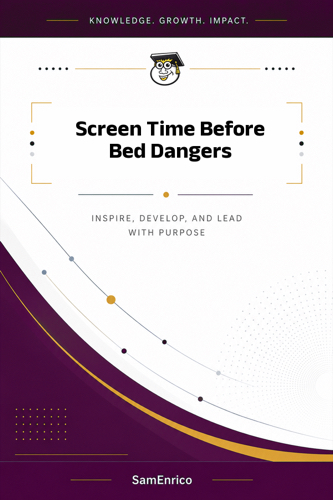
Screen Time Before Bed Dangers eBook
Avoid phones and laptops for 90 minutes before sle
by Coyle Terese
Avoid phones and laptops for 90 minutes before sleep.
Formats
Free sample
Chapter 1: The Silent Robbery--–- The blue glow from your phone is not just keeping you awake. It is stealing something far more valuable than sleep, and it has been doing so for years without your permission.Every night, in millions of bedrooms across the world, a silent robbery takes place. The victim does not scream. The thief leaves no fingerprints. And the stolen goods are never reported missing because the victim wakes up each morning having already forgotten what was taken.
This is the midnight heist, and your phone, laptop, or tablet is the getaway driver.You know the feeling. It is 11:15 PM. You are tired. Your eyelids are heavy. You tell yourself, "Just five more minutes of scrolling." Then, somehow, it is 12:47 AM.
You are wide awake, staring at a video of a cat wearing a hat, or an argument between strangers about politics, or a news story that fills you with vague dread. You finally put the phone down, close your eyes, and your brain erupts like a fireworks display. Unpaid bills. That awkward thing you said in 2017. Tomorrow's to-do list.
The email you forgot to send. Your heart races. Your mind spins. Sleep, when it finally comes, is shallow and fragmented. The alarm arrives like a punch to the skull.You blame yourself.
"I have no self-control," you think. "I'm addicted to my phone." But here is the truth that the multi-trillion-dollar technology industry does not want you to know: it is not just about willpower. It is biology. And the mechanism of this robbery is so elegant, so perfectly designed by evolution and then hijacked by engineers, that it feels like fate rather than physics.This chapter is about that mechanism. It is about the hormone that governs your sleep, the light that murders it, and the ninety-minute window that stands between you and a complete neurological reset.
By the time you finish reading, you will never look at your phone's bedtime "night mode" the same way again.The Master Clock Hidden Inside Your Brain Deep within your brain, just above the point where your optic nerves cross, sits a cluster of approximately twenty thousand neurons called the suprachiasmatic nucleus, or SCN. This tiny structure—smaller than a grain of rice—is your body's master clock. It does not tick in seconds or minutes. It ticks in a rhythm that repeats approximately every twenty-four hours. This is your circadian rhythm, from the Latin circa diem, meaning "about a day."The SCN is not a metaphor.
It is a physical piece of your brain, and it runs your life. It tells your liver when to process toxins. It tells your gut when to absorb nutrients. It tells your heart when to raise or lower your blood pressure. And most critically for this discussion, it tells your pineal gland—a tiny, pinecone-shaped gland deep in the center of your brain—exactly when to produce melatonin.Melatonin is the hormone of darkness.
It is not a sleeping pill; it does not knock you unconscious. Instead, melatonin is the chemical signal that says, "It is night. Begin the process of winding down." When melatonin rises in your bloodstream, your body temperature drops slightly. Your cells enter repair mode. Your brain begins to consolidate memories.
Your immune system ramps up production of infection-fighting cytokines. Melatonin is the conductor of the overnight orchestra, and without it, every instrument plays out of tune.Here is the critical fact that changes everything: the SCN determines day from night based entirely on one input—light. Specifically, blue light. And the SCN is ancient. It evolved hundreds of millions of years ago, long before electricity, long before fire, long before humans.
For the entire history of life on Earth until about 150 years ago, the only source of blue light bright enough to register on the SCN was the sun. When the sun went down, the SCN said, "Night has begun. Make melatonin." When the sun rose, the SCN said, "Stop melatonin production. Wake up."This system worked flawlessly for millions of years. Then we invented the light bulb.
Then we invented the smartphone. And now, for the first time in evolutionary history, we are flooding our retinas with blue light at midnight, and our ancient SCN has no idea what to do.The Wavelength That Hijacks Your Brain Not all light is created equal. Sunlight contains the full visible spectrum—red, orange, yellow, green, blue, indigo, violet. Each wavelength affects the SCN differently, but blue light (approximately 450 to 495 nanometers) is the most powerful regulator by a massive margin. Evolution designed it this way for a good reason: the sun's peak intensity during the day is in the blue range.
Blue light means "daytime, be alert, hunt for food, avoid predators, stay awake."Your phone screen, laptop display, and LED bulbs emit blue light at a similar wavelength but with a devastating difference: they emit it at night. The SCN cannot distinguish between the blue light of a noon sun and the blue light of a Twitter notification at 11:30 PM. It sees blue, it assumes daytime, and it orders the pineal gland to halt melatonin production immediately.This is not a subtle effect. Research from Harvard Medical School found that just six and a half hours of blue light exposure at night suppressed melatonin for twice as long as green light exposure and shifted circadian rhythms by three hours. Three hours.
That means checking your phone for thirty minutes before bed can trick your brain into thinking it is still early evening, delaying the entire sleep cycle.Let me pause here because this is where most books on sleep hygiene make a catastrophic error. They tell you to use "night mode" or "blue light filter" on your phone. They tell you to download an app that turns your screen orange. They tell you this will solve the problem. It will not.
And the reason is simple math.Why "Night Mode" Is a False Prophet Every modern smartphone includes a feature that reduces blue light emission. On i Phones, it is called Night Shift. On Android, it is called Night Light. On computers, there are programs like f.lux. These tools shift the screen's color temperature from cool (blue-heavy) to warm (orange-heavy).
They are well-intentioned. They are also insufficient.Multiple independent tests have measured the blue light reduction from these settings. The typical result: a reduction of approximately 30 to 40 percent. That means sixty to seventy percent of the blue light still reaches your retina. Your SCN is exquisitely sensitive.
It does not require full daylight to suppress melatonin; it requires only a fraction. Studies have shown that blue light at an intensity as low as five to ten lux—roughly the brightness of a phone screen dimmed to minimum—is enough to significantly delay melatonin onset.The math is unforgiving. If your phone emits one hundred units of blue light at full brightness and night mode reduces it to sixty units, your SCN still registers a daylight signal. You are not protecting your melatonin; you are just making the theft slightly less efficient.This is the first major revelation of this book: the ninety-minute rule is not arbitrary. It is not…
This is the end of the free sample. Get the eBook to keep going. Buy now
About this book
Details
- Author
- Coyle Terese
- Publisher
- SamEnrico
- Language
- English
- Genre
- Non-Fiction, Health & Wellness, Blue Light
- Released
- 2026-06-12
- Pages (approx.)
- 137
- Available as
- eBook, Audiobook

Read better in the ZLOADR app
Your eBooks on your phone or tablet. Sign in with your SamEnrico account and start reading.
More by Coyle Terese
 Cartoon Voice Actor ConfessionsCoyle Terese$11.99
 Blue Zone Nut Consumption GuideCoyle Terese$11.99
 The One Hour Cooking GuideCoyle Terese$11.99
 Teen Conversation GuideCoyle Terese$11.99
 The Sweethearts of Surgery: Florence and ThomasCoyle Terese$11.99
 How to Start a Photo Pick-up Service (retail) Business (Beginners Guide)Coyle Terese$11.99
 Ghana Startup IncubatorsCoyle Terese$12.99
 Founder Exercise AntidepressantCoyle Terese$12.99
 Understanding Wiedemann-rautenstrauch SyndromeCoyle Terese$17.99
 Vinyl RecordsCoyle Terese$11.99