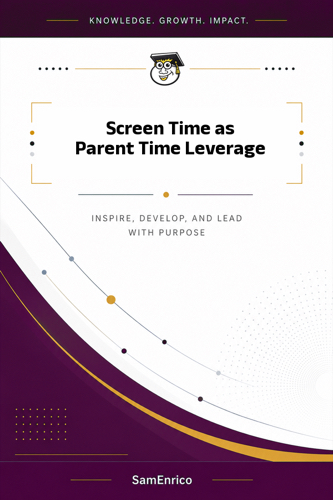
Screen Time as Parent Time Leverage eBook
Uses educational media to create windows for paren
by Nagy Celine
Uses educational media to create windows for parent tasks.
Formats
Free sample
Chapter 1: The Bathroom Floor Epiphany--–- The first time I hid from my own child, I was sitting on a cold tile bathroom floor, my back pressed against the tub, pretending I didn’t exist. My two-year-old was on the other side of the door, not crying, not banging—just watching. Watching a tablet. I had handed it to her fifteen minutes earlier with shaking hands and a pounding heart, not because she needed it, but because I needed five minutes of silence to answer an email from my boss that was already four hours overdue. The email was three sentences long.
It took me twelve minutes to write because I kept stopping to listen for her. Was she okay? Was she learning? Was I destroying her future because I couldn’t manage my own time?The email sent, I leaned my head against the wall and cried. Not because I was sad.
Because I was ashamed.I had read the articles. I had shared the studies on social media about how screens cause ADHD, how tablets delay language development, how every minute of screen time was a minute of childhood stolen. I had nodded along at parenting group when other mothers whispered about their “screen shame” like they were confessing a sin. And yet there I was, hiding in a bathroom, praying that a glowing rectangle would buy me ten more minutes of peace.That was the moment I realized something was deeply wrong—not with the screen, but with the story I had been told about it.The Guilt That Sells Books For the past decade, the parenting industry has built a multi-million-dollar empire on a single emotion: fear. Fear that you are not enough.
Fear that your child will fall behind. Fear that every choice you make is permanently wiring their brain for failure. And nowhere is this fear more potent than in the conversation about screen time.Look at the titles on the bestseller list. The Anxious Generation warns that smartphones are rewiring adolescence. The Screentime Solution offers a path to “digital minimalism” that feels attainable only for parents with full-time nannies and trust funds.
Glow Kids compares i Pads to cocaine. These books are not wrong about the risks—excessive, unmanaged, passive screen time absolutely can harm developing brains. But they are missing something crucial. They are written from the assumption that parents have unlimited time, unlimited energy, and unlimited support. They assume that the only ethical use of a screen is co-viewing, hands-on, side-by-side engagement.
They assume that any moment a child spends alone with a device is a moment of parental failure.These assumptions are a luxury that most families cannot afford.The parents I meet—in my research, in my workshops, in the grocery store checkout line—are not looking for permission to neglect their children. They are looking for permission to survive. They are single mothers working two jobs. They are fathers trying to cook dinner while a toddler wraps around their ankles. They are neurodivergent parents who need ten minutes of silence before they lose their temper.
They are exhausted, overwhelmed, and drowning in a culture that tells them that asking for help—even from a tablet—makes them bad parents.This book is not for the parents who have the time to co-view every episode of Bluey. This book is for the rest of us.The Purity Trap Let me name the enemy, because it is not the screen. The enemy is what I call The Purity Trap—the cultural narrative that good parents do everything themselves, all the time, without shortcuts, without rest, and without apology. The Purity Trap tells you that if you hand your child a tablet so you can fold laundry, you are lazy. If you let them watch a show so you can take a shower, you are neglectful.
If you need thirty minutes of quiet to finish a work report, you should have planned better, woken up earlier, or simply tried harder.The Purity Trap is a lie, but it is a seductive one. It flatters parents who have the resources to avoid screens—stay-at-home parents with financial stability, extended family nearby, and children who sleep through the night. It shames parents who do not have those advantages. And it sells books, courses, and Instagram memberships to guilty parents desperate to feel like they are doing enough.I know because I bought them. I spent hundreds of dollars on screen-free parenting courses.
I printed out “no screens until age three” charts and taped them to my refrigerator. I threw away the tablet, bought wooden toys, and lasted exactly four days before I broke down and bought a new one at Target at 9 PM, crying in the parking lot.The Purity Trap had me convinced that my only two options were perfect screen-free parenting or total failure. There was no middle ground. There was no room for strategy, for intention, for leverage. There was only guilt and more guilt.This book is the middle ground.The Question That Changes Everything At the heart of the Purity Trap is a single, unspoken question that parents ask themselves every time they reach for a screen: Is this bad for my child?It is the wrong question.The right question—the one that will guide you through every chapter of this book—is this:“What is this screen time doing for our family system right now?”Notice the difference.
The first question is about the child in isolation. It assumes that screen time is a substance with a fixed effect, like poison or medicine. It ignores context, duration, content, and—most importantly—the needs of the parent. The second question is about the whole family. It acknowledges that parents are people with real constraints, real deadlines, and real limits.
It invites you to think strategically rather than reactively. It replaces shame with assessment.Let me show you how this works in practice.Scenario A: Your child has been playing outside for two hours. They are tired but not cranky. You have a work call in ten minutes. You hand them a tablet with an educational game and a 20-minute timer.
What is this screen time doing for your family system? It is protecting your income while giving your child a quiet, low-stakes activity. That is leverage.Scenario B: Your child woke up thirty minutes ago. They have not eaten breakfast, gone outside, or spoken to another human. You hand them a tablet because you are hungover and do not want to deal with them.
What is this screen time doing for your family system? Nothing. It is avoidance, not leverage. The parent needs support, not a screen.Scenario C: Your child is sick with a fever. You have been up all night.
You hand them an i Pad with unlimited You Tube access. What is this screen time doing for your family system? It is survival. And survival is allowed.Notice that the duration of screen time in these scenarios is similar. What changes is the intention, the context, and the parent’s assessment.
That is why this book will never give you a one-size-fits-all “minutes per day” limit. Those limits are arbitrary. They…
This is the end of the free sample. Get the eBook to keep going. Buy now
About this book
Details
- Author
- Nagy Celine
- Publisher
- SamEnrico
- Language
- English
- Genre
- Non-Fiction, Self-Help, Digital Parenting
- Released
- 2026-06-05
- Pages (approx.)
- 139
- Available as
- eBook, Audiobook

Read better in the ZLOADR app
Your eBooks on your phone or tablet. Sign in with your SamEnrico account and start reading.
More by Nagy Celine
 Voiceover BootcampNagy Celine$11.99
 Lagoon Blue VisualizationNagy Celine$11.99
 Vegan Lab Testing GuideNagy Celine$11.99
 Letting Go of ControlNagy Celine$11.99
 The Goryeo Resistance: Korea's Forgotten War Against the MongolsNagy Celine$11.99
 People LeadNagy Celine$11.99
 How to Become a Concreting SupervisorNagy Celine$11.99
 Small Business AI Invoice Financing GuideNagy Celine$12.99
 Scholarship Acceptance GuideNagy Celine$12.99
 Understanding Neutral Lipid Storage MyopathyNagy Celine$17.99