
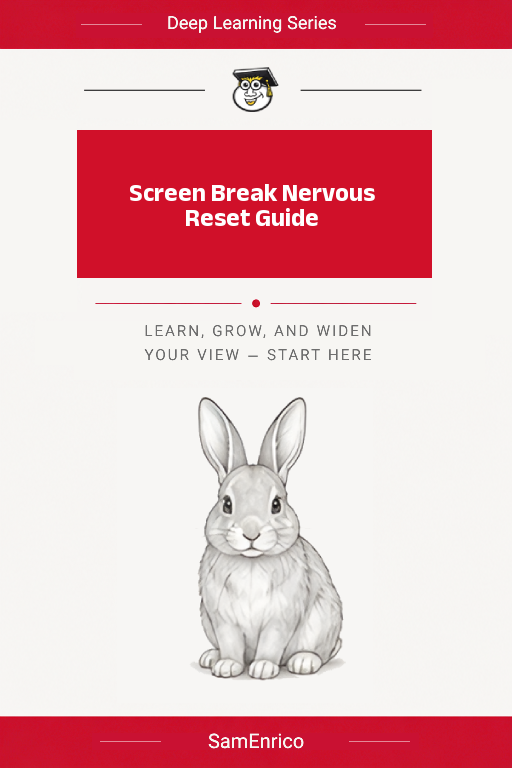
Non-FictionMental WealthDigital Wellness
Screen Break Nervous Reset Guide eBook
Step away from digital devices for two minutes wit
Step away from digital devices for two minutes with eye palming and peripheral vision expansion exercises.
Formats
Free sample
Chapter 1: The Focal Trap--Your phone is not addictive because of dopamine. At least, not primarily. That explanation—the one you have heard in every documentary, podcast, and self-help book—is incomplete. It is the nutritional label of digital burnout: technically true, but missing the real ingredient. Dopamine is the messenger, not the message.
The actual mechanism that leaves you drained, foggy, and strangely anxious after two hours of screen time has almost nothing to do with reward circuits and everything to do with a single, overlooked piece of human anatomy: your eyes.Consider what happens during a typical hour of screen use. You sit at a desk or curl up on a couch. Your phone or laptop sits at a fixed distance—roughly sixteen to twenty inches from your face. Your pupils constrict to sharpen focus. Your ciliary muscles, tiny ring-shaped bands inside each eye, contract and lock in place to maintain that focus.
Your eyes stop their natural microscopic saccadic wandering and adopt a rigid, target-locked stare. Your blink rate drops from fifteen to twenty blinks per minute to five or six. The tear film that coats your cornea thins and develops dry spots. Your trigeminal nerve—a massive cranial nerve responsible for facial sensation and eye health—begins firing low-grade alarm signals because the surface of your eye is no longer properly lubricated. Those signals travel to your brainstem, where they intersect directly with your autonomic nervous system.Here is what nobody tells you: the trigeminal nerve shares a nucleus with the vagus nerve, your body's primary parasympathetic "brake pedal." When the trigeminal nerve fires in distress mode, it inhibits the vagus nerve.
Your sympathetic nervous system—the fight-or-flight accelerator—gets the green light to stay on. Your heart rate remains elevated. Your cortisol levels stay high. Your digestion slows. Your muscles hold low-grade tension.
You are not relaxed. You are not resting. You are not even neutral. You are in a state of continuous, low-threat activation caused entirely by the position and condition of your eyes.This is the Focal Trap.It is a term we will use throughout this book, and it is worth pausing to define it clearly because understanding this concept is the single most important step toward escaping screen burnout. The Focal Trap is the neurological state in which narrowed visual attention and sympathetic nervous system activation become mutually reinforcing.
The more you focus on a near, fixed point, the more your brain interprets that narrowed awareness as a threat state. The more your brain interprets threat, the more it narrows your visual attention to scan for danger. You become trapped in a loop: screen focus triggers mild sympathetic activation, which sharpens focus, which deepens sympathetic activation, which reduces peripheral awareness, which makes you feel even more vigilant. You are not relaxing while scrolling. You are hunting.
Your body thinks it is tracking a predator or watching for an approaching threat. Only the predator is a spreadsheet. The threat is an email thread. And the hunt never ends.This chapter will dismantle the Focal Trap completely. You will learn exactly what happens inside your eyes and nervous system during screen use, why standard advice about "taking breaks" fails, and how a two-minute reset using palming and peripheral vision expansion can break the loop faster than any medication or meditation practice.
By the end of this chapter, you will understand the science so deeply that you will never look at your screen the same way again.The Autonomic Nervous System: Your Body's Two Pedals Before we go any further, we need to establish a shared vocabulary for how your nervous system works. Think of your autonomic nervous system as a car with two pedals: the accelerator and the brake. You need both to drive. The accelerator gets you moving; the brake slows you down and stops you. Neither is good or bad.
The problem is when one pedal gets stuck.The sympathetic nervous system is the accelerator. It activates what is commonly called the fight-or-flight response. When it is engaged, your heart rate increases, your blood pressure rises, your pupils dilate, your airways open wider, your digestion slows or stops, and your body releases glucose for quick energy. This system evolved for genuine emergencies: escaping a predator, running from a fire, or fighting an attacker. It is designed to turn on fast and turn off fast.
In the modern world, however, it turns on dozens of times per day and often stays on at low levels for hours.The parasympathetic nervous system is the brake. Often summarized by the phrase "rest and digest," it does the opposite: it slows your heart rate, lowers blood pressure, constricts your pupils, stimulates digestion, and promotes tissue repair and healing. The vagus nerve is the main highway of this system. When the parasympathetic branch is active, you feel calm, safe, and grounded. Your body repairs itself.
Your brain enters states conducive to creative thinking and deep processing.Here is the critical insight for this book: your visual system is directly wired to both branches. You do not experience screen stress as a thought. You experience it as a physical sensation in your eyes, your forehead, your neck, and your shoulders. That sensation is not metaphorical. It is a direct neural signal traveling from your eyes to your brainstem, where it either activates or inhibits your parasympathetic brake.Most people assume that screen fatigue is caused by "using your eyes too much." That is like saying a car crash is caused by "driving too much." The problem is not quantity.
The problem is the specific pattern of use: sustained near-point focus with minimal variation, low blink rates, and restricted peripheral awareness. This specific pattern triggers a specific neurological response: sympathetic dominance.The Trigeminal Nerve: The Unsuspecting Villain The trigeminal nerve is the largest cranial nerve. It has three major branches (hence "trigeminal") that cover your forehead, cheeks, and jaw. It provides sensation to your face and controls the muscles involved in chewing. But its most important function for our purposes is that it monitors the surface of your eyes.Your cornea is one of the most densely innervated tissues in your body.
It has more nerve endings per square millimeter than your fingertips. This makes sense evolutionarily: your eyes are vulnerable, and damage to them is catastrophic. The trigeminal nerve acts as a hypersensitive security system for your corneas. When your tear film is intact and your eyes are moist, the trigeminal nerve sends a low, steady signal indicating safety. When your tear film breaks down due to reduced blinking, the nerve begins firing rapid, high-frequency signals.
Those signals are interpreted by your brainstem as irritation, dryness, and threat.Here is where most people get lost. They assume dry eyes are uncomfortable but harmless. In reality, dry eyes are a direct trigger for sympathetic activation. The trigeminal nerve's distress signals travel to the spinal trigeminal nucleus in your brainstem. That nucleus has direct connections to the locus coeruleus, a tiny cluster of neurons that controls norepinephrine release—your body's primary arousal chemical.
When the trigeminal nerve fires in alarm mode, the locus coeruleus increases norepinephrine output. You become more alert, more vigilant…
This is the end of the free sample. Get the eBook to keep going. Buy now
About this book
Details
- Author
- Blackburn Rosella
- Publisher
- SamEnrico
- Language
- English
- Genre
- Non-Fiction, Mental Wealth, Digital Wellness
- Released
- 2026-05-30
- Pages (approx.)
- 150
- Available as
- eBook, Audiobook

Read better in the ZLOADR app
Your eBooks on your phone or tablet. Sign in with your SamEnrico account and start reading.
More by Blackburn Rosella
 Social Security for Widowers GuideBlackburn Rosella$11.99
 Hinton Mental Survival GuideBlackburn Rosella$11.99
 Cool Down Timeout ProtocolBlackburn Rosella$11.99
 Peg System For Football PlayersBlackburn Rosella$11.99
 The ABC Safety Stock GuideBlackburn Rosella$11.99
 Pomodoro for PhotographersBlackburn Rosella$11.99
 British Caribbean Sugar PlantationsBlackburn Rosella$11.99
 Dream Journaling for ArtistsBlackburn Rosella$11.99
 The Windward Kings: How Holland Ruled the WavesBlackburn Rosella$11.99
 The Alchemists of Timbuktu: Unlocking the Secrets of the UniverseBlackburn Rosella$11.99
 Mastering The Teres MajorBlackburn Rosella$11.99
 How to Start a Commonwealth War Graves Commission Business (Beginners Guide)Blackburn Rosella$11.99
You may also like
 Hong Kong Handover 1997Dunn Johnnie$11.99
 Zumba For Postnatal Recovery CourseNeal Christian$11.99
 Zumba for BeginnersLadner Nikia$11.99
 YouTube Comment Mining GuideHumes Pandora$12.99
 Worry Box MeditationCarlin Rudy$11.99
 Workplace Stress MeditationNguyen Lynn$11.99
 Workplace Stress and Sleep RepairHawley Ivory$11.99
 Workplace Perfectionism CureDelaney Jeffry$11.99
 Workplace Injustice Anger GuideWallen Isabelle$11.99
 Work Addiction and Burnout LinkGreenwood Ester$11.99
 Women in Yoga and WellnessBeattie Galina$11.99
 Women in Stand Up ComedyChun Evangeline$11.99