
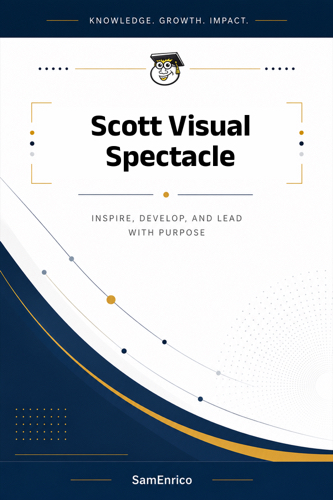
Scott Visual Spectacle eBook
Blade Runner, Gladiator, and the director's painte
by Rios Gwen
Blade Runner, Gladiator, and the director's painterly eye.
Formats
Free sample
Chapter 1: The Boy Who Drew Everything...--–- The aircraft carrier HMS Illustrious sat anchored off the coast of Malta in the summer of 1954, its gray hull cutting through Mediterranean blue like a knife. On its deck, among the polished brass and organized chaos of Royal Navy machinery, a seventeen-year-old boy sat alone with a sketchbook. His name was Ridley Scott. While other sailors smoked cigarettes and traded stories of home, Scott drew. He drew the planes—the De Havilland Sea Venoms with their folded wings, the Westland Whirlwind helicopters with their bulbous noses.
He drew the mechanics, hunched over engines with wrenches that caught the sunlight. He drew the sea itself, its surface broken by wind into a thousand tiny mirrors. He drew everything because drawing was the only way he knew how to see.His commanding officer noticed the sketchbook first. Most recruits used their downtime for card games or sleep. This one drew.
The officer picked up the pad one afternoon and flipped through page after page of hyper-detailed machinery, each propeller blade rendered with obsessive precision, each rivet in its proper place. He looked at Scott and said something the young man would remember for the rest of his life: "You don't just see things, do you? You inhabit them." Scott didn't know how to respond. He only knew that the sketchbook was not a hobby. It was a survival mechanism.This chapter is about the making of an eye.
Before Ridley Scott became the director of Blade Runner and Gladiator—before the rain-soaked streets and the blood-soaked sand, before the painterly frames that would change cinema forever—he was a boy who drew. And that boy, shaped by a childhood of displacement, a brutal art school education, and a television boot camp that demanded visual storytelling on a shoestring budget, became something rare in Hollywood: a director who thinks not in dialogue or plot points, but in composition, color temperature, and texture. He treats every frame as a canvas, the camera as a brush, and the set as a studio. To understand how he got there, we must start at the beginning.The Military Childhood That Forged the Eye Ridley Scott was born on November 30, 1937, in South Shields, a industrial town in northeast England. His father, Francis Percy Scott, was an officer in the Royal Engineers, which meant the family moved constantly.
In the years immediately following World War II, Britain was still a nation of bomb craters and ration books, and the Scott family lived a nomadic existence that took them from barracks to barracks, base to base. Ridley attended thirteen different schools before the age of sixteen. He never stayed anywhere long enough to make lasting friends. He never developed the easy social fluency that comes from growing up in a single place with a single peer group. What he developed instead was the ability to watch.When you are always the new kid, you learn to observe before you participate.
You learn to read rooms, to decode hierarchies, to understand who holds power and who is vulnerable. Scott turned this survival instinct into an artistic practice. He drew the new classrooms before he spoke in them. He drew the barracks yards, mapping their geometry with a pencil. He drew his mother's face—Iris Scott, a woman of considerable warmth and steel—because her face was the only constant in a world of impermanence.
Drawing became his anchor, his way of imposing order on chaos. He has said in interviews that he cannot remember a time when he did not have a pencil in his hand.The Scott household was not artistic in any conventional sense. There were no paintings on the walls, no discussions of Caravaggio or Turner. But there was a quiet respect for craft. Ridley's older brother, Frank, would later become a naval officer.
His younger brother, Tony, would eventually follow Ridley into directing (and become a hugely successful filmmaker in his own right, directing Top Gun, Beverly Hills Cop II, and Unstoppable). The Scott brothers competed constantly, and their competitions often took visual forms: who could draw the better airplane, who could build the more detailed model, who could capture the more accurate likeness of their mother. Ridley almost always won, not because he was more technically skilled but because he saw differently. He noticed things the others missed—the way light fell across a fuselage, the shadow under a chin, the slight asymmetry of a face that made it human rather than schematic.A teacher at one of his many schools pulled his parents aside after a class assignment. The children had been asked to draw a picture of "home." Most drew houses with chimneys and stick figures.
Ridley drew the inside of a moving car, looking out through a rain-streaked window at a landscape blurring past. The teacher told the Scotts: "Your son has an extraordinary eye. But more than that, he has an extraordinary memory for images. He doesn't just see what is in front of him. He sees what will be there a moment later.
He sees movement in stillness." This precognitive visual sense—this ability to anticipate rather than merely record—would become Scott's signature as a filmmaker.The Royal College of Art: Learning to Paint with Time Scott's path to the Royal College of Art was neither straight nor easy. He applied twice and was rejected twice. The first rejection came when he was eighteen, fresh out of military service (he had followed his father into the Navy, serving briefly before realizing that the life of a sailor was not the life of an artist). The second rejection came two years later, after he had spent months building a portfolio of drawings, paintings, and designs. Each rejection letter was brief, formal, and crushing.
Scott considered giving up. He considered becoming a commercial illustrator, a graphic designer, anything that would pay the bills and allow him to draw.But his mother would not let him quit. Iris Scott, who had spent her life following her husband from base to base, had learned something about persistence. She told her son: "If you want it badly enough, you will find a way. If you don't, you will find an excuse." Scott applied a third time.
This time, he was accepted.The Royal College of Art in the late 1950s and early 1960s was a crucible of conceptual thinking. Located in London's South Kensington, surrounded by museums and galleries, the RCA prided itself on producing not craftsmen but visionaries. Its philosophy, drawn from the Bauhaus tradition and filtered through postwar British pragmatism, held that design was not about decoration but about problem-solving. A painter's job was not to reproduce reality but to interpret it—to find the emotional truth beneath the surface. A graphic designer's job was not to make things pretty but to make things communicate.
These ideas would lodge themselves in Scott's mind and never leave.His professors included some of the most influential visual thinkers of the era. There was Richard Guyatt, the head of the graphic design school, who believed that the most important skill an artist could possess was not hand-eye coordination but…
This is the end of the free sample. Get the eBook to keep going. Buy now
About this book
Details
- Author
- Rios Gwen
- Publisher
- SamEnrico
- Language
- English
- Genre
- Non-Fiction, Biography, Visual Artistry
- Released
- 2026-06-07
- Pages (approx.)
- 137
- Available as
- eBook, Audiobook

Read better in the ZLOADR app
Your eBooks on your phone or tablet. Sign in with your SamEnrico account and start reading.
More by Rios Gwen
 Fibromyalgia Night Rest GuideRios Gwen$11.99
 Catherine the Great's Science Patronage GuideRios Gwen$11.99
 Restless Leg Syndrome Journaling TrackerRios Gwen$11.99
 Anger Management for Retail StaffRios Gwen$11.99
 Boat and Marine Emergency KitRios Gwen$11.99
 ESG Rating Downgrade DiscountRios Gwen$11.99
 Nonprofit Burnout PreventionRios Gwen$11.99
 Hormonal Anger Cognitive FixRios Gwen$11.99
 Stardust and the Silent Sentinel: The Enigma of the Heaven’s Gate CultRios Gwen$11.99
 The Great Unfollow: How a Single Tweet Toppled a Tech GiantRios Gwen$11.99
 The Curse of the Forgotten Pharaoh: The Last Days of AkhenatenRios Gwen$11.99
 The Mineral Guide to ZinciteRios Gwen$11.99