
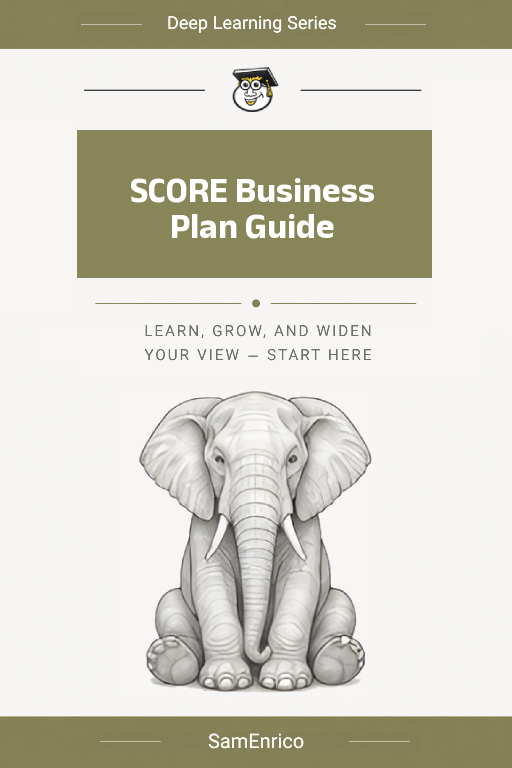
Non-FictionStartup GuideStrategic Planning
SCORE Business Plan Guide eBook
Use free SCORE templates and mentor support for re
Use free SCORE templates and mentor support for remote business plan writing. Online resources.
Formats
Free sample
Chapter 1: The 60-Page Lie--Every aspiring entrepreneur has heard the same terrifying statistic: businesses with a written plan grow 30% faster than those without. What the experts don't tell you is that most of those written plans are never used again after the day they're printed. They sit in a drawer, on a hard drive, or—in the most tragic cases—in a three-ring binder on a shelf, collecting dust while the business struggles to survive.You have been sold a lie.The lie is this: you need a sixty-page, bank-ready, perfectly formatted business plan before you can open your doors, raise money, or quit your job. Consultants charge thousands of dollars for this lie. Business plan software packages charge monthly subscriptions for this lie.
Even well-meaning mentors and SCORE volunteers—the very organization this book will help you leverage—have sometimes perpetuated this lie, asking entrepreneurs to complete lengthy templates before they have any idea whether their idea actually works.This chapter is going to do something radical. It is going to free you from the sixty-page lie and replace it with a one-page truth. That truth is called the Business Model Canvas, and it will save you months of wasted effort, thousands of dollars in unnecessary consulting fees, and—most importantly—the heartbreak of building a business that nobody wants.But before we get to the Canvas, we need to understand why the traditional approach fails so spectacularly, and why a "hypothesis first" mindset changes everything.The Graveyard of Perfect Plans Every SCORE mentor has a collection of stories that would break your heart. Mine—and I have been volunteering with SCORE for nearly a decade—involves a woman named Patricia. She spent six months writing a forty-seven-page business plan for a gourmet popcorn shop.
She had market research, five-year financial projections, a marketing plan with Gantt charts, and even a section on her exit strategy (selling to a national chain in year seven). She had paid a consultant nine hundred dollars to "polish" the financials.She brought this plan to me in December, hoping for a final review before applying for a twenty-thousand-dollar SBA microloan. The plan was beautiful. It was professional. It was also completely wrong.Patricia had never sold a single bag of popcorn to a real human being.
She had never set up a booth at a farmers' market. She had never tested whether people would pay seven dollars for her "artisanal sea salt and caramel drizzle" when the grocery store sold perfectly good popcorn for two dollars. She had spent six months writing about customers she had never met.I asked her a simple question: "What do you actually know to be true about this business?"She paused. Then she said, "I know I love making popcorn."That is not a business plan. That is a hobby with ambition.Patricia's story is not unusual.
Every year, thousands of entrepreneurs write themselves into bankruptcy by treating the business plan as an academic exercise rather than a tool for learning. They mistake activity for progress. They believe that a thick document signals seriousness. They are wrong.The top ten business planning books—including Hal Shelton's "The Successful Business Plan," which SCORE itself endorses—all emphasize the same counterintuitive truth: your first business plan should be a guess. A hypothesis.
A set of assumptions that you will test, not a set of promises you will defend to the death.The Hypothesis Mindset Shift Here is the mental reframe that will save your business before it starts:Stop thinking of a business plan as a document that proves you are right. Start thinking of it as a document that helps you discover where you are wrong.In science, a hypothesis is not something you prove. It is something you test. You design an experiment, run it, and let the results tell you whether your hypothesis holds up. If it fails, you don't burn the lab notebook.
You revise the hypothesis and test again.Business is no different. Your business plan is a set of hypotheses about nine fundamental questions:Who are my customers? (Hypothesis: I think my customer is a thirty-five-year-old suburban parent with disposable income.)What problem do they have? (Hypothesis: I think they are frustrated by the lack of healthy after-school snacks for their kids.)How will I reach them? (Hypothesis: I think Facebook ads targeting local parenting groups will be my most efficient channel.)What will they pay?
(Hypothesis: I think they will pay four dollars per serving.)How will I deliver? (Hypothesis: I think I can produce and ship within forty-eight hours.)What will it cost me? (Hypothesis: I think my cost of goods sold will be around one dollar and fifty cents per unit.)Who else is solving this? (Hypothesis: I think my main competitor is the grocery store snack aisle, and my advantage is freshness.)What key activities matter most? (Hypothesis: I think production efficiency is my biggest operational risk.)Who do I need to help me?
(Hypothesis: I think I need a co-packer and a shipping partner before I can scale.)Each of these hypotheses can be tested—cheaply, quickly, and without writing a sixty-page plan. The Business Model Canvas is the tool that organizes these nine hypotheses onto a single page.Introducing the Business Model Canvas The Business Model Canvas was created by Alexander Osterwalder and Yves Pigneur, and it has become the standard tool for lean startups, corporate innovators, and—increasingly—SCORE mentors who want to save their clients from the sixty-page lie. You can download it for free from SCORE's website alongside the other templates mentioned throughout this book.The Canvas is divided into nine boxes, each representing a core hypothesis of your business. Here is what each box contains:Box 1: Customer Segments Who are you serving? Be specific.
"Everyone" is not a customer segment. "Working parents within a ten-mile radius who currently buy lunch from the deli" is a customer segment. "Small business owners with five to twenty employees who are frustrated by their current payroll software" is a customer segment. The more specific you are, the easier it will be to test your hypotheses.Box 2: Value Propositions What problem do you solve? What need do you meet?
Why should a customer choose you over the alternative (including the alternative of doing nothing)? Your value proposition is not a feature list. It is a statement of relief. "We help working parents save thirty minutes each morning by delivering pre-made, healthy lunch kits" is a value proposition. "We have organic ingredients" is a feature.Box 3: Channels How will you reach your customers?
This includes both marketing channels (Facebook ads, SEO, word of mouth, trade shows) and distribution channels (your website, retail partners, a physical storefront, a food truck). Most entrepreneurs overestimate the effectiveness of their channels and underestimate the cost.Box 4: Customer Relationships What kind of relationship does each customer segment expect from you? Automated self-service? Personal assistance? A community forum?
A loyalty program? A dedicated account manager? The answer changes dramatically based on whether you are selling two-dollar items or twenty-thousand-dollar consulting engagements.Box 5: Revenue Streams What will customers pay for, and how will they pay? One-time purchase?…
This is the end of the free sample. Get the eBook to keep going. Buy now
About this book
Details
- Author
- Villasenor Madelene
- Publisher
- SamEnrico
- Language
- English
- Genre
- Non-Fiction, Startup Guide, Strategic Planning
- Released
- 2026-05-29
- Pages (approx.)
- 143
- Available as
- eBook, Audiobook

Read better in the ZLOADR app
Your eBooks on your phone or tablet. Sign in with your SamEnrico account and start reading.
More by Villasenor Madelene
 Mediterranean Pantry GuideVillasenor Madelene$11.99
 Values And Mission Alignment Compliance And Ethics CourseVillasenor Madelene$11.99
 The Career Plateau StressVillasenor Madelene$11.99
 Divorce Forgiveness GuideVillasenor Madelene$11.99
 The Writer's Block Unblocking GuideVillasenor Madelene$11.99
 Jutland: Letters from the Iron SeaVillasenor Madelene$11.99
 Understanding TrichomalaciaVillasenor Madelene$17.99
 Automotive Tire TechnicianVillasenor Madelene$11.99
 Franchise Candidate Country SelectionVillasenor Madelene$12.99
 How to Become a PlaterVillasenor Madelene$11.99
You may also like
 Hong Kong Handover 1997Dunn Johnnie$11.99
 Zumba For Postnatal Recovery CourseNeal Christian$11.99
 Zumba for BeginnersLadner Nikia$11.99
 YouTube Comment Mining GuideHumes Pandora$12.99
 Worry Box MeditationCarlin Rudy$11.99
 Workplace Stress MeditationNguyen Lynn$11.99
 Workplace Stress and Sleep RepairHawley Ivory$11.99
 Workplace Perfectionism CureDelaney Jeffry$11.99
 Workplace Injustice Anger GuideWallen Isabelle$11.99
 Work Addiction and Burnout LinkGreenwood Ester$11.99
 Women in Yoga and WellnessBeattie Galina$11.99
 Women in Stand Up ComedyChun Evangeline$11.99