
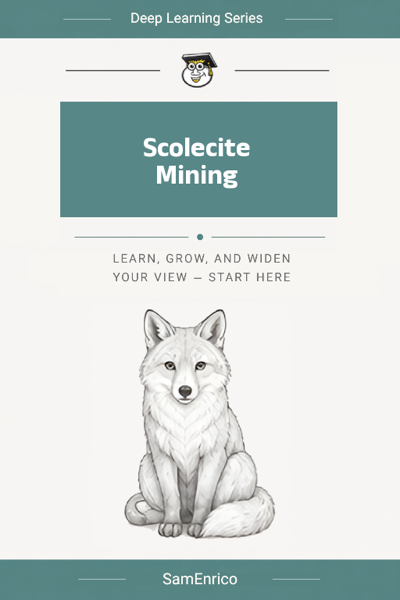
Non-FictionInformativeEducational
Scolecite Mining Audiobook
A Coursebook on Scolecite Mining
by Gunther Ione
A Coursebook on Scolecite Mining
Formats
Free sample
Chapter 1: The Worm That Glows--The first thing any aspiring Scolecite miner must understand is that you are not looking for a rock. You are looking for a ghost—a fibrous, translucent specter that hides inside ordinary basalt boulders, revealing itself only to those who know how to listen, tap, and split the stone with surgical precision. Unlike gold, which announces itself with weight, or copper, which stains the ground green, Scolecite gives no surface indication of its presence. A boulder containing a world-class Scolecite spray weighing several hundred grams looks identical—to the untrained eye—to a barren lump of road fill destined for the crusher. This invisibility is both the miner's greatest challenge and the mineral's greatest protection.
If Scolecite glowed in the dark or sparkled from a distance, every deposit would have been stripped clean centuries ago. Instead, it waits inside its dark basalt womb, discovered only by those who have learned the language of the stone.Before we can extract Scolecite, we must understand what it is, where it came from, and—most critically—how to distinguish it from its nearly identical cousins. The zeolite family is notorious among mineralogists for producing look-alike species that require chemical analysis or refractive index testing to separate. For the field miner, who cannot carry a laboratory into a remote quarry, this presents a practical problem. Mistaking a worthless Natrolite spray for valuable Scolecite wastes time and effort.
Mistaking a fragile Mesolite cluster for Scolecite can lead to a specimen crumbling in your hands during extraction. This chapter provides the foundational knowledge every Scolecite miner needs before swinging a hammer. We will cover the zeolite family tree, the unique chemical and physical properties of Scolecite, the historical test that gave the mineral its name, and—most importantly—the reliable field methods for distinguishing Scolecite from its invisible sisters.The Zeolite Family: Nature's Molecular Sieves To understand Scolecite, one must first understand zeolites as a group. Zeolites are tectosilicate minerals—a structural class defined by a three-dimensional framework of silicon and aluminum atoms bonded through oxygen bridges. Imagine a jungle gym built from tetrahedra, each tetrahedron containing either a silicon or aluminum atom at its center and four oxygen atoms at the corners.
These tetrahedra link together in an open, cage-like arrangement that contains channels and cavities of molecular dimensions. Within these voids, water molecules and exchangeable cations (typically sodium, calcium, potassium…
This is the end of the free sample. Get the Audiobook to keep going. Buy now
About this book
Details
- Author
- Gunther Ione
- Publisher
- SamEnrico
- Language
- English
- Genre
- Non-Fiction, Informative, Educational
- Released
- 2026-05-06
- Pages (approx.)
- 147
- Available as
- eBook, Audiobook

Listen in the VoxFlicks app
Audiobooks and audio dramas wherever you go. Sign in with your SamEnrico account and press play.
More by Gunther Ione
 RV Insurance Agency DatabaseGunther Ione$11.99
 Zumba Choreography Memory Hacks CourseGunther Ione$11.99
 Reaching Out Without FearGunther Ione$11.99
 Stretching For Mobility SeniorsGunther Ione$11.99
 Zazen for Chronic Pain ReliefGunther Ione$11.99
 The Corps of Discovery: Jefferson's Secret Mission to Claim the WestGunther Ione$11.99
 Blood and Betrayal: The Last Days of the Gambino EmpireGunther Ione$11.99
 How to Become a Channeling-machine RunnerGunther Ione$11.99
 CTA Exempt Entities ListGunther Ione$12.99
 Wharton Online CertificateGunther Ione$12.99
 Understanding Dermatographic UrticariaGunther Ione$17.99
You may also like
 Hong Kong Handover 1997Dunn Johnnie$11.99
 Zumba For Postnatal Recovery CourseNeal Christian$11.99
 Zumba for BeginnersLadner Nikia$11.99
 YouTube Comment Mining GuideHumes Pandora$12.99
 Worry Box MeditationCarlin Rudy$11.99
 Workplace Stress MeditationNguyen Lynn$11.99
 Workplace Stress and Sleep RepairHawley Ivory$11.99
 Workplace Perfectionism CureDelaney Jeffry$11.99
 Workplace Injustice Anger GuideWallen Isabelle$11.99
 Work Addiction and Burnout LinkGreenwood Ester$11.99
 Women in Yoga and WellnessBeattie Galina$11.99
 Women in Stand Up ComedyChun Evangeline$11.99