
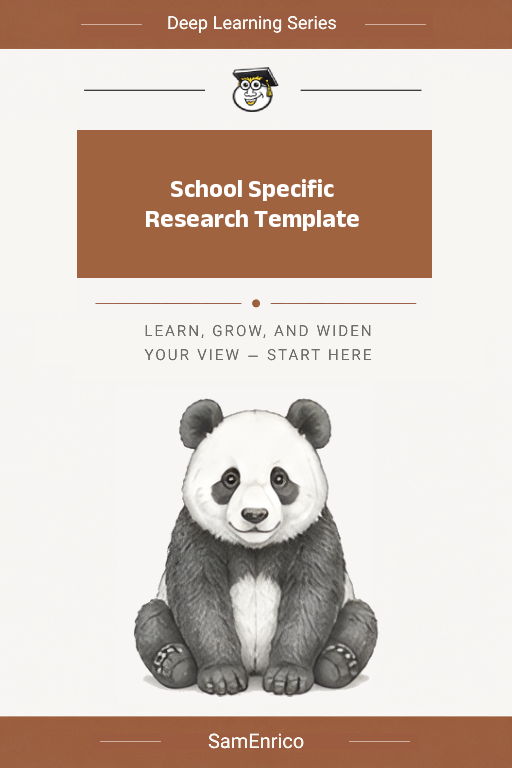
School Specific Research Template eBook
Find unique programs and professors for why-us ess
Find unique programs and professors for why-us essays, moving beyond website facts to alumni interviews and virtual events.
Formats
Free sample
Chapter 1: The Viewbook Liar...--–- Every August, a lie arrives in millions of mailboxes across America. It comes in glossy, 80-pound paper stock, smells like fresh ink, and features a smiling student sitting on a lawn that has never seen a brown patch. The Viewbook – that carefully curated brochure your dream school sends you – is not designed to help you get in. It is designed to make you want to apply. There is a profound difference, and understanding that difference is the first step toward writing a "Why Us" essay that actually works.The Viewbook has one job: to maximize applications.
Every photograph, every quote from a "current student," every statistic about student-to-faculty ratios has been focus-grouped, A/B tested, and approved by a marketing team whose bonuses depend on increasing application volume. The Viewbook does not care if you get rejected. The Viewbook does not care if you waste sixty hours of your life researching a school that was never going to admit you. The Viewbook cares about one metric: did you click "submit"?This is not cynicism. This is the economics of higher education.
Selective universities reject 80 to 95 percent of their applicants. They need a massive pool to reject from. The Viewbook is their fishing net, and you are the fish. Every year, millions of students take the bait. They read the Viewbook, fall in love with the "collaborative community" and the "cutting-edge research opportunities," and then write a "Why Us" essay that reads like a bullet-point summary of the brochure they just finished.Admissions officers have a name for these essays.
They call them "website scrapers."I have read hundreds of "Why Us" essays. I have sat in rooms where admissions officers read them aloud to each other, laughing not with cruelty but with exhaustion. "This student says they want to work with Professor Smith," one officer will say. "Professor Smith retired in 2019." Another officer will read: "They love our 7:1 student-to-faculty ratio. So does every other applicant.
So does the University of Rochester, which also has a 7:1 ratio. This essay could be about any school."The student who wrote that essay did nothing wrong. They worked hard. They visited the website. They found the professor's name.
They genuinely believed they were doing research. But they were not doing research. They were doing what the Viewbook trained them to do: consume marketing and mistake it for intelligence.This book exists because no one has ever taught you how to do real research for a "Why Us" essay. The bestselling college admissions books – Selingo's Who Gets In and Why, Sawyer's College Essay Essentials, the Furda and Steinberg guides – they tell you what colleges want. Authenticity.
Specificity. Demonstrated interest. They do not tell you how to find those things. They give you the destination but not the map.This chapter is the map. Or rather, this chapter is the moment you burn the Viewbook and learn to navigate a different way.The Anatomy of a Failure Let me tell you about Sarah.
(Her name has been changed, but her story is real.) Sarah was a good student. Not a genius, but good: 4.2 weighted GPA, 1490 SAT, captain of the debate team, volunteer tutor for immigrant students. She had her heart set on a selective liberal arts college in the Northeast. She did everything right. She attended the virtual information session.
She took notes. She visited the website and wrote down the names of three professors whose research interested her. She spent two weeks crafting a "Why Us" essay that mentioned those professors by name, praised the school's "close-knit community," and connected her love of debate to the school's "culture of intellectual dialogue."She was rejected. Not waitlisted. Rejected.She requested feedback.
Most colleges do not provide detailed feedback to rejected applicants, but this one had a policy of offering brief comments. The admissions officer wrote: "Your essay felt generic. You mentioned Professor Chen, but Professor Chen is on sabbatical and does not teach first-year students. You praised our 'close-knit community' – a phrase that appears on our website seventeen times. We saw no evidence that you had actually engaged with our school beyond reading our marketing materials."Sarah was devastated.
She had done more research than most of her classmates. She had read the website carefully. She had attended the info session. And still, she was a "website scraper."The problem was not her effort. The problem was her method.
She had been trained to research colleges the way you research a product on Amazon: read the description, look at the photos, check the reviews. But a college is not a product. A college is a living ecosystem of specific people, specific programs, specific quirks, and specific failures. You cannot research it from a distance. You have to get inside it.Sarah's story has a happy ending, by the way.
She found this book's method, applied it to her second-choice school, and got accepted. She stopped scraping the website and started talking to real people. She attended a virtual alumni panel. She emailed a current student she found on Reddit. She discovered that the school had an obscure undergraduate research festival with publicly available posters – and she found a project that connected directly to her debate experience.
Her second "Why Us" essay was not about the school's website. It was about a specific student's poster, a specific professor's methodology question, and a specific alumni panelist's comment about "failure-tolerant prototyping." She got in. The difference was not her GPA or her SAT. The difference was the quality of her intelligence.The Three Pillars of Proprietary Research The rest of this book is organized around three pillars. These pillars are not abstract concepts.
They are specific research methods that produce specific kinds of evidence. You will use all three for every school on your list.Pillar One: Proximity (Chapters 3-4)Proximity means using alumni as primary sources. Not secondary sources. Not website summaries. Real human beings who graduated from the school and can tell you what it was actually like.
The Viewbook will tell you the school has a "collaborative environment." An alumnus will tell you: "The computer science department had a culture of shared debugging sessions that made me a better programmer, but the pre-med students were cutthroat and hid their notes." That is specific. That is useful. That is something no other applicant will know.Proximity also means moving beyond Linked In. Linked In is useful for finding alumni, but it is terrible for understanding their experience. Alumni on Linked In are performing professionalism.
Alumni on a virtual panel about "Great Books to Great Careers" are performing reflection. Your job is to get them off-script. The chapter on Proximity will teach you how to find hidden alumni events, how to email alumni without sounding like a job seeker, and the one question that makes alumni open up every single time.Pillar Two: Currency (Chapters 5-7)Currency means using virtual events for real-time intel. The Viewbook was printed six months ago. The website was updated last month.
But a virtual research showcase happening next Tuesday is happening now. The professors and students at that event are not reading from a script prepared…
This is the end of the free sample. Get the eBook to keep going. Buy now
About this book
Details
- Author
- Comer Janessa
- Publisher
- SamEnrico
- Language
- English
- Genre
- research, Student's Shortcut
- Released
- 2026-05-30
- Pages (approx.)
- 130
- Available as
- eBook, Audiobook

Read better in the ZLOADR app
Your eBooks on your phone or tablet. Sign in with your SamEnrico account and start reading.
More by Comer Janessa
 Benzodiazepine Tapering and Healing ManualComer Janessa$11.99
 Oven Cleaner Lye DangersComer Janessa$11.99
 Slave Trade African ComplicityComer Janessa$11.99
 Foster Care and the Military EnlistmentComer Janessa$11.99
 Cat Rescue Shelter FounderComer Janessa$11.99
 Success Without Burnout for Physical TherapistsComer Janessa$11.99
 Russian Mafia in IsraelComer Janessa$11.99
 Remote Work Productivity AppsComer Janessa$11.99
 The Rum Runners' Last Stand: The 1928 Panama Heist That Changed Justice ForeverComer Janessa$11.99
 The Healers of the Nile: Ancient Egypt's Pioneers of Medical ScienceComer Janessa$11.99
 Service Providers Guide to PET Matching ServicesComer Janessa$11.99
 How to Start a Coriander Growing Business (Beginners Guide)Comer Janessa$11.99
You may also like
 Scientific Research On TM GuideMartens Nathanial$11.99
 Research Proposal Methodology Section MasteryPauley Debroah$11.99
 Research Proposal Appendix CompilationRaines Tyisha$11.99
 Academic Researcher Distraction GuideFord Virgil$11.99
 TM Research and ScienceCovert Nicki$11.99
 Social Anxiety Research ReviewRoberge Cole$11.99
 Research Proposal Significance Section GuideBock Tory$12.99
 Research Proposal Reviewer PsychologyLugo Tawanda$11.99
 Research Proposal Research Questions DesignLara Robbi$11.99
 Research Proposal References and CitationsPatten Shanice$11.99
 Research Proposal Mixed Methods DesignCameron Omega$11.99
 Research Proposal Data Management PlanAnderson Roberto$12.99