
Non-FictionHealth & WellnessEducation
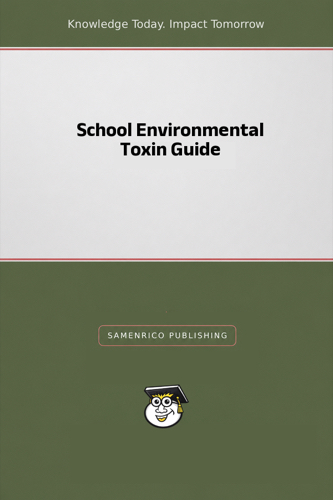
School Environmental Toxin Guide eBook
Teaches parents to advocate for cleaning product a
by Felton Lesia
Teaches parents to advocate for cleaning product and air quality policies.
Formats
Free sample
Chapter 1: The Weekend Miracles--The first time Maya noticed the pattern, she was standing in her kitchen on a Saturday morning, watching her seven-year-old daughter Zoe inhale a stack of blueberry pancakes like she hadn’t eaten in a week.Just five days earlier, on Monday afternoon, Zoe had come home from school and collapsed on the couch at 3:45 PM—something she never did. Her face was pale. Dark circles hung under her eyes like tiny bruises. She complained of a headache, told her mother she was “too tired to even watch TV,” and fell asleep before dinner. Maya had taken her temperature: normal.
She checked for strep throat: negative. She assumed it was a random virus.Tuesday was worse. Zoe woke up coughing—not a wet, congested cough, but a dry, hollow hack that sounded like she was trying to clear something that wasn’t there. Her teacher sent her to the school nurse at 10:30 AM. The nurse’s note said: “No fever.
Possible allergies. Sent back to class.”Wednesday: headache, fatigue, and now a new symptom—irritability. Zoe screamed at her little brother for touching her pencil. She refused to do her math homework, something she usually finished without being asked. Maya felt like she was living with a stranger.Thursday: the cough returned, worse this time.
Zoe’s teacher reported that she seemed “spacy” during reading group, staring at the wall instead of following along. By Thursday night, Maya was exhausted and worried. She had already made a pediatrician’s appointment for Friday afternoon.Friday morning: Zoe woke up coughing again. Maya sent her to school anyway because the pediatrician’s appointment wasn’t until 3:00 PM, and she had deadlines at work. But by noon, the school called.
Zoe had fallen asleep at her desk. Her face was flushed. Her breathing sounded “funny.” Maya picked her up early.At the pediatrician’s office, Dr. Chen listened to Zoe’s lungs, looked in her ears and throat, and checked her oxygen saturation. “Her lungs are clear,” Dr.
Chen said, frowning. “No wheezing. No crackles. Her oxygen is 98 percent. There’s no sign of infection—no fever, no swollen tonsils, no fluid in her ears.
I’m not seeing anything wrong.”Maya felt a flash of frustration. “But she’s exhausted. She’s coughing. She looks terrible.”Dr. Chen nodded slowly.
“I believe you. But sometimes viruses present atypically. Let’s give it the weekend. If she’s not better by Monday, come back.”That night, Zoe slept for eleven straight hours.Saturday morning—the blueberry pancake morning—Zoe was a different child. She woke up before Maya.
She was laughing. She had color in her cheeks. She finished her homework in twenty minutes without complaining. She played outside for two hours. She ate dinner with enthusiasm.
She went to bed happy.Sunday: same thing. Energy. Appetite. No cough. No headache.
No dark circles. Maya almost canceled the follow-up appointment.Monday morning: Zoe woke up coughing.The symptoms returned exactly as they had been. By Monday afternoon, Maya was back in Dr. Chen’s office, this time with a notebook. She had started writing things down.
And that was when she saw it.From Monday to Friday: coughing, fatigue, headaches, irritability, spaciness.Saturday and Sunday: perfectly fine.The pattern was so clear that Dr. Chen saw it immediately. “This isn’t a virus,” she said quietly. “Viruses don’t take weekends off. This is environmental.
Something at school is triggering these symptoms.”Maya felt her stomach drop. She had spent five days assuming Zoe was sick. She had been treating the symptoms—rest, fluids, Tylenol—while the actual cause remained invisible. But now she had a name for what was happening. And that name was terrifying and liberating at the same time.Something in her daughter’s school was making her sick.The Biology of Vulnerability: Why Children Are Not Small Adults Maya’s story is not unique.
It is, in fact, a near-perfect illustration of a hidden epidemic playing out in thousands of schools across the United States. The Environmental Protection Agency (EPA) estimates that half of the nation’s 130,000 schools have indoor air quality problems. More than 20 percent of schools report that their heating, ventilation, and air conditioning (HVAC) systems are in fair or poor condition. And a growing body of research suggests that the very design of modern schools—sealed tight to save energy, cleaned with industrial-strength chemicals, and surrounded by idling buses—is making children sick.But before we can understand why schools are toxic, we must understand why children are so vulnerable. This is not simply a matter of smaller bodies.
Children are not miniature adults. Their biology makes them uniquely susceptible to environmental toxins in ways that most parents—and even many pediatricians—do not fully appreciate.First, children breathe more air per pound of body weight than adults. A resting adult inhales approximately 14 to 18 breaths per minute. A child breathes 20 to 25 breaths per minute. Over the course of a day, a child inhales 50 percent more air per pound of body weight than an adult does.
That means that for any given concentration of a toxin in the air, a child receives a significantly higher dose.Second, children’s organs are still developing. The brain, the lungs, the liver, the kidneys, the endocrine system—all of these undergo critical developmental windows in childhood. Exposure to a neurotoxin during a period of rapid brain development can cause permanent damage. Exposure to an endocrine disruptor during puberty can alter hormonal signaling for life. Adults, whose organs are fully formed, have more resilience.Third, children spend more time on the floor.
This is not a trivial point. Many toxic chemicals—lead dust from old paint, pesticide residue tracked in from lawns, flame retardants from carpet padding—settle close to the ground. A child crawling, playing, or sitting on the floor inhales and ingests these particles at concentrations that can be ten times higher than at adult breathing height.Fourth, children’s detoxification systems are immature. The liver and kidneys, which filter toxins from the blood, do not reach full function until late adolescence. A child who inhales the same amount of a chemical as an adult will retain that chemical in their body for a longer period, allowing more time for damage to accumulate.Fifth, children put their hands in their mouths constantly.
This is not a behavioral quirk; it is a biological imperative for exploring the world. But it also means that any chemical residue on surfaces—desktops, floors, toys, door handles—ends up inside a child’s body.These five factors together create what environmental health scientists call the “children’s vulnerability multiplier.” For any given environmental toxin, a child is two to five times more vulnerable than an adult. For some chemicals, like lead, the multiplier is even higher.This is not alarmism. This is pediatric physiology. The American Academy of Pediatrics has issued multiple policy statements warning that schools are “under-recognized sources of environmental exposures” and that “children’s unique developmental and behavioral characteristics make them particularly susceptible to environmental toxicants.” The EPA’s own Office of Children’s Health Protection was created specifically because the agency recognized that children require a…
This is the end of the free sample. Get the eBook to keep going. Buy now
About this book
Details
- Author
- Felton Lesia
- Publisher
- SamEnrico
- Language
- English
- Genre
- Non-Fiction, Health & Wellness, Education
- Released
- 2026-06-10
- Pages (approx.)
- 126
- Available as
- eBook, Audiobook

Read better in the ZLOADR app
Your eBooks on your phone or tablet. Sign in with your SamEnrico account and start reading.
More by Felton Lesia
 Helping Kids with DreamsFelton Lesia$11.99
 FODMAP And IBS Management GuideFelton Lesia$11.99
 Tap Water Contaminant GuideFelton Lesia$11.99
 TM for DepressionFelton Lesia$11.99
 Bipolar Depression GuideFelton Lesia$11.99
 Niacinamide Skin Aging Prevention WorkbookFelton Lesia$11.99
 Tai Chi For Arthritis BalanceFelton Lesia$11.99
 Campaign Manager StressFelton Lesia$11.99
 The Opium Wars: A Forgotten Empire's Deadly TradeFelton Lesia$11.99
 The Billion-Dollar Whisper: How a Secretive Trader Cracked the Code of Wall StreetFelton Lesia$11.99
 Summit Pioneers: The Forgotten Women Who Conquered North America's PeaksFelton Lesia$11.99
 Intermarket Analysis and CorrelationsFelton Lesia$11.99
You may also like
 Hong Kong Handover 1997Dunn Johnnie$11.99
 Zumba For Postnatal Recovery CourseNeal Christian$11.99
 Zumba for BeginnersLadner Nikia$11.99
 YouTube Comment Mining GuideHumes Pandora$12.99
 Worry Box MeditationCarlin Rudy$11.99
 Workplace Stress MeditationNguyen Lynn$11.99
 Workplace Stress and Sleep RepairHawley Ivory$11.99
 Workplace Perfectionism CureDelaney Jeffry$11.99
 Workplace Injustice Anger GuideWallen Isabelle$11.99
 Work Addiction and Burnout LinkGreenwood Ester$11.99
 Women in Yoga and WellnessBeattie Galina$11.99
 Women in Stand Up ComedyChun Evangeline$11.99