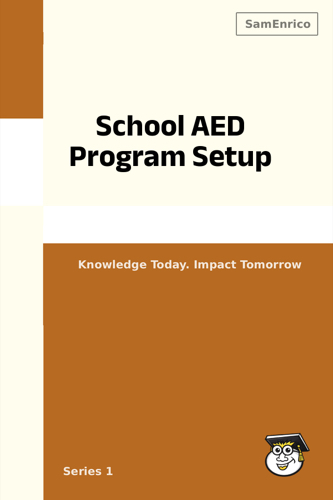
School AED Program Setup eBook
Teaches placement near gyms, staff training ratios
Teaches placement near gyms, staff training ratios, and student awareness for K12 schools.
Formats
Free sample
Chapter 1: The Hidden Epidemic...--It begins like a hundred other school days. The bell rings. Backpacks zip. Hallways fill with the sound of sneakers on tile and the low hum of teenage conversation. In the cafeteria, a sophomore bites into a sandwich.
On the gym floor, a freshman runs suicides during basketball tryouts. In the third-floor science lab, a senior leans over a microscope, squinting at a slide. Nothing seems unusual. Nothing feels dangerous. And yet, somewhere in America today—probably in a school very much like yours—a child’s heart will stop beating.Not because of a car crash.
Not because of a drug overdose. Not because of a fight or a fall from the monkey bars. But because, for reasons that often remain a mystery even to doctors, the electrical system of a young heart suddenly malfunctions. Within seconds, that child collapses. Their eyes may roll back.
Their breathing becomes irregular or stops altogether. They are, in that moment, in sudden cardiac arrest.Here is what most parents and principals do not know: sudden cardiac arrest is not a rare, freak event that happens only to aging adults with clogged arteries. It is, in fact, a leading cause of death in school-aged children. Approximately 7,000 children suffer sudden cardiac arrest in the United States every single year. That number rivals pediatric cancer deaths.
It dwarfs deaths from fires, drownings, and choking combined. And yet, if you walk into the average American school, you will find a fire extinguisher on every wall, a smoke detector in every hallway, and a detailed evacuation plan posted in every classroom. You will not reliably find an Automated External Defibrillator, or AED—the only device that can restart a heart once it has stopped.This chapter exists to change that. It will lay out, in stark and unflinching terms, the true scale of the problem, the myths that have allowed schools to remain unprepared, and the moral and practical case for treating cardiac arrest with the same urgency we treat a fire. By the end of this chapter, you will understand why your school needs an AED program not as a “nice to have” but as a “must have.” You will also understand that this book is not a theoretical exercise.
It is a survival manual. And the first step to survival is admitting that the threat is real.The Number That Should Keep Every Principal Awake Let us begin with the data, because data cuts through fear and replaces it with clarity. Every year, the American Heart Association, the Centers for Disease Control and Prevention, and the National Institutes of Health track the incidence of out-of-hospital cardiac arrests. For adults, the numbers are staggering—over 350,000 annually. For children, the numbers are smaller but no less devastating.
Between 5,000 and 7,000 children experience sudden cardiac arrest outside of a hospital setting each year. The majority of these events—nearly 40%—occur at school or during school-sponsored athletic activities.Pause on that number for a moment. Forty percent. That means that when a child’s heart stops, there is nearly a one-in-two chance that it will happen on a campus where adults are present, where help is theoretically close, and where an AED could mean the difference between life and death.But here is where the numbers turn tragic. The survival rate for out-of-hospital cardiac arrest in the general population hovers between 8% and 10%.
That means nine out of ten people who collapse will not survive. However, when a person collapses in a location with a functioning AED program—including trained responders, a coordinated response plan, and equipment that is actually accessible—survival rates soar to 70% or higher. Let me repeat that: seventy percent. That is not an incremental improvement. It is a paradigm shift.
It is the difference between a school sending a child home in an ambulance and sending that same family to a funeral home.How can AEDs produce such dramatic results? The answer lies in the biology of cardiac arrest. When the heart enters a fatal rhythm known as ventricular fibrillation, it is not actually “stopped” in the way most people imagine. It is quivering, like a bowl of jelly. It is not pumping blood.
But it can be reset. The only thing that resets it is a controlled electrical shock delivered by an AED. For every minute that passes without defibrillation, the chance of survival drops by 7% to 10%. After ten minutes, survival is nearly impossible. This is why the American Heart Association mandates that defibrillation occur within three to five minutes of collapse.
This is why seconds matter. This is why a locked cabinet, a missing battery, or an untrained staff member is not an inconvenience—it is a death sentence.The Myth of the Athlete If you ask the average person to picture a child suffering sudden cardiac arrest, they will likely describe a basketball player collapsing during a game, or a football player going down after a hard hit. This image has been seared into the public consciousness by heartbreaking news stories. In 2023, Buffalo Bills safety Damar Hamlin collapsed on national television during a Monday Night Football game, and millions watched as CPR and an AED saved his life. That moment was a watershed for public awareness of cardiac arrest.
But it also reinforced a dangerous misconception: that cardiac arrest is primarily a threat to athletes in the middle of intense exertion.The research tells a very different story. Multiple peer-reviewed studies have examined the locations and activities associated with pediatric sudden cardiac arrest. The findings are consistent and surprising. While organized sports account for a significant number of events—roughly 30% to 35%—the majority occur during non-strenuous activities. Children collapse while sitting in class.
They collapse while walking between periods. They collapse in the cafeteria, in the library, in the bathroom, on the bus. They collapse at home watching television, at the movie theater with friends, and in the grocery store with their parents.Why does this matter for schools? Because it means that focusing your AED program exclusively on the gymnasium and the football field is a fatal error. The student most at risk may not be the star quarterback wearing a jersey.
It may be the quiet freshman in the back of third-period history class. It may be the eighth-grader eating lunch alone. It may be the kindergartener sitting on the carpet during story time.One study published in the journal Circulation examined 2,500 cases of sudden cardiac arrest in individuals under 18. The researchers found that only 31% occurred during sports or exercise. The remaining 69% occurred during rest, sleep, or light activity.
Another study from the United Kingdom found that nearly 60% of pediatric cardiac arrests happened in educational settings, but only a minority of those were in gymnasiums or athletic fields. Classrooms, hallways, and common areas accounted for the majority.This is not to say that athletes are not at risk. They are. Hypertrophic cardiomyopathy, a genetic condition that thickens the heart muscle, is more likely to cause arrest during exertion. But the broader point is that risk is not confined to the athletic arena.
A school that places its only AED in the gymnasium is like a fire department that only responds to fires…
This is the end of the free sample. Get the eBook to keep going. Buy now
About this book
Details
- Author
- Spalding Charles
- Publisher
- SamEnrico
- Language
- English
- Genre
- Non-Fiction, Health & Wellness, School Health
- Released
- 2026-06-05
- Pages (approx.)
- 144
- Available as
- eBook, Audiobook

Read better in the ZLOADR app
Your eBooks on your phone or tablet. Sign in with your SamEnrico account and start reading.
More by Spalding Charles
 Hair Loss and Testosterone GuideSpalding Charles$11.99
 Submariner Silent Service TalesSpalding Charles$11.99
 The Remote Feedback CultureSpalding Charles$11.99
 Tips of the Spear: Tipu Sultan's Green ResistanceSpalding Charles$11.99
 Bore SurfingSpalding Charles$11.99
 UK Business Credit BrokerSpalding Charles$12.99
 How to Produce BoardsSpalding Charles$11.99
 How to Start a Bending Machines (metal Forming) Business (Beginners Guide)Spalding Charles$11.99