
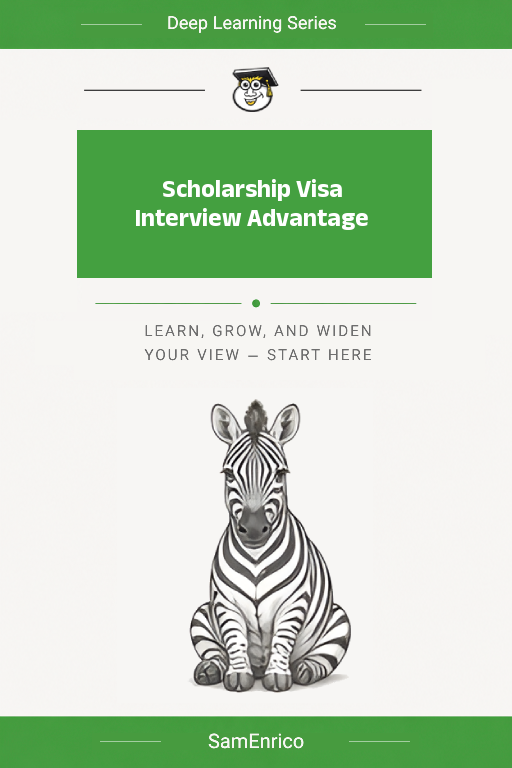
Scholarship Visa Interview Advantage eBook
Highlight fully funded awards to automatically dem
Highlight fully funded awards to automatically demonstrate financial sufficiency and academic merit.
Formats
Free sample
Chapter 1: The Golden Ticket...--Every year, nearly one million international students sit for visa interviews across the globe. They dress in their best clothes, arrive three hours early, and clutch folders stuffed with bank statements, property deeds, and affidavits of support. They have been told that the interview is a test of documentation—that if they can just prove they have enough money, the visa will be theirs.They are wrong.Not partially wrong. Not slightly misguided. Fundamentally, strategically wrong.I have watched students with 200,000inliquidsavingswalkoutofembassydoorswithadenialstampburningintheirmemory.And Ihavewatchedstudentswitha200,000 in liquid savings walk out of embassy doors with a denial stamp burning in their memory.
And I have watched students with a 200,000inliquidsavingswalkoutofembassydoorswithadenialstampburningintheirmemory.And Ihavewatchedstudentswitha25,000 scholarship—barely enough to cover basic expenses—walk out with an approval, smiling and confused about why their wealthy counterpart was rejected.The difference was never the amount of money. The difference was the source of validation.This chapter dismantles the single most destructive myth in visa preparation: that all funds are created equal. It introduces the concept that will become the foundation of every strategy in this book—the Third-Party Validation Effect—and reveals why your scholarship is not just financial aid but a psychological weapon that changes the entire dynamics of your interview.By the time you finish this chapter, you will understand why the visa officer's first question is never about money and always about trust. And you will never prepare for a visa interview the same way again.The Million-Dollar Mistake Let me tell you about Maria. (Her name has been changed, but her story is real, and it is documented in the visa refusal records of a South American embassy.)Maria had been accepted to a master's program in public health at a respected American university.
Her family was wealthy by any standard—they owned a chain of pharmacies in Bogotá. For her visa interview, Maria's father liquidated nearly $80,000 in assets and deposited the money into her personal bank account. He also provided property deeds for two buildings, a letter from their family accountant, and five years of tax returns.Maria walked into the embassy confident. She had more money than the university's estimated cost of attendance by a factor of two. She had home ties—a family business, property, siblings still in Colombia.
She had done everything the internet forums told her to do.The visa officer asked three questions. "Who will pay for your education?" Maria answered, "My father. Here are his bank statements." The officer glanced at the documents for approximately eight seconds. Then he asked, "What does your father do?" Maria explained the pharmacy business. Finally, he asked, "Do you plan to return to Colombia?"Maria said yes.
She meant it.The officer typed for thirty seconds. Then he handed her a white slip of paper: 214(b) denial. Failure to demonstrate sufficient ties to the home country.Maria was devastated. She had done everything right—or so she thought.Now consider Raj. (Also a pseudonym, also a real case from the same year, different country.)Raj had been accepted to a Ph D program in chemical engineering.
His funding came from a modest university fellowship—25,000peryear,plustuitionwaiver.Hehadnofamilywealth.Hisparentswereschoolteachersinasmall Indiancity.Hispersonalsavingstotaledlessthan25,000 per year, plus tuition waiver. He had no family wealth. His parents were schoolteachers in a small Indian city. His personal savings totaled less than 25,000peryear,plustuitionwaiver.Hehadnofamilywealth.Hisparentswereschoolteachersinasmall Indiancity.Hispersonalsavingstotaledlessthan4,000.But Raj had something Maria did not. His scholarship letter came on official university letterhead.
It stated, in explicit terms, that he had been selected through a competitive process. It named the fellowship—the Dean's Excellence Award—and noted that fewer than 5% of applicants received it.When the visa officer asked, "Who will pay for your education?" Raj answered differently. He said, "I am funded by the Dean's Excellence Award at the University of [Name]. It's a competitive university fellowship awarded to less than 5% of applicants. It covers my full tuition and provides a living stipend for five years."The officer asked one follow-up question about Raj's research interests.
Then he approved the visa.Two students. Two vastly different financial profiles. The one with less money got the visa. The one with a fully funded scholarship—even a modest one—walked out approved.Why?Because Maria was trying to prove she had money. Raj was proving someone else had already vetted him.This is the Third-Party Validation Effect, and it is the most underutilized advantage in visa strategy.The Third-Party Validation Effect: A Complete Definition The Third-Party Validation Effect is simple to state but profound in its implications: An endorsement from a trusted, established institution carries exponentially more weight in a visa interview than any personal documentation, regardless of the dollar amount involved.Let me break this down into its component parts.First, who qualifies as a "trusted, established institution"?
In order of decreasing power:Sovereign governments (the Fulbright program, Chevening, DAAD, the China Scholarship Council). These carry the highest weight because they represent bilateral diplomatic relationships.Major universities (through named fellowships, presidential scholarships, or Dean's awards). These carry the second-highest weight because universities have their own reputational risk.Recognized foundations and corporations (the Gates Foundation, Rhodes Trust, major multinational sponsors). These carry significant weight but may require additional explanation if the brand is unfamiliar to the visa officer.Academic departments (through TA-ships or RA-ships). These carry moderate weight but are still superior to personal funds.Notice what is not on this list: your family, your friends, your personal savings, your property, your business.
These are not "trusted institutions" in the eyes of a visa officer. They are you—or people connected to you. And you, dear reader, are not an objective validator of your own financial stability.Second, why does third-party validation matter more than money? The answer lies in the visa officer's operational reality.A typical consular officer processes between 150 and 300 visa interviews per day. That means they have between two and four minutes per applicant—often less.
In that time, they must make a determination about whether you are likely to overstay your visa or become a public charge.They cannot investigate your family's business. They cannot verify your father's income. They cannot audit your property deeds. They can only scan documents and make a judgment call.But when they see a scholarship from a recognized institution, their job changes. They do not need to verify the funds.
They only need to verify that the scholarship is real. And that verification takes approximately ten seconds: a quick glance at the letterhead, a check against known programs, and a decision to trust the institution that already vetted you.The scholarship has done their work for them.Third, what makes third-party validation so psychologically powerful? It shifts the officer's mental frame from "investigate" to "facilitate."A visa officer looking at personal bank statements is looking for reasons to say no. They are searching for inconsistencies, recent large deposits, signs that the money is borrowed or temporary. Their default assumption is that personal documentation may be fraudulent or misleading.A visa officer looking at a government scholarship is looking for reasons to say yes.
The scholarship itself is proof of legitimacy. The officer's default assumption becomes that the applicant has already been vetted and…
This is the end of the free sample. Get the eBook to keep going. Buy now
About this book
Details
- Author
- Graves Emanuel
- Publisher
- SamEnrico
- Language
- English
- Genre
- Non-Fiction, Student's Shortcut
- Released
- 2026-06-01
- Pages (approx.)
- 155
- Available as
- eBook, Audiobook

Read better in the ZLOADR app
Your eBooks on your phone or tablet. Sign in with your SamEnrico account and start reading.
More by Graves Emanuel
 Geo Arbitrage for Sales ProfessionalsGraves Emanuel$11.99
 Scripting MetaphorsGraves Emanuel$11.99
 Vocal Persuasion GuideGraves Emanuel$11.99
 IBS Colonoscopy Preparation GuideGraves Emanuel$11.99
 Managing Interruptions for Parents HandbookGraves Emanuel$11.99
 The Rapid Planning MethodGraves Emanuel$11.99
 The Freelance Family Time BalanceGraves Emanuel$11.99
 Shin Splints Prevention and RecoveryGraves Emanuel$11.99
 Navigating Car Wash TunnelsGraves Emanuel$11.99
 The Great Bitcoin Heist: How 1,000,000 Coins Vanished OvernightGraves Emanuel$11.99
 The Viking Geometer: Lost in the Ice and Found in the StarsGraves Emanuel$11.99
 The Sky Splitter: How a 1908 Asteroid Nearly Ended the WorldGraves Emanuel$11.99
You may also like
 LSE Online Program LengthAgee Letisha$11.99
 Harvard Extension School for Working AdultsRoush Yer$11.99
 LSE Online Reading ListAshford Ludivina$11.99
 LSE Online Language RequirementsWhitten Daphine$11.99
 LSE Online Class SizeHughey Garret$11.99
 LSE Online Alumni MentorshipWild Lyla$11.99
 London School of Economics Alumni NetworkDutton Chantal$11.99
 Harvard Extension School Student SupportCantrell Christene$11.99
 Harvard Extension School Library AccessSantana Adah$11.99
 Harvard Extension School Degree CompletionBray Wyatt$11.99
 Harvard Extension School Course AuditingAbbott Craig$11.99
 Harvard Extension School Extension DiplomaNew Joane$11.99