
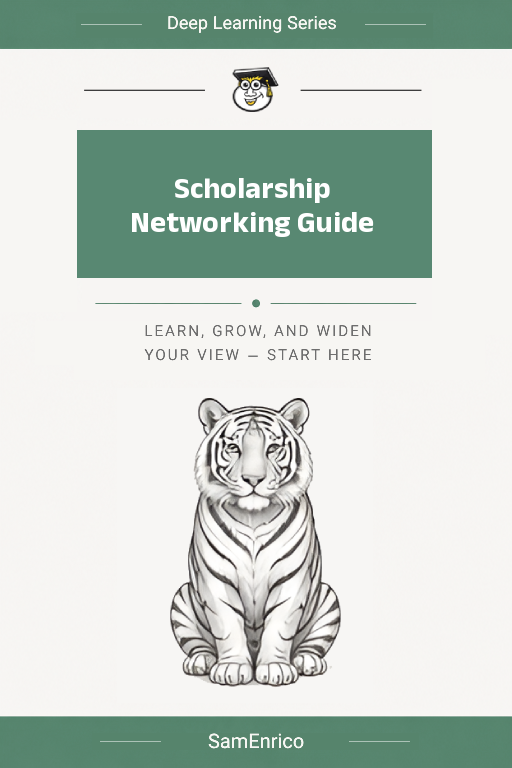
Scholarship Networking Guide eBook
Connect with past African recipients for mentorshi
Connect with past African recipients for mentorship and tips.
Formats
Free sample
Chapter 1: The Lonely Genius Myth--–- The email arrived at 11:47 PM on a Tuesday. Adaeze, a brilliant final-year engineering student in Lagos, had spent eighteen months applying for scholarships. She had a first-class degree, three published conference papers, and a perfect IELTS score. She had also been rejected seventeen times. The email was her eighteenth rejection.
“We regret to inform you...” The words blurred as she stared at the screen. She had done everything right. She had followed every guide, checked every box, and worked harder than anyone she knew. But she had made one catastrophic mistake: she had tried to do it alone.This chapter is for every Adaeze who has ever believed that scholarships are won by solitary geniuses locking themselves in rooms and grinding out perfect applications. That belief is the most expensive myth in international education.
It costs aspirants years of rejections, thousands of dollars in application fees, and immeasurable amounts of hope. The truth is radically different and far more accessible: competitive scholarships are not won by individuals. They are won by networks.The Hidden Curriculum of Competitive Funding Every year, millions of talented African students apply for scholarships to study locally and internationally. A fraction of one percent succeed. The standard explanation is that these scholarships are simply too competitive—too many applicants, too few slots.
But that explanation misses something crucial. Ask any successful scholar how they won, and they will tell you about a conversation, an introduction, a mentor who reviewed their personal statement at 10 PM, or an alumnus who told them which section of the application actually mattered. These are not coincidences. They are evidence of a hidden curriculum.The concept of a “hidden curriculum” comes from education research. It refers to the unwritten, unofficial, and often unspoken lessons, values, and perspectives that students must learn to succeed—but which are nowhere in the official materials.
For scholarships, the hidden curriculum includes questions like: How do funders actually read applications? Which sections are weighted more heavily than the guidelines admit? What kind of language signals “low risk” versus “high risk” to a selection committee? What mistakes get applications automatically filtered out? None of this is published.
All of it is passed through relationships.Let us be precise about what the hidden curriculum is not. It is not secret evaluator rubrics. No mentor has ever stolen a confidential scoring sheet from a scholarship committee, and any claim otherwise should be treated with extreme skepticism. What mentors possess is something different but equally valuable: experiential knowledge. They have sat on the other side of the process.
They have seen patterns across multiple application cycles. They have talked with fellow recipients about what worked and what failed. They have made mistakes you can avoid. That knowledge is not infallible—selection committees change, priorities shift, and what worked three years ago may not work today. But it is infinitely better than navigating the process blind.Consider the difference between reading a recipe online and learning to cook from your grandmother.
The recipe gives you ingredients and steps. Your grandmother tells you that the oven runs hot, that you should ignore the baking time and watch for the color change, that adding a pinch of salt makes the difference even though it is not listed. She shows you what success looks like in real time. That is the difference between official scholarship guidelines and mentorship. The guidelines tell you what to submit.
Mentors tell you how to win.The Three Pillars of Scholarship Success Through analyzing hundreds of successful scholarship applications from African students and interviewing scholarship ambassadors across multiple funding bodies, a clear pattern emerges. Success rests on three interdependent pillars. These are not secrets, but their relationship to one another is almost always misunderstood.The first pillar is mentorship. This is the relational infrastructure that connects aspirants to those who have already walked the path. Mentorship is not about having someone hold your hand through every step.
It is about targeted, efficient access to the hidden curriculum at critical moments: before you choose which scholarships to apply for, before you finalize your personal statement, before you submit your application, and after you receive a decision. A single hour with the right mentor can save you three months of trial and error.The second pillar is portfolio. This is the tangible evidence you create that demonstrates you are worth investing in. Many aspirants believe their grades and test scores are their portfolio. They are wrong.
Grades prove you can follow instructions and perform under controlled conditions. Scholarships, especially competitive ones, fund people they believe will change the world. Grades do not prove that. A portfolio includes volunteer work that shows leadership, online courses that show intellectual curiosity beyond your degree, writing samples that show clarity of thought, and projects that show initiative. The portfolio is what mentors look at when they decide whether to invest their limited time in you.The third pillar is timing.
This is the most underrated and most destructive element. Scholarships operate on cycles that are often invisible to outsiders. There are moments when mentors are available (before their own deadlines, not during exam periods). There are moments when applications are being reviewed (when you can no longer change anything). There are moments when you should reach out (three months before the deadline, not three days).
Timing is not luck. It is a skill you can learn by understanding the rhythms of academic calendars, funding cycles, and the lives of busy professionals.Here is what almost no one tells you: networking is the engine that drives all three pillars. You cannot find mentors without networking. You cannot learn what belongs in your portfolio without mentors telling you what actually impresses committees. You cannot understand timing without conversations with people who have lived through the cycles.
Networking is not a separate activity you do after you have prepared your application. It is the preparation.The Cost of Going It Alone Let us return to Adaeze. Her eighteen rejections were not random bad luck. When she finally connected with a senior scholar from her university who had won the very scholarship she kept failing to get, the mentor asked to see her application materials. Within fifteen minutes, the mentor identified four fatal flaws.
Her personal statement was written for a general audience when it should have been written for a technical committee. Her letters of recommendation came from lecturers who knew her grades but not her character because she had never built relationships with them. She had applied to scholarships for which she was objectively qualified but poorly matched culturally. And she had submitted every application on the deadline day, guaranteeing that no last-minute errors could be caught by fresh eyes.None of these flaws were visible in the official guidelines. None of them required extraordinary intelligence to fix.
But Adaeze could not see them because she was inside her own application. She needed someone on the outside who had been through the process before. The mentor spent forty-five minutes on a Zoom call with her. The next cycle, she won three scholarships.This is not an exceptional story. It is the normal pattern…
This is the end of the free sample. Get the eBook to keep going. Buy now
About this book
Details
- Author
- Levesque Arnulfo
- Publisher
- SamEnrico
- Language
- English
- Genre
- Non-Fiction, Student's Shortcut
- Released
- 2026-05-30
- Pages (approx.)
- 140
- Available as
- eBook, Audiobook

Read better in the ZLOADR app
Your eBooks on your phone or tablet. Sign in with your SamEnrico account and start reading.
More by Levesque Arnulfo
 Rejection Sensitivity Love GuideLevesque Arnulfo$11.99
 Being Late TriggersLevesque Arnulfo$11.99
 The Everyday ImposterLevesque Arnulfo$11.99
 Child Nightmare GuideLevesque Arnulfo$11.99
 Teen Adoption Identity GuideLevesque Arnulfo$11.99
 Sabbatical Programs ImpactLevesque Arnulfo$11.99
 Pet Loss Poetry AnthologyLevesque Arnulfo$11.99
 Fibromyalgia and CostochondritisLevesque Arnulfo$11.99
 Condoleezza Rice PianoLevesque Arnulfo$11.99
 The Celestial Cartographers: How 15th-Century Southeast Asians Charted the MoonLevesque Arnulfo$11.99
 The Bone-Eater of the Andes: The Curse of the YacumamaLevesque Arnulfo$11.99
 Silent Saboteurs: The Betrayal of the Tuskegee AirmenLevesque Arnulfo$11.99
You may also like
 LSE Online Program LengthAgee Letisha$11.99
 Harvard Extension School for Working AdultsRoush Yer$11.99
 LSE Online Reading ListAshford Ludivina$11.99
 LSE Online Language RequirementsWhitten Daphine$11.99
 LSE Online Class SizeHughey Garret$11.99
 LSE Online Alumni MentorshipWild Lyla$11.99
 London School of Economics Alumni NetworkDutton Chantal$11.99
 Harvard Extension School Student SupportCantrell Christene$11.99
 Harvard Extension School Library AccessSantana Adah$11.99
 Harvard Extension School Degree CompletionBray Wyatt$11.99
 Harvard Extension School Course AuditingAbbott Craig$11.99
 Harvard Extension School Extension DiplomaNew Joane$11.99