
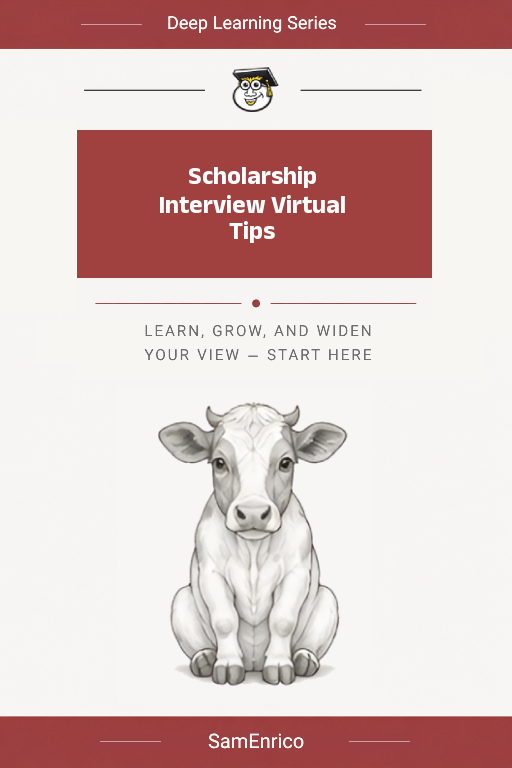
Scholarship Interview Virtual Tips eBook
Prepare for Zoom interviews with stable internet,
Prepare for Zoom interviews with stable internet, professional background, and clear audio from Africa.
Formats
Free sample
Chapter 1: Your Living Room Boardroom--The moment you receive that email invitation—the one with the scholarship panel’s name in the sender line and a Zoom link in the body—your heart rate doubles. You read it once, then again, searching for clues. The interview is scheduled. The judges are real people with names you can Google. And somewhere between the rush of “I made it to the final round” and the cold realization that you will be broadcasting from your bedroom, your living room, or a corner of a shared house, a familiar fear begins to crawl up your spine.Will they see the zinc roof?
Will they hear the generator? Will they notice that I don’t have a study with leather-bound books and a window overlooking a garden?This chapter is not about what to say during your interview. That comes later. This chapter is about something more foundational: the battle between your ambition and your environment. It is about the lie that says your surroundings disqualify you before you speak—and the truth that says scholarship judges are not interior designers.
They are investors in human potential. And the candidate who can deliver brilliance from a humble room is often more impressive, not less.But let us be clear. This is not permission to be sloppy. You cannot show up with a tangled bedsheet behind you, a shadow across your face, and the sound of a television blaring from the next room and expect sympathy. What you need is something more sophisticated: a framework for turning your actual space into a credible, professional, and even memorable virtual boardroom.
You need what we will call Contextual Professionalism.The Psychology of the Virtual Boardroom Before we adjust a single camera angle, we must address the invisible barrier that stops more African candidates than any technical limitation: imposter syndrome filtered through environment.The standard scholarship guides—the bestsellers by Tanabe & Tanabe, the Ivy League interview prep books, the HR manuals written for corporate America—all assume a certain baseline. They assume you have a quiet, private room. They assume you have a desk that is not also a dining table. They assume the biggest distraction you face is a stack of papers or a coffee mug. These books were not written with you in mind.
That is not a criticism of those books. It is simply a fact. And it is the reason this book exists.Here is what those books get right: interview anxiety is universal. It stems from perceived power asymmetry. The judges hold the funding; you hold the dream.
That dynamic creates a natural psychological disadvantage. You want something from them, so you feel smaller.Here is what those books miss: for the African candidate, that asymmetry is amplified by visible difference. A candidate from Boston might worry about a messy desk. You might worry about a zinc roof. A candidate from London might worry about their cat walking across the keyboard.
You might worry about a rooster crowing at exactly the wrong moment. A candidate from Sydney might worry about their expensive microphone picking up echo. You might worry that your only microphone is the one built into your phone.But here is the reframe that changes everything: virtual interviews fundamentally alter the power dynamic. When you walk into a physical interview room, you are a visitor in their territory. The furniture, the artwork, the receptionist, the carpet—all of it signals that you are the outsider seeking entry.
On a Zoom call, that dynamic inverts. You are no longer a visitor. You are the host of your own digital boardroom. The judges are entering your frame. They see your wall, your lighting, your choice of background.
That shift—from supplicant to host—is psychological gold if you know how to use it.Consider this: when a judge joins a Zoom call and sees a candidate who has clearly made an effort—who has positioned themselves against a clean wall, who has found good light, who has minimized background noise—the judge thinks, This person is serious. This person respects the process. When a judge joins and sees a candidate who appears not to have noticed their surroundings, the judge thinks, This person did not prepare. Notice that the judge does not think, This person is poor. They think, This person is unprepared.
That distinction is everything.Your goal is not to pretend you have resources you do not have. Your goal is to demonstrate that you have maximized the resources you do have. A candidate with a 50phoneanda50 phone and a 50phoneanda5 pair of earbuds who has carefully framed their shot and tested their audio will almost always outperform a candidate with a $2,000 laptop and fiber internet who has given no thought to lighting or background. Resourcefulness is the skill. Preparation is the signal.
Your environment, properly managed, becomes evidence of both.The Fear That Your Reality Will Disqualify You Let us name the fear directly. It is not a small fear. It is a loud, insistent, humiliating fear that whispers: They will see where you really come from. They will hear the poverty. They will dismiss you before you open your mouth.This fear has a name in psychology: environmental imposter syndrome.
It is the specific anxiety that your physical surroundings will betray you. It is what you feel when you look at your video preview and see the crack in the wall behind you, the visible laundry in the corner, the bed that doubles as a couch. It is what you feel when you hear the generator kick on two minutes before your scheduled start time.Here is what the research says—and you need to believe this: scholarship judges are significantly more forgiving of environmental constraints than candidates fear, provided the candidate demonstrates intentionality. A study of admissions officers across multiple scholarship programs found that judges rated candidates higher when they had clearly attempted to control their environment, even if the result was imperfect. A candidate with a visible bed but a framed shot that crops it out scores higher than a candidate with a perfect background who appears unaware of the camera.
Effort signals respect. Effort signals seriousness. Effort signals that you understand the stakes.The candidate who looks at their environment and does nothing signals the opposite. So the question is not whether your environment is perfect. The question is whether you have done something about it.Let me tell you about a candidate I will call Adaeze.
She was applying for a full scholarship to a university in Canada. She lived in a two-room house in Enugu that she shared with her mother and two younger siblings. Her interview was scheduled for 8 PM Nigerian time, which meant her family would be home. She had no study, no desk, no private space. Her only option was the corner of the living room, which had a visible crack in the wall, a shelf with cooking oil and spices, and a chair that wobbled.Adaeze could have panicked.
She could have apologized preemptively. She could have spent the interview distracted, waiting for the judge to notice the oil stains. Instead, she…
This is the end of the free sample. Get the eBook to keep going. Buy now
About this book
Details
- Author
- Troutman Celine
- Publisher
- SamEnrico
- Language
- English
- Genre
- Non-Fiction, Student's Shortcut
- Released
- 2026-05-30
- Pages (approx.)
- 135
- Available as
- eBook, Audiobook

Read better in the ZLOADR app
Your eBooks on your phone or tablet. Sign in with your SamEnrico account and start reading.
More by Troutman Celine
 Metta For All Beings GuideTroutman Celine$11.99
 Immigrant Beauty Brand Founder StoriesTroutman Celine$11.99
 Storm Before the CalmTroutman Celine$11.99
 African Independence SummaryTroutman Celine$11.99
 Empathy for Postpartum DepressionTroutman Celine$11.99
 Double Close Wholesaling MethodTroutman Celine$11.99
 Height Insecurity Self-EsteemTroutman Celine$11.99
 British Casualty FiguresTroutman Celine$11.99
 Conditional Love Fallout GuideTroutman Celine$11.99
 The Iron Kings of Meroë: Forging the Golden Age of KushTroutman Celine$11.99
 The Last Verdict: The Judge Who Ruled the Internet AgeTroutman Celine$11.99
 Into the Abyss: The Kayak Explorers of Europe’s Hidden UnderworldTroutman Celine$11.99
You may also like
 Hong Kong Handover 1997Dunn Johnnie$11.99
 Zumba For Postnatal Recovery CourseNeal Christian$11.99
 Zumba for BeginnersLadner Nikia$11.99
 YouTube Comment Mining GuideHumes Pandora$12.99
 Worry Box MeditationCarlin Rudy$11.99
 Workplace Stress MeditationNguyen Lynn$11.99
 Workplace Stress and Sleep RepairHawley Ivory$11.99
 Workplace Perfectionism CureDelaney Jeffry$11.99
 Workplace Injustice Anger GuideWallen Isabelle$11.99
 Work Addiction and Burnout LinkGreenwood Ester$11.99
 Women in Yoga and WellnessBeattie Galina$11.99
 Women in Stand Up ComedyChun Evangeline$11.99