
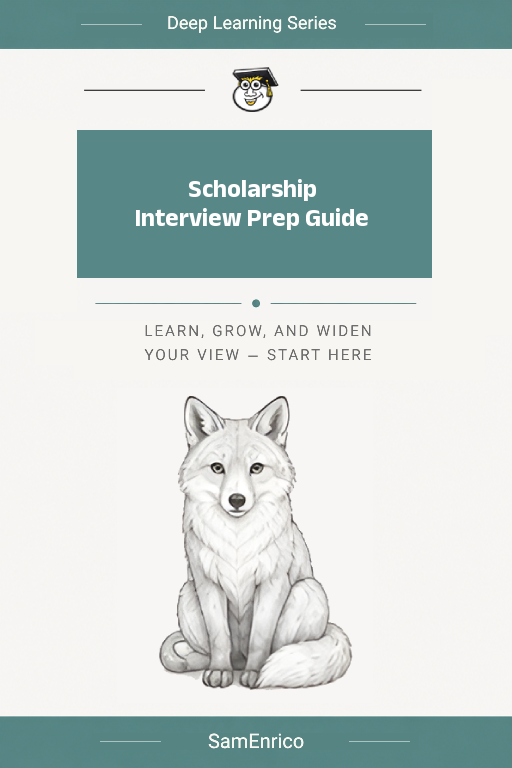
Non-FictionInterview GuideApplication Prep
Scholarship Interview Prep Guide eBook
Ace your funding interview with confidence. Practi
Ace your funding interview with confidence. Practice common questions and learn what scholarship panels seek from African candidates.
Formats
Free sample
Chapter 1: The Investment Paradox---- You have done everything right. Your grades are impeccable. Your essays have been reviewed by professors, mentors, and that one friend who never misses a grammatical error. Your recommendation letters glow with superlatives. You have the CV that admissions offices dream about.
And still, you are terrified. Not because you are unprepared, but because you have heard the stories. The first-class graduate who was rejected. The community leader who never got a callback. The candidate who walked out of the room knowing, with absolute certainty, that they had failed.This book exists because those stories are not random.
They follow patterns. And those patterns can be learned, practiced, and mastered.Let me tell you a different story. A few years ago, I worked with a candidate from rural Zimbabwe. She had good grades but not the best in her cohort. Her English was fluent but carried an accent she was self-conscious about.
She had never traveled outside southern Africa. On paper, she was not the obvious choice for a full scholarship to a top British university. But she got it. Not because of luck. Because she understood something that the candidates with better grades did not.
She understood that a scholarship interview is not an exam. It is an investment pitch. And she pitched herself as the best investment in the room.This chapter will teach you what she knew. By the time you finish reading, you will never look at a scholarship interview the same way again. You will stop preparing like a student and start preparing like a founder pitching venture capital.
And that shift, more than any single answer or technique, is what will separate you from the hundreds of other qualified applicants.The Fundamental Mistake Almost Everyone Makes Let us name the problem directly. The vast majority of scholarship candidates prepare for the interview as if it were a continuation of the application. They memorize their CV. They rehearse answers to common questions. They practice speaking slowly and clearly.
They worry about their accent, their grammar, and their posture. All of this is useful. None of it is sufficient. Because the interview is not asking the same questions as the application.The application asked: Are you qualified?The interview asks: Are you worth betting on?These are completely different questions. Qualification is about the past.
It is about degrees earned, exams passed, positions held. You can prove qualification with documents. Bet-worthiness is about the future. It is about what you will do with the opportunity, how you will grow, and whether you will make the scholarship provider proud. You cannot prove bet-worthiness with documents.
You can only demonstrate it through presence, clarity, and connection.This is what I call the Investment Paradox: The candidates who are most qualified on paper are often the worst at interviews because they believe their qualifications should speak for themselves. They walk into the room expecting to be rewarded for their past achievements. When the panel does not immediately recognize their brilliance, they become defensive, confused, or arrogant. Meanwhile, candidates with slightly weaker paper qualifications but stronger interview skills walk away with the funding.The paradox exists because qualifications are a threshold, not a ranking. Once you have passed the minimum bar, having a 4.0 GPA instead of a 3.8 does not matter nearly as much as you think.
What matters is how you make the panel feel about the future. And feelings are not created by CVs. They are created by stories, confidence, and the subtle art of making people believe in you.Why Panels Are Not Judges (And Why This Matters)Most candidates imagine the interview panel as a courtroom. The panelists are judges. The questions are cross-examinations.
The candidate is the defendant, trying to prove their innocence. This mental model is disastrous because it makes you defensive, reactive, and small.Here is the truth that will change everything: The panel wants you to succeed.Not because they are kind (though many are). Not because they are rooting for you personally (though some might be). But because their job is exhausting, and the easiest outcome for them is a candidate who is clearly excellent and clearly the right fit. They do not want to spend thirty minutes digging for your flaws.
They want to spend thirty minutes having their initial positive impression confirmed. They want to say yes. They want to go to lunch.When you understand this, your entire demeanor shifts. You stop trying to defend yourself against attacks that are not coming. You stop treating every question as a trap.
You start treating the interview as a collaboration. The panel is trying to understand you. You are trying to help them understand you. This is not an adversarial relationship. It is a matching process.Let me give you a concrete example.
Many candidates dread the question "What is your greatest weakness?" because they have been told it is a trick. They try to spin a strength as a weakness ("I work too hard") or deflect entirely. This makes the panel's job harder because they have to decide whether you are hiding something. A candidate who answers honestly, with a real weakness and a real plan for improvement, makes the panel's job easier. They think, "This person is self-aware.
This person is trustworthy. This person has done the work of reflection." That candidate gets the funding.The panel is not your enemy. They are your future partners. Treat them that way.The Three Currencies of Selection If the panel is an investment committee, what exactly are they investing in? What returns are they hoping to see?
Over years of analyzing scholarship interviews and interviewing panel members themselves, I have identified three distinct currencies that panels use to evaluate candidates. Every answer you give, every story you tell, every question you ask should generate at least one of these currencies. Ideally, all three.Currency One: Impact Impact is the most obvious currency. It answers the question: What will change in the world because of this scholarship? Panels want to fund candidates who will create measurable, positive change in their home countries, fields, or communities.
This does not mean you have to cure cancer or end poverty. It does mean you have to be specific about the problem you are solving and how your degree will help you solve it.A weak impact statement: "I want to help my community."A strong impact statement: "My community has a 30% maternal mortality rate because the nearest hospital is four hours away. I will use a Master's in Public Health to design and pilot a community health worker program that brings prenatal care to rural villages. Within five years of returning, I aim to reduce maternal mortality in my district by half."Notice the difference. The weak statement is a sentiment.
The strong statement is a plan with a metric. Impact is not about good intentions. It is about specific, achievable outcomes.Currency Two: Representation Representation is the currency that most candidates forget. It answers the question: What signal does selecting this candidate send? Every scholarship program has a brand and a narrative.
They want to tell stories about their scholars that inspire others to apply, that demonstrate their values, and that build…
This is the end of the free sample. Get the eBook to keep going. Buy now
About this book
Details
- Author
- Ireland Teisha
- Publisher
- SamEnrico
- Language
- English
- Genre
- Non-Fiction, Interview Guide, Application Prep
- Released
- 2026-06-01
- Pages (approx.)
- 149
- Available as
- eBook, Audiobook

Read better in the ZLOADR app
Your eBooks on your phone or tablet. Sign in with your SamEnrico account and start reading.
More by Ireland Teisha
 Metta for Academic BullyingIreland Teisha$11.99
 Peer Tutoring Stress Management WorkbookIreland Teisha$11.99
 The Pain Locus Of Control GuideIreland Teisha$11.99
 Retirement Account Beneficiary FormIreland Teisha$11.99
 The GPS Reroute Frustration GuideIreland Teisha$11.99
 The Last Stand of the Ming: Blood Letters from the Fall of NanjingIreland Teisha$11.99
 Licensed HairstylistIreland Teisha$11.99
 How to Become a Lay-out FormerIreland Teisha$11.99
 Wayfair SWOT LibraryIreland Teisha$12.99
 Understanding Neurocutaneous MelanosisIreland Teisha$17.99
You may also like
 Hong Kong Handover 1997Dunn Johnnie$11.99
 Zumba For Postnatal Recovery CourseNeal Christian$11.99
 Zumba for BeginnersLadner Nikia$11.99
 YouTube Comment Mining GuideHumes Pandora$12.99
 Worry Box MeditationCarlin Rudy$11.99
 Workplace Stress MeditationNguyen Lynn$11.99
 Workplace Stress and Sleep RepairHawley Ivory$11.99
 Workplace Perfectionism CureDelaney Jeffry$11.99
 Workplace Injustice Anger GuideWallen Isabelle$11.99
 Work Addiction and Burnout LinkGreenwood Ester$11.99
 Women in Yoga and WellnessBeattie Galina$11.99
 Women in Stand Up ComedyChun Evangeline$11.99