
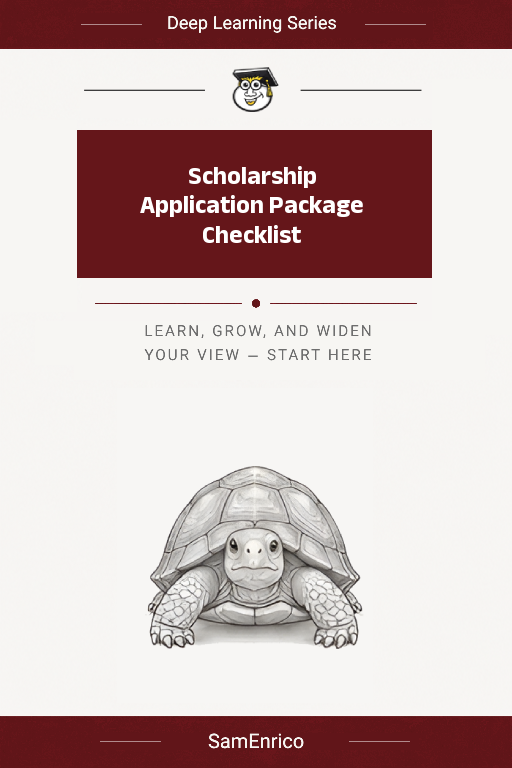
Scholarship Application Package Checklist eBook
Verify transcripts, test scores, recommendation le
by Fink Shavon
Verify transcripts, test scores, recommendation letters, and essays before submission deadlines.
Formats
Free sample
Chapter 1: The Silent Saboteur--–- You have already lost scholarships you never knew you applied for.Not because your grades were too low. Not because your essay was boring. Not because someone else had a richer resume or a more tragic backstory. You lost because of something far more mundane, far more invisible, and far more fixable than any of those things.You lost because of a typo. A mismatched name.
A file that wouldn’t open. A recommendation letter that arrived one hour late. A transcript that showed an "Incomplete" from a semester you thought you had explained elsewhere. A test score you self-reported as 720 when the official report said 702.These are not the dramatic failures that make for memorable rejection stories. They are the quiet, embarrassing, easily hidden errors that students carry with them like small, heavy stones.
Each one seems too trivial to mention. Each one, by itself, seems like bad luck. But together, they form a pattern. And that pattern has a name.It is called the Silent Saboteur.The Scholarship Lie Nobody Tells You Every year, billions of dollars in scholarship money go unclaimed. That is the statistic you have heard.
It is meant to inspire you. It is meant to make you think: All that money is sitting there, waiting for someone smart enough to reach out and take it.The statistic is true. But the implication is a lie.The money does not go unclaimed because students do not know about it. The money goes unclaimed because the students who do apply — millions of them, every year — submit applications that are immediately, silently, and permanently rejected. Not in the final round after careful consideration.
Not after a close call where the judges debated their merits late into the night.Rejected in the first sixty seconds.Scholarship judges, the ones who agreed to share their internal processes for this book, describe a grim ritual. On the first day of reading, they open a portal and see hundreds — sometimes thousands — of applications. They have exactly three weeks to select finalists. They are overworked, underpaid, and deeply skeptical.Their first pass is not a reading. It is a triage.They sort by the most basic signals of competence.
Did the student follow the file naming instructions? Did they upload a PDF or a corrupted Word document? Did they spell their own name consistently across the application and the transcript? Did they actually meet the minimum GPA requirement, or did they apply anyway hoping no one would notice?Sixty seconds per application. That is the average.
Sometimes less.If your application survives that first pass, it moves to the second round, where someone might actually read your essay. But if you fail the sixty-second test, no human being ever reads a single word you wrote. Your $50,000 dream dies in a folder called "Disqualified — Formatting."This is not a conspiracy. This is not unfair. This is the logical consequence of an application system that receives ten qualified applicants for every available award.
The judges are not looking for reasons to keep you. They are looking for reasons to eliminate you. And you are giving them those reasons, freely and unknowingly, every single time you submit.The "Good Enough" Trap Let us name the enemy.Most students operate under a mental model called "Good Enough." You finish your essay at 2 AM. You have proofread it twice. You are exhausted.
Your eyes are blurry. You tell yourself: It is good enough. They will understand what I meant.This is not laziness. This is biology.Cognitive psychology research has identified a phenomenon called "ego depletion." The theory, first proposed by social psychologist Roy Baumeister, suggests that self-control and decision-making draw from a limited resource. Every choice you make — what to eat for breakfast, whether to check your phone, how to phrase that sentence — depletes the same reservoir of mental energy.By the time you are finishing your scholarship application, that reservoir is empty.
You have made hundreds of decisions. You have edited, revised, worried, and second-guessed. Your brain is desperate to be done. And in that state, "Good Enough" feels like a victory.It is not a victory. It is a trap.The trap works like this: you convince yourself that the judges will be generous.
You imagine them reading your essay with patience, overlooking the missing comma, filling in the gaps where your logic jumps. You think: They will see how hard I tried. They will understand.They will not. They cannot. They have two hundred other applications to read.
The missing comma is not a small flaw to them. It is a signal that you do not care enough to re-read your own work. And if you do not care, why should they?The Psychology of Your Own Blindness Even when you genuinely try to be careful, your brain works against you. Three cognitive biases are particularly dangerous in scholarship applications.Confirmation Bias is the tendency to see what you expect to see. When you proofread your own essay, you are not really reading it.
You are remembering it. Your brain already knows what the words are supposed to say, so it projects that meaning onto the page, skipping over actual errors. This is why you can read "the the" three times without noticing the duplication. Your brain expects one "the," so it supplies one "the."The Familiarity Illusion is similar but more insidious. The more you read your own writing, the less your brain actually processes each word.
After the fifth read-through, you are essentially looking at a blank page. Your eyes move, but no new information enters. This is why students submit essays with missing words — words that existed in their heads but never made it to the page.The Dunning-Kruger Effect is the tendency for inexperienced individuals to overestimate their competence. In scholarship applications, this manifests as the belief that your verification process is sufficient when it is not. You have never been trained to catch these errors.
You do not know what you do not know. So you assume you are doing fine.These biases are not character flaws. They are features of human cognition. Every single applicant suffers from them. The difference between the students who win and the students who lose is not that winners are immune to cognitive biases.
It is that winners have built systems to compensate for those biases.They do not trust their brains. They trust their checklists.The Thirty-Second Test Before we go any further, I want you to run a small experiment.Open your most recent scholarship application. Not the one you are most proud of. The most recent one — the one you submitted when you were tired and just wanted to be done.Now look at the first page. Do not read for content.
Read for errors.Is your name spelled exactly the same way everywhere it appears?Does your email address have any typos? (A missing dot, an extra letter?)Is the scholarship name correct, or did you accidentally leave a placeholder from a different application?Are all the required fields filled, or did you skip something small assuming it was optional?Is your uploaded file named professionally, or does…
This is the end of the free sample. Get the eBook to keep going. Buy now
About this book
Details
- Author
- Fink Shavon
- Publisher
- SamEnrico
- Language
- English
- Genre
- Non-Fiction, Student's Shortcut
- Released
- 2026-06-01
- Pages (approx.)
- 123
- Available as
- eBook, Audiobook

Read better in the ZLOADR app
Your eBooks on your phone or tablet. Sign in with your SamEnrico account and start reading.
More by Fink Shavon
 Immigrant Trucking Business Success GuideFink Shavon$11.99
 ABCDE For Email ManagementFink Shavon$11.99
 Metta For Workplace KindnessFink Shavon$11.99
 Empathy for Body DysmorphiaFink Shavon$11.99
 Scorched GroundFink Shavon$11.99
 Being an Effective MenteeFink Shavon$11.99
 Bombay Army LoyaltyFink Shavon$11.99
 Tattoo and Piercing AcceptanceFink Shavon$11.99
 Workplace Assertiveness TrainingFink Shavon$11.99
 Archimedes' Eureka: The Birth of Mathematical BrillianceFink Shavon$11.99
 The Navigator of the Indian Ocean: Ibn Majid and the Secrets of the SeasFink Shavon$11.99
 Crowns and Chaos: The Royal Wedding That Shook a NationFink Shavon$11.99
You may also like
 Hong Kong Handover 1997Dunn Johnnie$11.99
 Zumba For Postnatal Recovery CourseNeal Christian$11.99
 Zumba for BeginnersLadner Nikia$11.99
 YouTube Comment Mining GuideHumes Pandora$12.99
 Worry Box MeditationCarlin Rudy$11.99
 Workplace Stress MeditationNguyen Lynn$11.99
 Workplace Stress and Sleep RepairHawley Ivory$11.99
 Workplace Perfectionism CureDelaney Jeffry$11.99
 Workplace Injustice Anger GuideWallen Isabelle$11.99
 Work Addiction and Burnout LinkGreenwood Ester$11.99
 Women in Yoga and WellnessBeattie Galina$11.99
 Women in Stand Up ComedyChun Evangeline$11.99