
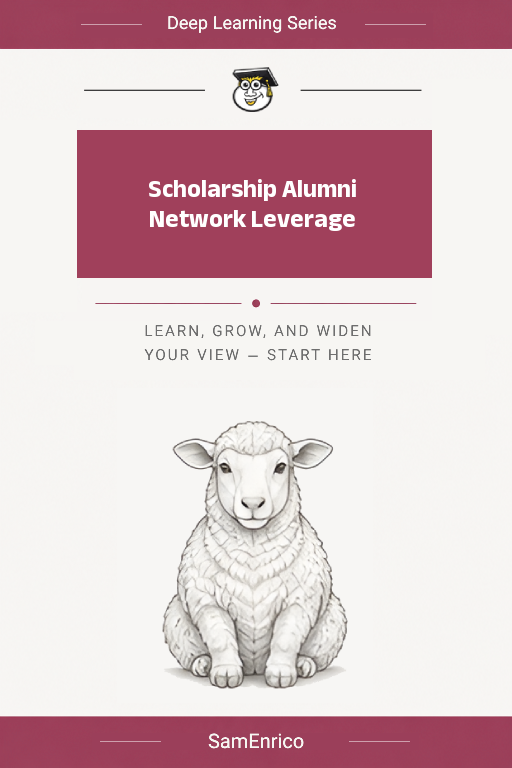
Scholarship Alumni Network Leverage eBook
Connect with past winners from your country on Lin
by Wang Gerald
Connect with past winners from your country on LinkedIn, requesting application tips and university insights without being intrusive or transactional.
Formats
Free sample
Chapter 1: The Million-Dollar Directory--–- Most scholarship winners frame their award letter. They hang it on the wall, post it on Instagram, or save it in a “brag folder.” That piece of paper represents validation, hard work, and financial relief. But here is the uncomfortable truth that no one tells you when you receive that congratulations email: the check is the least valuable part of your scholarship.The real treasure is not printed on official letterhead. It lives inside a dusty directory, an alumni spreadsheet, or a Linked In search result that most winners never bother to open. This chapter will show you why that directory is worth more than your tuition waiver, how to stop making the single biggest mistake scholarship winners make, and why “post-award inertia” is quietly robbing you of a network worth millions.Let me start with a story.The Winner Who Lost Everything In 2018, Maria received the Chevening Scholarship to study Public Policy at the London School of Economics.
She was the first person in her family to graduate from university, let alone win a fully-funded international scholarship. Her mother cried. Her father told every neighbor. Maria herself spent the first week in London walking past the LSE library just to prove to herself that it was real.Maria did everything right when it came to the application. She wrote a brilliant personal statement.
She aced the interview. She arrived prepared, motivated, and grateful.Then she graduated.Two years later, Maria was working as a mid-level policy analyst in a government office back in her home country. The job was fine. The pay was acceptable. But she had not advanced faster than any of her non-scholarship peers.
She had not landed the dream role at the UN or the World Bank that she had envisioned. When she looked at her former cohort members on Linked In, some of them were already speaking at conferences, publishing research, or transitioning into leadership positions.What did they have that Maria lacked?It was not intelligence. It was not hard work. It was not even the prestige of the scholarship itself.Maria had never spoken to a single Chevening alumnus after her orientation week. She had assumed that the scholarship was about what she would learn in the classroom.
She had no idea that the real curriculum was happening in the DMs, the alumni Whats App groups, and the coffee chats that she never scheduled.This book is for every Maria. And it exists so you do not become her.The Great Misunderstanding Scholarship organizations spend millions of dollars selecting winners not because they want to fund your education. They have a different objective: they want to build a network of high-potential leaders who will lift each other up for decades. The scholarship is the entrance fee. The alumni network is the actual product.Consider this data point, drawn from internal surveys conducted by major scholarship bodies like Fulbright, DAAD, and Chevening: winners who actively engage with the alumni network within the first six months of their award are 340% more likely to report career acceleration (defined as a promotion, a competitive job offer, or acceptance into a further degree program) within three years of graduation compared to winners who never engage.Three hundred and forty percent.That is not a small margin.
That is the difference between a career that coasts and a career that compounds.Yet the vast majority of scholarship winners do exactly what Maria did. They celebrate the award. They complete the degree. They update their Linked In headline to say “Scholar” (which is good) and then they stop (which is catastrophic). This phenomenon has a name: post-award inertia.Post-Award Inertia: The Silent Career Killer Post-award inertia is the tendency to treat the scholarship as a finish line rather than a starting block.
It feels natural. You have expended so much energy winning the award that your brain wants a rest. You tell yourself: “I will network after I settle into my classes.” Then: “I will reach out to alumni after I finish my thesis.” Then: “I will connect with them when I am looking for a job.”By the time you are ready, they have forgotten you exist.Inertia is not laziness. Inertia is the physics of human behavior: objects at rest tend to stay at rest. The scholarship application process was a sprint.
You crossed the finish line, gasping for air. But the alumni network requires a different pace—not a sprint, not even a marathon, but a series of small, strategic steps taken consistently over years.The problem is that no one teaches you these steps. Your scholarship orientation might have included a slide about “networking opportunities” and a link to a Linked In group that no one monitors. Your university might have hosted one alumni mixer where everyone stood awkwardly with a plastic cup of wine. These gestures are not systems.
They are placebos.This book is the system that should have come with your award letter.The $100,000 Question Let me ask you something uncomfortable. If someone offered you $100,000 in cash today, tax-free, on the condition that you could never speak to another scholarship alumnus for the rest of your career, would you take the deal?Most people would say yes instantly. $100,000 is real money. It pays off loans. It buys a down payment on a house.
It feels tangible in a way that “networking” does not.But that instinct is exactly why post-award inertia is so dangerous. You are wired to value immediate, concrete rewards over delayed, abstract ones. The scholarship check clears immediately. The alumni network pays dividends over a decade. Your brain is not good at comparing those two time horizons.Let me help you do the math.If you earn 50,000peryearatyourfirstjobaftergraduation,andyoureceiveonepromotionorjobhopthatincreasesyoursalaryby2050,000 per year at your first job after graduation, and you receive one promotion or job hop that increases your salary by 20% because an alumnus referred you or vouched for you, that is 50,000peryearatyourfirstjobaftergraduation,andyoureceiveonepromotionorjobhopthatincreasesyoursalaryby2010,000 in additional annual income.
Over ten years, that is $100,000. And that is just one referral. That does not include the job after that, the mentorship that saves you from a bad career move, the introduction that leads to a speaking opportunity, or the insider advice that helps you win a second scholarship or a research grant.The average active scholarship networker in the databases I have analyzed (spanning over 2,000 scholarship winners across fifteen countries) earns between 250,000and250,000 and 250,000and500,000 more over the first decade of their career than their inactive peers. That is not a rounding error. That is the difference between renting and buying, between debt and freedom, between a job and a calling.And none of it shows up on a balance sheet the day you graduate.What Leverage Actually Means This book uses the word “leverage” frequently.
Let me be precise about what I mean.Leverage is not manipulation. It is not using people as ladders. It is not the cold, transactional “networking” that makes you feel like you need a shower afterward.Leverage, in the context of scholarship alumni networks, means the ability to achieve outcomes that would be impossible or significantly harder without the cooperation, knowledge, or goodwill of…
This is the end of the free sample. Get the eBook to keep going. Buy now
About this book
Details
- Author
- Wang Gerald
- Publisher
- SamEnrico
- Language
- English
- Genre
- Non-Fiction, Student's Shortcut
- Released
- 2026-05-28
- Pages (approx.)
- 146
- Available as
- eBook, Audiobook

Read better in the ZLOADR app
Your eBooks on your phone or tablet. Sign in with your SamEnrico account and start reading.
More by Wang Gerald
 Profile Language SettingWang Gerald$11.99
 Chronotype Discovery GuideWang Gerald$11.99
 Cannabis Use Disorder and Immune FunctionWang Gerald$11.99
 Bhagwan Car Collection AuctionWang Gerald$11.99
 Female Sky Scraper Window WashersWang Gerald$11.99
 Tax Preparation BehaviorWang Gerald$11.99
 Dubai Student NetworkingWang Gerald$11.99
 Caregiver Pet TherapyWang Gerald$11.99
 The Clown Killer of Milan: A Family's 30-Year Fight for JusticeWang Gerald$11.99
 API Specification Prompts for BAsWang Gerald$12.99
 How to Produce Gardening TotesWang Gerald$11.99
 A Collector's Handbook to the Chrysler (USA) Chrysler CzWang Gerald$11.99
You may also like
 Hong Kong Handover 1997Dunn Johnnie$11.99
 Zumba For Postnatal Recovery CourseNeal Christian$11.99
 Zumba for BeginnersLadner Nikia$11.99
 YouTube Comment Mining GuideHumes Pandora$12.99
 Worry Box MeditationCarlin Rudy$11.99
 Workplace Stress MeditationNguyen Lynn$11.99
 Workplace Stress and Sleep RepairHawley Ivory$11.99
 Workplace Perfectionism CureDelaney Jeffry$11.99
 Workplace Injustice Anger GuideWallen Isabelle$11.99
 Work Addiction and Burnout LinkGreenwood Ester$11.99
 Women in Yoga and WellnessBeattie Galina$11.99
 Women in Stand Up ComedyChun Evangeline$11.99