
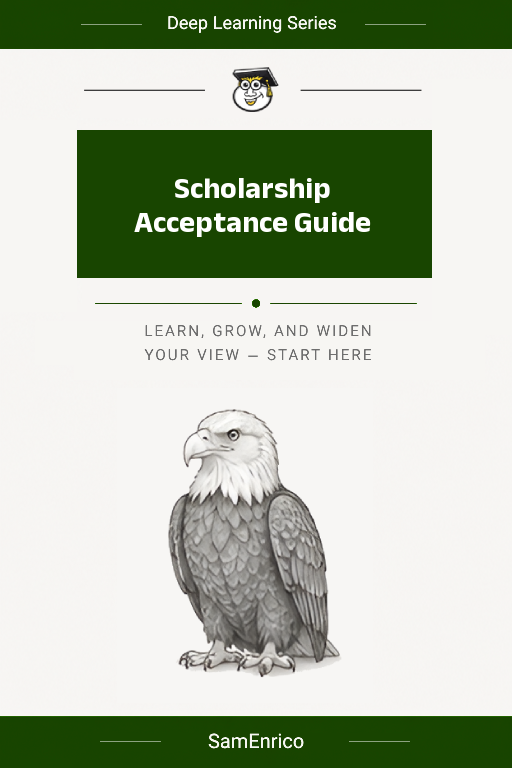
Non-FictionPost-Award GuideTransition Guide
Scholarship Acceptance Guide eBook
What to do when you win. Acceptance letters, negot
by Nagy Celine
What to do when you win. Acceptance letters, negotiations, and preparing for departure.
Formats
Free sample
Chapter 1: The Confetti Trap--–- Maya’s phone buzzed at 7:14 AM on a Tuesday. She was still in bed, half-asleep, when she saw the subject line: “Congratulations – Gates Scholarship Decision.” Her heart stopped. She opened the email, read the first sentence three times, and then screamed so loudly that her roommate fell out of bed. She had won. Forty thousand dollars per year.
Four years. Full ride. She called her mother, who cried. She texted her best friend, who sent back fifteen exclamation points. Then, still shaking, she did what almost every winner does: she opened Instagram.She took a screenshot of the email—the part that said “Congratulations”—cropped out the fine print at the bottom, and posted it with the caption “Blessed.
Hard work pays off. #Scholarship Winner #Gates Scholar #Blessed.” Within an hour, she had two hundred likes and forty comments. Within six hours, she had a direct message from a stranger: “Did you declare your volunteer position at the non-profit on your application? Because I just checked their website and you’re listed as a paid contractor, not a volunteer. That’s a conflict of interest.
I’ve forwarded this to the scholarship committee.”Within seventy-two hours, the scholarship was gone.Maya had violated the “no conflicting activities” clause buried on page four of the award letter she had not yet read. Her Instagram post—celebrating her victory—had provided the evidence. She did not lose because she was unqualified. She lost because she celebrated too fast, read too slowly, and trusted that winning was the end of the fight. It was not.
It was the beginning.This chapter is for everyone who does not want to be Maya.The First 72 Hours: A Window of Extreme Vulnerability Winning a scholarship triggers a neurochemical flood: dopamine (reward), cortisol (stress relief), and adrenaline (excitement). Together, they create a state of what psychologists call “post-win euphoria”—a temporary reduction in critical thinking and risk assessment. You are, quite literally, chemically impaired from making good decisions.The research on high-stakes winners (from lottery winners to Nobel laureates) shows a consistent pattern: the 72 hours following a major award are when winners are most likely to make irreversible mistakes. They sign contracts without reading them. They post on social media without considering consequences.
They call family members before calling their financial aid office. They assume the hard part is over.It is not. The hard part has just begun.Consider the data: according to a 2023 survey of 1,500 scholarship recipients conducted by the National Scholarship Providers Association, forty-three percent of winners experienced some form of funding disruption within the first ninety days. Of those, nearly half occurred within the first seventy-two hours. The most common causes?
Failure to report the award to the financial aid office (twenty-two percent), social media posts that triggered conduct reviews (eighteen percent), and signing acceptance letters before reading conditions (thirty-four percent).Seventy-two hours. That is the window in which most winners lose their awards. This chapter is designed to get you through those seventy-two hours alive, intact, and with your scholarship fully protected.The Emotional Whiplash: Why Winning Feels Terrifying Before we talk about strategy, we need to talk about psychology. Because if you do not understand what is happening inside your head, no checklist in the world will save you.Winning a scholarship produces a specific emotional profile that is surprisingly uncomfortable. Students expect pure joy.
What they often get is a confusing cocktail of:Imposter Syndrome. You read the acceptance letter and immediately think: “They made a mistake. I am not actually qualified. Someone else deserved this more.” This is not a sign of humility; it is a sign of cognitive distortion. Your brain is protecting you from the fear of being “found out.” But here is the truth: scholarship committees do not make mistakes.
They read hundreds—sometimes thousands—of applications. They deliberate for hours. If they chose you, you earned it. The imposter syndrome will fade, but only if you actively fight it. Say out loud, three times, “I earned this.” It feels absurd.
Do it anyway.Anticipatory Anxiety. You won, so why are you worried? Because now you have something to lose. Before the scholarship, you had nothing to lose but the application fee. Now you have forty thousand dollars dangling over your head, with conditions attached.
That anxiety is rational—but only if you channel it into action. Unchecked, it becomes paralysis.The Urge to Celebrate Publicly. This is the most dangerous emotion. You want validation. You want the world to know you won.
That is normal. But the scholarship committee does not care about your need for validation. They care about their rules. And their rules almost always include a “conduct clause,” a “confidentiality clause,” or a “no public disclosure without prior approval” clause. Posting your award letter on social media is like posting your bank account number on a billboard.
You are inviting trouble.Guilt. Some winners feel guilty about winning, especially if they know other qualified applicants who lost. This guilt often manifests as self-sabotage: delaying acceptance, failing to report the award, or “forgetting” to read the fine print because deep down, you feel you do not deserve the money. Recognize guilt for what it is—a useless emotion that helps no one. You deserve the scholarship.
Take it. Protect it.The “Hustle Hangover.” You have been grinding for months—essays, interviews, recommendation letters, deadlines. Suddenly, the grind stops. The silence is deafening. Many winners feel lost without the next application to complete.
This is the hustle hangover, and it leads to one of two bad outcomes: either you fill the void with reckless celebration (social media, oversharing) or you fill it with unnecessary anxiety (re-reading the application for mistakes). Neither helps. The solution is to replace the hustle with a new mission: protecting the award.The 72-Hour Action Plan: What to Do, In Order The following is a minute-by-minute, hour-by-hour plan for the first seventy-two hours after receiving your scholarship acceptance letter. Follow it exactly. Do not improvise.Hour 0-1: The Silent Scream When you first see the “Congratulations” email, your first instinct will be to scream, cry, or call your mother.
Do not do any of those things yet. Instead:Read the entire email twice. Not once. Twice. The first read is for emotion.
The second read is for information. Pay attention to the subject line, the sender’s email address (is it legit?), and any attachments.Do not forward the email. Forwarding can trigger automatic out-of-office replies or spam filters that alert the committee to “unusual activity.” Keep it in your inbox.Take a screenshot—for your own records only. Do not post it. Do not text it.
Save it to a secure folder.Set a timer for fifteen minutes. Sit in silence. Breathe. You are not allowed to tell anyone for fifteen minutes. This is not cruel; it is strategic.
The first person you tell should be your financial aid office (see Hour 4), not your mother. Your mother will cry. Your financial aid office will give you instructions. One of those is more useful right now.Hour 1-4: The Controlled Notification After the fifteen-minute silence…
This is the end of the free sample. Get the eBook to keep going. Buy now
About this book
Details
- Author
- Nagy Celine
- Publisher
- SamEnrico
- Language
- English
- Genre
- Non-Fiction, Post-Award Guide, Transition Guide
- Released
- 2026-06-01
- Pages (approx.)
- 147
- Available as
- eBook, Audiobook

Read better in the ZLOADR app
Your eBooks on your phone or tablet. Sign in with your SamEnrico account and start reading.
More by Nagy Celine
 Voiceover BootcampNagy Celine$11.99
 Lagoon Blue VisualizationNagy Celine$11.99
 Vegan Lab Testing GuideNagy Celine$11.99
 Letting Go of ControlNagy Celine$11.99
 Screen Time as Parent Time LeverageNagy Celine$11.99
 The Goryeo Resistance: Korea's Forgotten War Against the MongolsNagy Celine$11.99
 People LeadNagy Celine$11.99
 How to Become a Concreting SupervisorNagy Celine$11.99
 Small Business AI Invoice Financing GuideNagy Celine$12.99
 Understanding Neutral Lipid Storage MyopathyNagy Celine$17.99
You may also like
 Hong Kong Handover 1997Dunn Johnnie$11.99
 Zumba For Postnatal Recovery CourseNeal Christian$11.99
 Zumba for BeginnersLadner Nikia$11.99
 YouTube Comment Mining GuideHumes Pandora$12.99
 Worry Box MeditationCarlin Rudy$11.99
 Workplace Stress MeditationNguyen Lynn$11.99
 Workplace Stress and Sleep RepairHawley Ivory$11.99
 Workplace Perfectionism CureDelaney Jeffry$11.99
 Workplace Injustice Anger GuideWallen Isabelle$11.99
 Work Addiction and Burnout LinkGreenwood Ester$11.99
 Women in Yoga and WellnessBeattie Galina$11.99
 Women in Stand Up ComedyChun Evangeline$11.99