
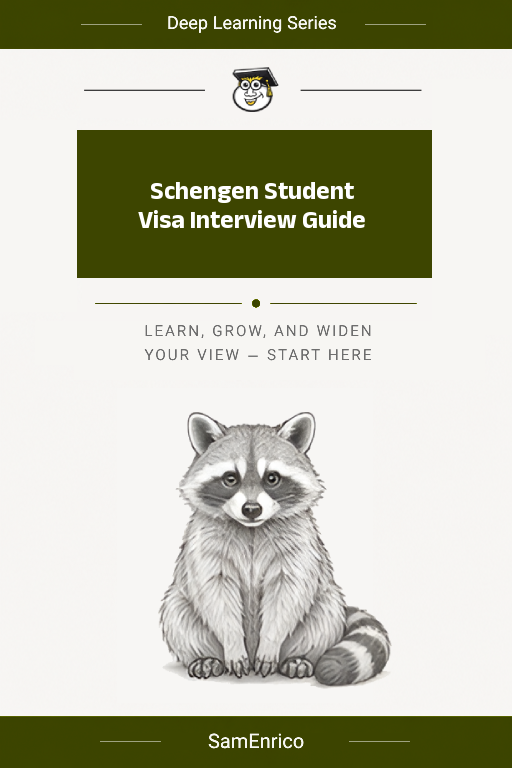
Non-FictionStudent's ShortcutRegional GuideCountry-Specific Manual
Schengen Student Visa Interview Guide eBook
Navigate unique requirements for France, Germany,
Navigate unique requirements for France, Germany, and Netherlands student visas. Covers health insurance proof, accommodation booking, and financial block account specifics.
Formats
Free sample
Chapter 1: The Visa Trap...–- Most students begin their Schengen student visa journey by googling “How to get a student visa for Europe” or watching a cheerful You Tube video of someone unboxing their passport with a shiny sticker inside. That was my first mistake too. I spent weeks assembling what I thought was a perfect application: a thick folder of bank statements, an acceptance letter from a respected university, and even a signed rental agreement I had begged a friend to draft. I walked into the embassy confident, almost smug. Twenty minutes later, I walked out holding a rejection letter that cited a single, baffling reason: “Incorrect visa category requested.”The visa officer had barely looked at my documents.
She flipped to the application form, circled the box marked “Schengen Visa (Type C),” and slid it back toward me. “You are not a tourist,” she said. “You cannot study on this visa. Next.”That moment of confusion cost me three months of waiting, a non-refundable €80 application fee, and nearly my admission to the master’s program I had worked two years to secure. I was not alone.
In the waiting room that day, I met a young woman from Brazil who had flown 10,000 kilometers to submit her file in person, only to realize she had booked an appointment at the wrong embassy because she misunderstood which country was her “primary destination.” Another student, a software engineer from India, had shown a savings account with €30,000 – three times the required amount – and was still rejected because the money had appeared as a single lump sum two weeks before the interview. “The officer said it looked like a loan,” he told me, his voice hollow. “But it was my father’s life savings.”This book exists because those stories are not rare exceptions. They are the rule.Every year, tens of thousands of qualified, motivated students fail to obtain their Schengen student visa – not because they lack intelligence, ambition, or financial resources, but because they fall into the same predictable traps. They apply for the wrong visa type.
They submit the wrong financial proof. They misunderstand what “proof of accommodation” actually means in Germany versus France versus the Netherlands. And by the time they realize their error, their university enrollment deadline has passed, their non-refundable flight has been booked, and their dream of studying in Europe has crumbled into a bureaucratic nightmare.This chapter, and this entire book, is designed to ensure that does not happen to you.The Schengen student visa landscape has changed dramatically in the past three years. In 2024, the German Foreign Office reported a 37% rejection rate for student visa applications from non-EU countries, up from 22% in 2019. France rejected nearly one in four student applicants.
The Netherlands, despite its reputation for efficiency, turned away over 5,000 qualified students in 2025 alone. These rejections are not random. They follow patterns. They cluster around specific errors that are entirely avoidable once you know what the visa officers are actually looking for.Most online resources fail you because they treat the “Schengen visa” as a single, monolithic process. A blog post about getting a tourist visa for a two-week vacation in Paris gets repurposed as “advice” for a student planning to live in Berlin for two years.
A forum comment about showing a bank statement for a weekend trip to Amsterdam becomes gospel for someone trying to prove €11,904 in a blocked German account. This is not just unhelpful – it is dangerous.The truth is that a “Schengen student visa” does not exist as a single category. What you are actually applying for is a National Long-Stay Visa (Type D) for your specific country of study. The “Schengen” part merely means that once you are admitted, you can travel to other Schengen countries for up to 90 days per 180-day period. But the visa itself is issued by, and governed by, the individual nation where you will study.
This distinction is not a technicality. It is the difference between approval and rejection.Consider this: A Type C tourist visa allows you to stay for 90 days maximum. It cannot be extended. It cannot be converted into a student visa after you arrive. Every year, students arrive in Europe on a tourist visa, thinking they will simply “switch” to a student visa once they find an apartment or open a bank account.
They cannot. The law is explicit: you must apply for a Type D visa from your home country before you travel. The only exception is for certain short-term study programs (under 90 days), which are vanishingly rare for degree-seeking students.I have watched students cry in embassy waiting rooms when they learned this. I have read forum posts from people who sold their cars, quit their jobs, and flew to Paris only to be told at border control that their tourist visa would be canceled and they would be put on the next flight home. These are not horror stories designed to scare you.
They are the predictable consequences of following bad advice.The Three-Country Reality: Why Germany, France, and Netherlands Are Different This book focuses on the three most popular study destinations in the Schengen area: Germany, France, and the Netherlands. Together, they host over 60% of all international students in Europe. And while they share a common geographic region, their visa requirements diverge in critical ways.Germany demands a Sperrkonto – a blocked bank account that locks away your living expenses for an entire year, releasing a fixed monthly amount. You cannot substitute this with a parent’s bank statement, a scholarship letter, or a promise of future income. The German visa officer will not look at your family’s savings account or your cryptocurrency portfolio.
They want to see a document from an approved German bank stating that €11,904 (as of 2026) is frozen in your name. Without it, your application is dead on arrival.France takes a more flexible approach. You can show a standard bank statement in your name or your parent’s name, provided the funds have been sitting there for at least three to six months. You can use a sponsorship letter (Attestation d’Hébergement) from a relative in France. You can even show a scholarship letter from the Eiffel program or your home government.
But this flexibility is a double-edged sword: French visa officers have wide discretion to reject applications they deem insufficiently documented. A student from a country with high perceived “immigration risk” may be held to a higher standard than a student from a wealthier nation. This is unfair, but it is reality.The Netherlands operates through a different mechanism entirely. Before you even apply for a visa, your Dutch university often submits a request to the Immigration and Naturalisation Service (IND) on your behalf. This is called the “entry visa” or “TEV” procedure.
You must prove financial solvency – usually around €11,400 – but the Dutch do not require a blocked account. A standard bank statement or a scholarship letter suffices. However, the Dutch are exceptionally strict about health insurance: you must show a policy from an approved provider that covers your entire study period, not just the first 90 days.If you try to use German financial documentation for…
This is the end of the free sample. Get the eBook to keep going. Buy now
About this book
Details
- Author
- Suarez Melissia
- Publisher
- SamEnrico
- Language
- English
- Genre
- Non-Fiction, Student's Shortcut, Regional Guide, Country-Specific Manual
- Released
- 2026-06-01
- Pages (approx.)
- 156
- Available as
- eBook, Audiobook

Read better in the ZLOADR app
Your eBooks on your phone or tablet. Sign in with your SamEnrico account and start reading.
More by Suarez Melissia
 Sexual Acting Out In Public Places HandbookSuarez Melissia$11.99
 Dreams After Torture TraumaSuarez Melissia$11.99
 Zoom Communication MasterySuarez Melissia$11.99
 PMS Skin Care RoutineSuarez Melissia$11.99
 Dreams in Schizophrenia Trauma WorkSuarez Melissia$11.99
 The Whispering Walls of BhangarhSuarez Melissia$11.99
 The Martian Codebreakers: How a Global Network of Scientists Cracked the Red PlanetSuarez Melissia$11.99
 Understanding HemangiomaSuarez Melissia$17.99
 Finance Process and Systems Development ManagerSuarez Melissia$11.99
 Floating Solar Outlook 2026Suarez Melissia$12.99
 How to Become a Kick Press SetterSuarez Melissia$11.99
You may also like
 Hong Kong Handover 1997Dunn Johnnie$11.99
 Zumba For Postnatal Recovery CourseNeal Christian$11.99
 Zumba for BeginnersLadner Nikia$11.99
 YouTube Comment Mining GuideHumes Pandora$12.99
 Worry Box MeditationCarlin Rudy$11.99
 Workplace Stress MeditationNguyen Lynn$11.99
 Workplace Stress and Sleep RepairHawley Ivory$11.99
 Workplace Perfectionism CureDelaney Jeffry$11.99
 Workplace Injustice Anger GuideWallen Isabelle$11.99
 Work Addiction and Burnout LinkGreenwood Ester$11.99
 Women in Yoga and WellnessBeattie Galina$11.99
 Women in Stand Up ComedyChun Evangeline$11.99