
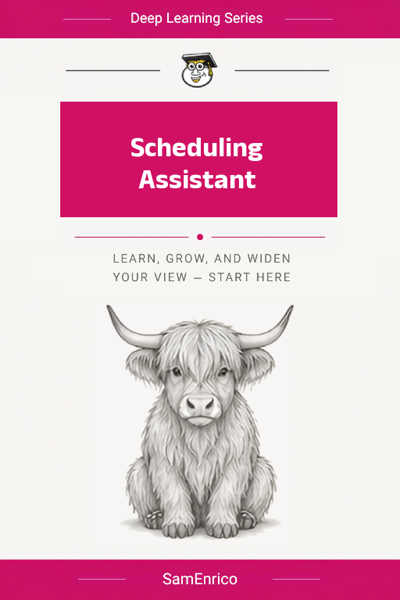
Non-FictionInformativeEducational
Scheduling Assistant eBook
A Coursebook on Scheduling Assistant
A Coursebook on Scheduling Assistant
Formats
Free sample
Chapter 1: The Finite Cage--–- You are reading this book because you feel behind. Not occasionally behind, not temporarily behind, but structurally, existentially, irredeemably behind. The emails keep coming. The meeting invites multiply. Your calendar looks like a game of Tetris played by a caffeine-addicted monkey, and no matter how many tasks you check off, no matter how early you wake up or how late you stay, the list only grows longer.
This is not a failure of your character, your discipline, or your work ethic. This is a failure of a fundamental assumption you have been carrying your entire adult life: the assumption that if you could just get organized enough, disciplined enough, or productive enough, you could eventually get everything done.You cannot. And accepting that truth is the first and most important step toward building a scheduling system that actually works.The Myth of "Getting It All Done"Let us name the enemy. For most of your life, you have been chasing a phantom called "getting everything done." This phantom whispers that there exists a future state—perhaps after this project, after this promotion, after this quarter—where your to-do list will be empty, your inbox will be zero, and your calendar will have breathing room. You have been running toward that horizon for years, and it has only receded further into the distance.This is not an accident.
It is a structural feature of modern knowledge work, not a bug that can be fixed with better habits. The British economist and philosopher Staffan noted that the productivity trap is the cruelest joke ever played on the professional class: the more you produce, the more is demanded of you. Every email you answer generates two more. Every meeting you attend spawns three follow-up tasks. Every problem you solve reveals five new problems you had not noticed before.
Your productivity does not empty your plate. It fills it faster.Consider the mathematics of this trap. If you improve your efficiency by twenty percent, you do not gain twenty percent more free time. Instead, your organization or your clients or your own ambition simply give you twenty percent more work. The system absorbs every efficiency gain and converts it into new demand.
You are on a treadmill that gets faster every time you run harder. The only way to win is to realize that winning was never the point—and to step off the treadmill entirely, not by doing less, but by redesigning what counts as "done."The Productivity Trap Let me introduce a concept that will appear throughout this book, always capitalized to remind you of its weight: The Productivity Trap. Here is its formal definition:The Productivity Trap is the phenomenon where completing more tasks does not reduce your workload but instead generates new tasks at an equal or faster rate, creating a persistent and escalating feeling of being behind despite increasing output.You have felt this. You have finished a massive project on Friday afternoon, expecting Monday morning to feel light and manageable, only to discover that the project's completion triggered a new round of stakeholder feedback, follow-up meetings, and derivative tasks. You have cleared your inbox to zero, felt a moment of peace, and watched it refill within the hour.
You have blocked out a full day for deep work, completed everything on your list, and still gone to bed feeling anxious because tomorrow's list is already longer.The Productivity Trap is not a personal failing. It is a systemic property of any environment where work generates work, which is to say almost every modern workplace. The trap exists because tasks are not independent units that can be eliminated one by one. They are nodes in a network. Completing one task often creates connections to other tasks, reveals dependencies, or opens new avenues of inquiry.
In a complex system, work is not a bucket you can empty. It is a spring that feeds from an underground aquifer. The more you pump, the more flows in.Time Anxiety: The Emotional Toll If the Productivity Trap is the mechanical engine of overwhelm, time anxiety is the emotional fuel that keeps it running. Time anxiety is that low-level, background hum of stress that tells you there is never enough time, that you are always forgetting something, that the clock is your enemy and you are losing the battle.Time anxiety manifests in specific, recognizable ways. You check your calendar first thing in the morning with a small spike of dread.
You feel a flicker of irritation when a meeting invite appears because it means something else will have to shift. You look at a free afternoon on your schedule and feel suspicious rather than relieved—surely there is something you should be doing. You lie in bed at night and mentally rehearse the next day's schedule, searching for the gaps where something might fall through.This anxiety has a physiological reality. Studies using cortisol measurement have shown that merely anticipating a busy schedule raises stress hormone levels hours before the first meeting begins. The anticipation of time pressure is often more damaging than the pressure itself.
Your body does not distinguish between an actual scheduling conflict and the fear of one. It simply floods your system with stress chemicals, preparing you for a threat that may or may not materialize.Here is the counterintuitive truth that liberates you from time anxiety: The feeling of being behind is not caused by the actual quantity of work you have to do. It is caused by the gap between your expectations and reality. If you expect to finish everything, you will always be behind. If you expect to finish only what matters most, you might actually be ahead.
The problem is not your calendar. It is the yardstick you are using to measure it.Why To-Do Lists Are a Lie Let me say something that will sound heretical to anyone who has built their productivity system around this humble tool: the traditional to-do list is one of the most dangerous illusions in modern life. Not because it is useless, but because it is deceptively useful in ways that ultimately make your situation worse.A to-do list creates what psychologists call an illusion of control. When you write down all the tasks you need to do, you feel organized. You feel that the chaos has been captured, tamed, and rendered manageable.
This feeling is not entirely false. Writing things down does reduce cognitive load. It does prevent forgetting. It does provide a satisfying sense of progress as you check items off.But the illusion lies in what the to-do list implicitly promises: that the items on the list are the right items, that they can be done in some order, and that doing them will bring you to a state of completion. A to-do list has no mechanism for distinguishing the vital from the trivial.
It treats "reply to vendor email" and "finalize annual strategy" as equivalent units of effort. It gives you no information about how long any task will take or when it should be done. It is a list of nouns pretending to be a schedule.Worst of all, the…
This is the end of the free sample. Get the eBook to keep going. Buy now
About this book
Details
- Author
- Holm Harriett
- Publisher
- SamEnrico
- Language
- English
- Genre
- Non-Fiction, Informative, Educational
- Released
- 2026-06-02
- Pages (approx.)
- 133
- Available as
- eBook, Audiobook

Read better in the ZLOADR app
Your eBooks on your phone or tablet. Sign in with your SamEnrico account and start reading.
More by Holm Harriett
 Cognitive Behavioral Memory AnxietyHolm Harriett$11.99
 Walking Meditation For Anxiety CourseHolm Harriett$11.99
 Sober Living House GuideHolm Harriett$11.99
 Project Naming Convention GuideHolm Harriett$11.99
 Body Scan for Pregnancy GuideHolm Harriett$11.99
 Quetzalcoatl’s Feathered Serpent: The Plumed God’s DescentHolm Harriett$11.99
 Understanding Northern Epilepsy SyndromeHolm Harriett$17.99
 Armstrong World IndHolm Harriett$12.99
 College Essay Read-Aloud TestHolm Harriett$12.99
 How to Start a other Alloy Steel Business (Beginners Guide)Holm Harriett$11.99
You may also like
 Hong Kong Handover 1997Dunn Johnnie$11.99
 Zumba For Postnatal Recovery CourseNeal Christian$11.99
 Zumba for BeginnersLadner Nikia$11.99
 YouTube Comment Mining GuideHumes Pandora$12.99
 Worry Box MeditationCarlin Rudy$11.99
 Workplace Stress MeditationNguyen Lynn$11.99
 Workplace Stress and Sleep RepairHawley Ivory$11.99
 Workplace Perfectionism CureDelaney Jeffry$11.99
 Workplace Injustice Anger GuideWallen Isabelle$11.99
 Work Addiction and Burnout LinkGreenwood Ester$11.99
 Women in Yoga and WellnessBeattie Galina$11.99
 Women in Stand Up ComedyChun Evangeline$11.99