
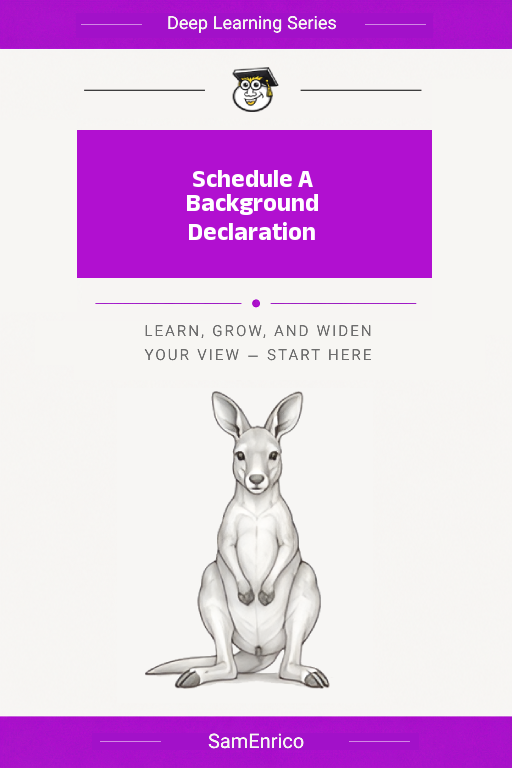
Schedule A Background Declaration eBook
Complete IMM 5669 Schedule A correctly including p
by Bray Tandy
Complete IMM 5669 Schedule A correctly including personal history and address details from age 18.
Formats
Free sample
Chapter 1: The 5-Year Ban--–- Maria Santos had done everything right. She had a valid job offer from a Canadian employer. Her language scores were exemplary. Her bank statements showed more than enough funds. Her consultant had assured her the application was "rock solid." Eight months later, she wasn't in Canada.
She wasn't even in the queue. She was holding a letter that began with the words: "I am satisfied that you have misrepresented a material fact." The consequence? A five-year ban from entering Canada. The cause? A single week.
Seven days. Missing from her address history from 2015.Maria's story is not unique. It is not rare. And it is not an accident. Every year, thousands of Canadian immigration applications are refused or derailed not because the applicant was unqualified, not because they lacked funds or skills, but because of mistakes on a single form: the IMM 5669 Schedule A Background Declaration.
Immigration, Refugees and Citizenship Canada (IRCC) processes over 5 million applications annually across all streams. Of the refusals issued for misrepresentation—the most severe finding IRCC can make against an applicant without a criminal conviction—fully 67 percent originate on Schedule A. That is not a typo. Two-thirds of all misrepresentation cases have nothing to do with fake diplomas, fraudulent job letters, or hidden criminal convictions. They come from honest applicants who treated Schedule A as administrative paperwork rather than what it actually is: a legal deposition under oath.This book exists because almost no one understands this distinction.
Immigration consultants, lawyers, and online forums focus on the flashy parts of Canadian immigration—the Comprehensive Ranking System scores, the Provincial Nominee Programs, the Express Entry draws. They obsess over eligibility. They ignore admissibility. And in that blind spot, applications die.This chapter establishes the foundation for everything that follows. By the time you finish reading, you will understand why Schedule A is not a form but a lie detector, how the Five Eyes intelligence alliance turns your innocent omissions into global evidence, and why a missing week of address history can cost you five years of your life.
More importantly, you will learn the single most important rule that governs this entire book: the 7-day gap rule, the consistent standard that applies across every chapter and every question on Schedule A.Let us begin with the anatomy of a refusal.The Eligibility Fallacy Most applicants believe that Canadian immigration is a points game. Gather enough points, submit the documents, and the visa arrives. This is dangerously incomplete. Immigration applications have two completely separate components: eligibility and admissibility.Eligibility answers the question: "Are you qualified?" Do you have enough points? Enough funds?
The right language scores? The valid job offer? Eligibility forms include language test results, educational credential assessments, proof of funds, and employment letters. These are what consultants obsess over. These are what applicants stress about.Admissibility answers a completely different question: "Are you safe to let in?" Have you committed a crime?
Have you been refused visas elsewhere? Have you lied to immigration authorities? Have you been a member of a proscribed organization? Do you have a medical condition that poses a danger to the public or would cause excessive demand on Canada's healthcare system?Here is what most applicants never realize: you can have perfect eligibility and still be refused on admissibility grounds. In fact, you can have perfect eligibility and still be banned from Canada for five years without ever committing a crime.
Maria Santos learned this the hard way. Her eligibility was flawless. Her admissibility was destroyed by a missing week.Schedule A is the primary admissibility document. It is not a form that IRCC uses to check boxes. It is a tool that IRCC uses to detect deception.
And IRCC assumes, as a matter of policy, that any omission from Schedule A is intentional unless proven otherwise.The Sworn Deposition, Not a Form Look at the bottom of the IMM 5669. Before the signature line, read the text carefully. It states that you "solemnly declare" the information is true, complete, and accurate. It warns that "misrepresentation" can lead to a five-year ban and criminal prosecution. It invokes the authority of the Immigration and Refugee Protection Act (IRPA), which makes lying on an immigration application a criminal offense punishable by fines up to $100,000 and imprisonment for up to five years.This is not bureaucratic boilerplate.
This is a sworn deposition. The legal standard for Schedule A is identical to the standard for testifying in a Canadian court under oath. You cannot claim "I didn't know" or "I forgot" or "I didn't think it mattered." Canadian immigration law does not recognize a defense of ignorance. The question is not whether you intended to deceive. The question is whether the information you provided is materially true, complete, and accurate.
If it is not, you have misrepresented. Intention is irrelevant.This is the single most important legal principle governing Schedule A: strict liability for accuracy. You are strictly liable for every date, every address, every activity, every status entry on this form. There is no "I didn't mean to" defense. There is no "my consultant filled it out" defense.
There is no "it was an honest mistake" defense. The form is your sworn statement. You sign it. You own it.The 67 Percent Statistic: Where Refusals Really Happen Let me repeat the statistic because it is so counterintuitive that most readers will not believe it the first time: 67 percent of all misrepresentation findings by IRCC originate on Schedule A. Not on credential fraud.
Not on fake job offers. Not on hidden criminal convictions. On the background declaration form that most applicants fill out in twenty minutes while watching television.How is this possible? Because eligibility fraud is relatively rare. Most applicants do not have fake degrees.
Most do not fabricate job offers. But almost every applicant makes mistakes on Schedule A. And IRCC treats those mistakes as fraud unless proven otherwise.Consider the math. IRCC issues approximately 8,000 to 10,000 misrepresentation findings per year across all immigration streams. A finding of misrepresentation triggers a five-year ban from entering Canada, a permanent record of deception on your file, and mandatory disclosure on all future immigration applications to any country that shares data with Canada (which is almost every major country).
Of those 8,000 to 10,000 findings, approximately 5,000 to 6,700 come from Schedule A errors.That is not a trickle of unlucky applicants. That is an epidemic of preventable refusals.The Five Eyes Alliance: Your Data Is Everywhere Maria Santos did not just hide a week from Canada. She hid a week from the Five Eyes alliance. The Five Eyes is an intelligence-sharing agreement among Australia, Canada, New Zealand, the United Kingdom, and the United States. Originally created for military intelligence, the agreement now covers immigration data in real time.When you submit a Schedule A to IRCC, the data is automatically available to immigration authorities in the other four countries within hours.
A gap hidden from Canada will surface from a US visa application filed six years ago. A different gap hidden from the UK will surface from your Canadian application. A discrepancy between your Australian work visa history and your Canadian Schedule A will be flagged automatically…
This is the end of the free sample. Get the eBook to keep going. Buy now
About this book
Details
- Author
- Bray Tandy
- Publisher
- SamEnrico
- Language
- English
- Genre
- Non-Fiction, Student's Shortcut, Schedule A, Background Form
- Released
- 2026-05-30
- Pages (approx.)
- 139
- Available as
- eBook, Audiobook

Read better in the ZLOADR app
Your eBooks on your phone or tablet. Sign in with your SamEnrico account and start reading.
More by Bray Tandy
 Parenting After Trauma GuideBray Tandy$11.99
 Nonverbal Cues For Teachers CourseBray Tandy$11.99
 The Financial Ruin Prevention GuideBray Tandy$11.99
 Contamination OCD Recovery PlanBray Tandy$11.99
 Survey Segmentation with AI ClusteringBray Tandy$11.99
 The Great Firewall: How China's Digital Inferno Reshaped the WorldBray Tandy$11.99The Great Firewall: How China's Digital Inferno Reshaped the WorldBray Tandy$11.99
 The Secret Serum: How a Little-Known Doctor Fueled Cycling’s Darkest EraBray Tandy$11.99
 PhD Application Without Any PapersBray Tandy$12.99
 Understanding Café AU Lait Spots SyndromeBray Tandy$17.99
 How to Become a Card PlayerBray Tandy$11.99
 VentriloquistBray Tandy$11.99