
Non-FictionInformativeEducational
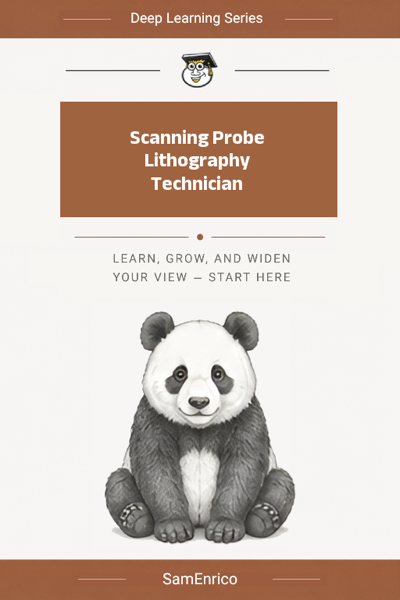
Scanning Probe Lithography Technician eBook
A Coursebook on Scanning Probe Lithography Technic
A Coursebook on Scanning Probe Lithography Technician
Formats
Free sample
Chapter 1: The Invisible Frontier--– At 7:43 on a Tuesday morning, Maria Chen watched a speck of dust destroy three months of work. The particle, smaller than a single bacterium, had landed on her silicon wafer during a routine spin-coating step. Under the optical microscope, it looked like nothing—a faint blur. But inside her scanning probe lithography tool, that invisible speck became a boulder. The tip, sharpened to a radius of less than ten nanometers, struck the dust particle and snapped.
Fifty thousand dollars of precision engineering turned into a useless nub of silicon in less time than it takes to blink. Maria didn’t cry. She had learned that lesson in her first year. Instead, she walked to the logbook, recorded the failure, and reached for a new cantilever. Three months of work meant nothing.
The invisible frontier demanded respect, or it would take everything.Welcome to the world of scanning probe lithography, where the battlefield is measured in atoms and the enemies are things you cannot see. This is not a world of heroic breakthroughs and tidy Nobel speeches. It is a world of humidity sensors, vibration isolation tables, and logbooks filled with the corpses of broken tips. If you are reading this book, you are likely training to become a scanning probe lithography technician—or you already are one, and you know exactly what Maria felt. This chapter is your induction.
It will teach you not the romantic history of nanotechnology, but the practical, gritty reality of working at the nanoscale. You will learn why size matters, how SPL fits into the larger world of chipmaking, and most importantly, when to reach for an SPL tool and when to walk away. By the end of this chapter, you will understand the invisible frontier and whether you have the patience to work there.The Scale of the Unseen: Understanding the Nanoworld Before you can write with atomic precision, you must first understand how small “small” really is. The prefix “nano” comes from the Greek word for “dwarf,” and one nanometer is one-billionth of a meter. To put that in human terms: if a meter were the size of the Earth, a nanometer would be the size of a marble.
If a millimeter were the length of a football field, a nanometer would be the thickness of a single sheet of paper. These analogies help, but they fail to convey the visceral strangeness of the nanoscale.At the scale of meters and centimeters, the world behaves as we expect. Gravity dominates. Objects fall. Surfaces feel smooth or rough based on our fingertips.
At the scale of micrometers—millionths of a meter—we enter the world of cells and bacteria. You can see these with a good optical microscope. But at the nanometer scale, the rules change entirely. Forces that are negligible in our daily lives become overwhelming. Gravity is irrelevant; a single bacterium experiences gravity as we would experience a feather landing on our shoulder.
Instead, van der Waals forces, electrostatic attraction, and capillary forces from microscopic water films rule everything. A clean surface in air is never truly clean—it is covered in a layer of water molecules and hydrocarbons that fell from the air. When you bring a sharp tip within a few nanometers of a surface, it will snap into contact as if pulled by an invisible hand. That is not magic; it is physics.Let us build a practical size ladder:A single hydrogen atom: approximately 0.1 nanometers in diameter. You cannot see it with any optical tool.
Even the most advanced electron microscopes show it as a blur.A DNA double helix: about 2 nanometers wide. This is the scale where scanning probe lithography begins to feel comfortable.A typical virus (e.g., influenza): around 100 nanometers. You could fit five hundred of them across the width of a human hair.A red blood cell: about 7,000 nanometers (7 micrometers). Now we are leaving the nanoworld and entering the micro-world.A human hair: roughly 80,000 nanometers thick. Hair is a monster at the nanoscale.
A single dust particle that Maria encountered (around 500 nanometers) is smaller than a speck of talcum powder.The transistors in the most advanced computer chips—as of 2026—are between 3 and 5 nanometers in critical dimension. That means the smallest feature on a state-of-the-art processor is about fifteen silicon atoms wide. When you perform scanning probe lithography, you are writing features at or below this scale. You are building structures that are smaller than the gate length of a smartphone’s processor. This is not an academic exercise.
This is the frontier of computing, sensing, and materials science.But with that power comes a brutal constraint: everything you touch is fragile. A single dust particle that drifted in from the hallway, a micro-wobble in the floor from a passing cart, a change in humidity because someone opened a door—any of these can destroy your pattern, your tip, or both. The invisible frontier is unforgiving, and it does not care about your deadline.Top-Down vs. Bottom-Up: Two Philosophies of Small To understand where scanning probe lithography sits in the world of nanofabrication, you must understand two opposing philosophies: top-down and bottom-up.Top-down fabrication is the approach we inherited from the microchip industry. You start with a large piece of material—a silicon wafer, a metal film, a block of plastic—and you carve away the parts you do not want.
Think of a sculptor chipping away marble to reveal the statue inside. Photolithography, electron beam lithography, and scanning probe lithography are all top-down techniques. They use masks, beams, or tips to remove or modify material. The advantage of top-down is control. You can design complex patterns with exact coordinates.
The disadvantage is waste. You remove most of what you deposited, and you are limited by the resolution of your carving tool.Bottom-up fabrication is the opposite. You start with individual atoms or molecules and assemble them into larger structures, like building with LEGO bricks. Nature is the master of bottom-up: DNA assembles itself, proteins fold, cells organize into tissues. In the lab, bottom-up includes techniques like self-assembled monolayers, colloidal assembly, and directed self-assembly.
The advantage is efficiency—you only place atoms where you want them, and you can achieve molecular precision. The disadvantage is control. Self-assembly is driven by thermodynamics, not by a CAD file. Getting molecules to arrange themselves into a specific circuit pattern is notoriously difficult.Scanning probe lithography is a hybrid. It is top-down because you start with a substrate and selectively modify it.
But it can also operate in a bottom-up mode, as in dip-pen nanolithography, where you deposit molecules directly onto a surface. This hybrid nature is SPL’s secret weapon. It gives you the precision of a top-down tool (sub-10 nanometer features, registered to fiducial marks) with the material flexibility of bottom-up (inks, biomolecules, nanoparticles). No other lithography method can claim that.A Brief and Practical History: From AFM to SPLYou might have heard the story of the atomic force microscope (AFM) in another textbook. In 1986, Gerd Binnig, Calvin Quate, and Christoph Gerber invented a microscope that could image surfaces by dragging a sharp tip across them and measuring the tiny forces between tip…
This is the end of the free sample. Get the eBook to keep going. Buy now
About this book
Details
- Author
- Thorton Charise
- Publisher
- SamEnrico
- Language
- English
- Genre
- Non-Fiction, Informative, Educational
- Released
- 2026-05-04
- Pages (approx.)
- 146
- Available as
- eBook, Audiobook

Read better in the ZLOADR app
Your eBooks on your phone or tablet. Sign in with your SamEnrico account and start reading.
More by Thorton Charise
 YouTube Creator Comparison CourseThorton Charise$11.99
 West Papua Sea CucumberThorton Charise$11.99
 Burnout Recovery Body AwarenessThorton Charise$11.99
 The Cognitive Reserve Building GuideThorton Charise$11.99
 George Jones No Show JonesThorton Charise$11.99
 The Beast of Gévaudan: A Wolf’s Shadow in the French WildsThorton Charise$11.99
 Coffee Payment Terms GuideThorton Charise$12.99
 Japanese Scholarship DeadlinesThorton Charise$12.99
 Understanding Shaver's DiseaseThorton Charise$17.99
 How to Become a Polishing-wheel SetterThorton Charise$11.99
You may also like
 Hong Kong Handover 1997Dunn Johnnie$11.99
 Zumba For Postnatal Recovery CourseNeal Christian$11.99
 Zumba for BeginnersLadner Nikia$11.99
 YouTube Comment Mining GuideHumes Pandora$12.99
 Worry Box MeditationCarlin Rudy$11.99
 Workplace Stress MeditationNguyen Lynn$11.99
 Workplace Stress and Sleep RepairHawley Ivory$11.99
 Workplace Perfectionism CureDelaney Jeffry$11.99
 Workplace Injustice Anger GuideWallen Isabelle$11.99
 Work Addiction and Burnout LinkGreenwood Ester$11.99
 Women in Yoga and WellnessBeattie Galina$11.99
 Women in Stand Up ComedyChun Evangeline$11.99