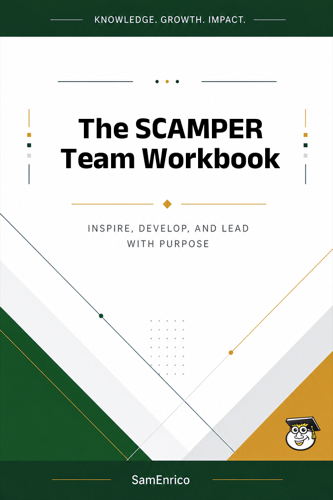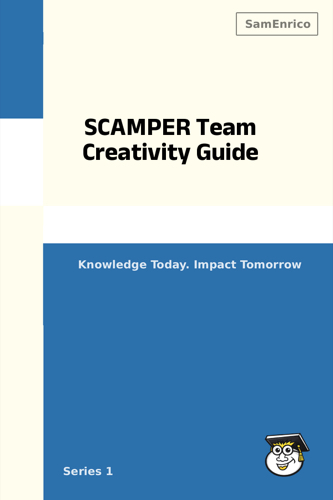
SCAMPER Team Creativity Guide eBook
Apply the SCAMPER method for group innovation usin
Apply the SCAMPER method for group innovation using this practical collaboration workbook.
Formats
Free sample
Chapter 1: The Brainstorming Lie--–- Every minute you spend in another pointless brainstorming session is a minute your competitors are using to outthink you. That sounds harsh, but the data is unforgiving. Studies across hundreds of organizations show that the vast majority of traditional brainstorming meetings produce exactly zero actionable ideas that ever see the light of day. Zero. You have sat in these rooms.
You know the feeling. The stale coffee, the dry-erase markers running out of ink, the senior manager who speaks first and loudest, and the quiet intern who has the breakthrough idea but will never say it because they have learned that speaking up is a career-limiting move. This chapter is the diagnosis. Before we can fix your team's creativity, we must first name the disease. And the disease is not a lack of smart people.
The disease is a lack of structure.The $50 Million Idea You Already Killed Let me tell you a story. The names and specific details have been changed to protect the embarrassed, but the facts are real. A mid-sized software company, let us call it Fin Soft, had a problem. Their customer support tickets were spiking, and their users were complaining that the password recovery process took over twenty minutes. In a quarterly offsite, the CEO gathered the top thirty managers for a "brainstorming summit." They had whiteboards, sticky notes, and a fancy facilitator who wore colorful shoes.
For three hours, they generated ideas. Someone suggested a biometric login. Someone else suggested outsourcing support to a third party. The head of engineering proposed a complete rewrite of the authentication system, which would take nine months and cost two million dollars.In the back of the room, a junior product manager named Priya had an idea. She had noticed that 67% of password reset requests came from the same three user segments: people over fifty-five, people using the mobile app for the first time, and people who had last logged in more than ninety days ago.
Her idea was simple. Instead of fixing password recovery, what if they eliminated the password entirely for those three segments? What if they sent a one-time magic link to their email, no password required, and then gradually introduced a simpler four-digit PIN? She estimated the engineering work at two weeks.She did not speak. Why?
Because she had learned the hard way. In the previous quarter's brainstorming session, she had suggested a small change to the onboarding flow. The head of sales had laughed and said, "That will never work with enterprise clients." The CEO had moved on to the next topic. Priya had learned that her job was to keep her head down and her mouth shut. So the Fin Soft offsite continued.
They voted on the biometric solution. They spent nine months and two million dollars. The biometric system launched to poor adoption because users did not trust it. Six months later, a competitor launched a "magic link" login feature. That competitor grew their mobile user base by 300% in one year and was acquired for fifty million dollars.Priya left Fin Soft six months after that offsite.
She now runs product at a startup that uses SCAMPER in every weekly meeting. The Fin Soft CEO, when asked about the missed opportunity, told a reporter, "We had the idea in the room. We just didn't have a way to hear it."That is what this book fixes. Not a lack of ideas. A lack of a system to surface, legitimize, and develop the ideas already sitting in your team's heads.The Four Horsemen of Brainstorming Failure After studying hundreds of failed creative sessions across technology, healthcare, manufacturing, and nonprofit organizations, researchers have identified four predictable failure modes.
I call them the Four Horsemen. Learn to recognize them, because they will appear in your next meeting. And if you do nothing, they will kill your best ideas before they are born.The First Horseman: The Loudest Voice Syndrome In any group of humans, some voices are louder than others. This is not a moral failing; it is simply a fact of social dynamics. Seniority amplifies volume.
Extroversion amplifies volume. Physical presence, such as standing at the whiteboard, amplifies volume. The problem is not that loud voices are always wrong. The problem is that creative problem-solving requires a diversity of inputs, and the loudest voice is statistically no more likely to have the best idea than the quietest voice. In fact, research from the Harvard Business Review found that in teams where one person spoke more than 40% of the time, the quality of solutions dropped by 60% compared to teams where participation was evenly distributed.I have watched this happen hundreds of times.
The director speaks. The manager agrees. The senior individual contributor adds a minor refinement. The junior team member, who has been tracking a completely different data set, says nothing. The team walks out with the director's idea, which was the first idea, which was the obvious idea, which the competitor already tried and abandoned last year.
The Loudest Voice Syndrome is not malice. It is physics. And physics requires countermeasures.The Second Horseman: Idea-Killing The second horseman is the most socially acceptable form of violence in business. Someone proposes an idea. Someone else responds with a phrase that begins with "Yes, but..." and then the idea dies.
The most common idea-killing phrases are so predictable that you can make a bingo card for your next meeting. "We tried that before." "That's not how we do things here." "That will never work because of compliance, legal, budget, time, or the phase of the moon." "Let me play devil's advocate." (The devil, by the way, has enough advocates. He does not need your help.)The tragedy of idea-killing is that the killer is often correct about the obstacle. Yes, there is a compliance issue. Yes, the budget is tight.
Yes, the last attempt failed. But the job of creative problem-solving is not to name obstacles; it is to solve them. When someone says "We tried that before," the correct response is not silence. The correct response is "What was different then? What could we change this time?" But in traditional brainstorming, no one has permission to ask that question.
The idea dies. The killer moves on. The team feels slightly smarter for having identified a problem. They have not solved anything. They have merely closed a door.The Third Horseman: Cognitive Fixation The third horseman is more subtle.
It is not a person but a pattern. Cognitive fixation occurs when a team latches onto the first reasonable idea and then spends the entire session refining it instead of exploring alternatives. This is the "good enough" trap. Someone suggests an idea that is not great but is solid. The team feels a sense of progress.
They add details. They assign owners. They sketch a timeline. By minute forty-five, they have invested so much mental energy in this first idea that abandoning it feels like failure. They have become fixated.The research on cognitive fixation is chilling.
In one study, teams were given a simple creative challenge and told to brainstorm for twenty minutes. The teams that generated the most…
This is the end of the free sample. Get the eBook to keep going. Buy now
About this book
Details
- Author
- Headrick Kandi
- Publisher
- SamEnrico
- Language
- English
- Genre
- Non-Fiction, Self-Help, Creative Techniques
- Released
- 2026-06-09
- Pages (approx.)
- 153
- Available as
- eBook, Audiobook

Read better in the ZLOADR app
Your eBooks on your phone or tablet. Sign in with your SamEnrico account and start reading.
More by Headrick Kandi
 The Trigger Diary MethodHeadrick Kandi$11.99
 Roommate Conflict Academic Impact WorkbookHeadrick Kandi$11.99
 The Workaholic's Parenting RepairHeadrick Kandi$11.99
 Owen Bradley Nashville SoundHeadrick Kandi$11.99
 Magellan's Gambit: Storms, Mutiny, and the Birth of the PacificHeadrick Kandi$11.99
 The Last Bequest: A Billionaire’s Secret LegacyHeadrick Kandi$11.99
 Accelerator Competition PrimerHeadrick Kandi$12.99
 Waste Reduction PricingHeadrick Kandi$12.99
 Understanding Frydman–cohen–ashenazi SyndromeHeadrick Kandi$17.99
 ATV Sales LeadHeadrick Kandi$11.99
 How to Start a Multi-wall Paper Sack Business (Beginners Guide)Headrick Kandi$11.99