
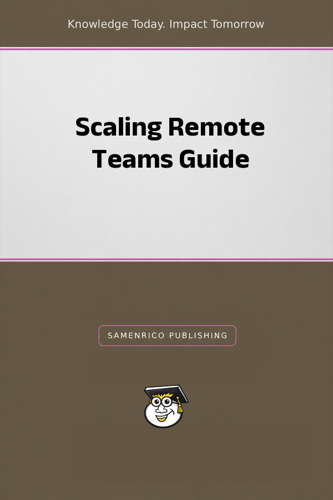
Non-FictionBusiness BriefRemote Work
Scaling Remote Teams Guide eBook
Manage async workflows across time zones without l
Manage async workflows across time zones without losing productivity.
Formats
Free sample
Chapter 1: The Green Dot Lie--It was 11:47 PM on a Tuesday when Elena Vargas closed her laptop, stared at the ceiling of her home office, and realized she couldn't remember the last time she had actually finished a thought.Not a task. Not a meeting. A thought.Her Slack had 1,247 unread messages across forty-three channels. Her calendar showed back-to-back meetings for the next three days, with exactly zero two-hour blocks of unscheduled time. She had answered three "quick questions" from her team in Singapore at 6 AM, led a product review with London at 9 AM, spent four hours in what should have been an email with her US team, and was now looking at a "brief check-in" message from her CEO about quarterly planning that had somehow spawned a seventeen-message thread.Elena was the Vice President of Engineering at a 200-person Saa S company that had gone fully remote eighteen months ago.
On paper, she was successful. Her team shipped features. The company was growing. But she hadn't slept through the night in weeks. Her best engineer, a brilliant woman in Poland named Anya, had sent her a resignation letter that morning.
The reason? "I can't work when everyone expects an answer in five minutes. I can't think."Anya's resignation was the third from Elena's top performers in six months.Elena had a time zone problem, a tool problem, a communication problem, and a trust problem. But she didn't know that yet. All she knew was that she was drowning, and the green dot next to her name in Slack had been glowing for sixteen hours straight.She was available.
She was responsive. She was burning alive.This book is for Elena. And if you recognize yourself in her story, it's for you too.The problem is not that remote work is broken. The problem is that most leaders are trying to run remote teams using the playbook of co-located work—just with video calls instead of conference rooms. They are measuring presence instead of progress.
They are rewarding speed instead of depth. And they are confusing the green dot of availability with the actual work of building things.This chapter dismantles the most dangerous assumption in distributed work: that real-time communication is the default, and asynchronous communication is a compromise. We will show you why that assumption is not just wrong, but actively destructive. We will introduce the concept of "response debt"—the hidden tax that instant expectations impose on deep work. We will examine how companies like Git Lab and Zapier turned time zone differences into 24-hour productivity cycles instead of logistical nightmares.
And we will establish a new operating principle for the rest of this book.But first, we need to understand how we got here.The Invention of the Green Dot In the early 2000s, instant messaging was a novelty. AIM and ICQ were for teenagers. Then came Slack in 2013, and suddenly the office had a pulse. The green dot meant someone was at their desk. The gray dot meant they weren't.
It was simple. It was harmless.Except it wasn't.The green dot evolved from a convenience into an expectation. Managers who could see a team member online began to expect responses. Teams that worked across floors began to treat instant messaging as a default. The phrase "I saw you were online" became a passive-aggressive accusation.
The green dot stopped being a status indicator and became a leash.Then the pandemic hit.Millions of knowledge workers moved home overnight. Companies that had never managed remotely suddenly needed tools. Slack usage exploded. Zoom became a verb. The default assumption was simple: if we can't see each other in an office, we'll see each other on screens.
We'll replicate the office, but worse. More meetings. More messages. More interruptions.The result was not productivity. The result was burnout at scale.Data from a 2022 study by the National Bureau of Economic Research found that the average knowledge worker's number of meetings increased by 150% between 2019 and 2021.
The average workday lengthened by 48 minutes. But deep work—uninterrupted, focused, creative work—declined by 35%. People were busier and less productive.The green dot had become a tyrant.The Myth of "Just Ask"Here is a belief that is quietly destroying your team's productivity: "If you need something, just ask."In a co-located office, "just ask" means walking ten feet to someone's desk, waiting for them to look up from their screen, and having a thirty-second conversation. The interruption cost is low for the asker and high for the askee, but the office environment normalizes these micro-interruptions.In a remote environment, "just ask" means sending a Slack message. That message arrives instantly, regardless of whether the recipient is in a state of deep concentration.
The recipient feels pressure to respond quickly because the green dot signals availability. The response comes within minutes. The asker learns that asking gets fast answers. The cycle reinforces itself.But here is what no one measures: the cost of context switching.Research from the University of California, Irvine, found that it takes an average of twenty-three minutes to fully regain focus after an interruption. Every Slack message that arrives during deep work is not a five-second distraction.
It is a twenty-three-minute productivity tax.Now multiply that by the average number of Slack messages a knowledge worker receives per day. According to a 2023 survey by Rescue Time, the average Slack user receives 147 messages daily. Even if only half arrive during focused work, that's more than seventy interruptions. At twenty-three minutes of recovery each, that is over twenty-six hours of lost productivity per week.Per person.The numbers are staggering. But leaders don't see them because they are looking at the green dot.We call this phenomenon response debt—the cumulative cognitive cost of expecting and delivering immediate answers.
Every time you send a message that could have waited, you are not saving time. You are borrowing time from someone else's future focus, with interest.The Case Against Speed Before we go further, we need to confront a deeply held belief in most organizations: that speed is a virtue.Fast answers. Fast decisions. Fast shipping. We worship speed.But speed is not the same as progress.
A fast answer to the wrong question is worse than no answer. A fast decision made without context will need to be unmade. A fast shipping schedule that produces buggy software creates more work than it saves.In the world of async workflows, we need to replace the cult of speed with a different value: clarity.A clear answer that takes four hours to write but requires zero follow-up questions is faster than a fast answer that takes ten seconds to send and generates three hours of back-and-forth. A clear decision that includes its context and rationale is faster than a fast decision that everyone has to re-litigate next week.The math is simple: Response time + Follow-up time = Total time.When you optimize for response time alone, you often increase follow-up time exponentially. When you optimize for clarity, you may increase response time slightly but collapse follow-up time to near zero.Most teams are optimizing for the wrong variable.The Companies That Figured It Out Not every remote team is…
This is the end of the free sample. Get the eBook to keep going. Buy now
About this book
Details
- Author
- Jolly Nicholle
- Publisher
- SamEnrico
- Language
- English
- Genre
- Non-Fiction, Business Brief, Remote Work
- Released
- 2026-06-11
- Pages (approx.)
- 145
- Available as
- eBook, Audiobook

Read better in the ZLOADR app
Your eBooks on your phone or tablet. Sign in with your SamEnrico account and start reading.
More by Jolly Nicholle
 Low Income Financial Stress GuideJolly Nicholle$11.99
 Hidden Anger Signs GuideJolly Nicholle$11.99
 The Suburban MayorJolly Nicholle$11.99
 The Day the Internet Broke: How a Single Line of Code Stopped the WorldJolly Nicholle$11.99
 The Great Typewriter Conspiracy: How a Secret War Was Fought in Plain SightJolly Nicholle$11.99
 Wound Care NurseJolly Nicholle$11.99
 Energy Management Side Hustle PrimerJolly Nicholle$12.99
 Telehealth Regulation Outlook 2026Jolly Nicholle$12.99
 How to Start a Cases for Clocks and Watches Business (Beginners Guide)Jolly Nicholle$11.99
 Understanding Hyperaldosteronism, Familial Type 1Jolly Nicholle$17.99
You may also like
 Hong Kong Handover 1997Dunn Johnnie$11.99
 Zumba For Postnatal Recovery CourseNeal Christian$11.99
 Zumba for BeginnersLadner Nikia$11.99
 YouTube Comment Mining GuideHumes Pandora$12.99
 Worry Box MeditationCarlin Rudy$11.99
 Workplace Stress MeditationNguyen Lynn$11.99
 Workplace Stress and Sleep RepairHawley Ivory$11.99
 Workplace Perfectionism CureDelaney Jeffry$11.99
 Workplace Injustice Anger GuideWallen Isabelle$11.99
 Work Addiction and Burnout LinkGreenwood Ester$11.99
 Women in Yoga and WellnessBeattie Galina$11.99
 Women in Stand Up ComedyChun Evangeline$11.99