
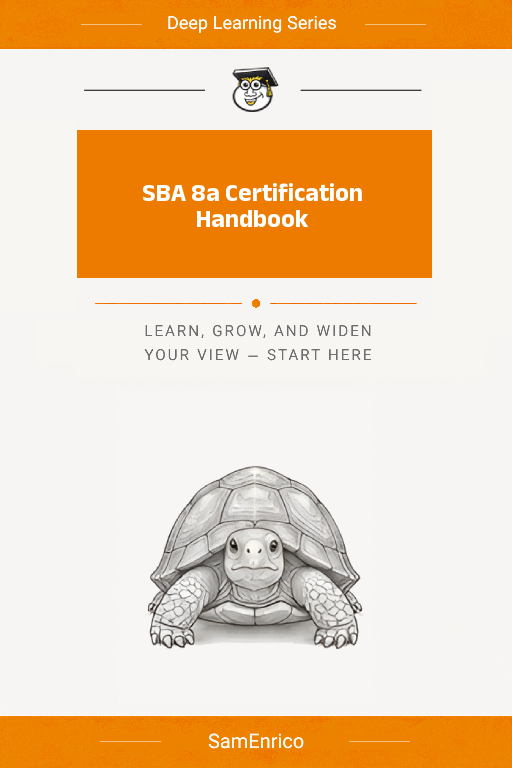
Non-FictionBusiness BriefSBA Programs
SBA 8a Certification Handbook eBook
Complete the 9 year business development program a
Complete the 9 year business development program application for socially and economically disadvantaged firms.
Formats
Free sample
Chapter 1: The $168M Loophole--–- The first time Maria Villanueva heard about the 8(a) program, she almost hung up the phone. A cold caller from the Small Business Administration was explaining that her tiny IT consulting firm—three employees, one leaky office roof, and exactly 47,000inannualrevenue—mightbeeligibleforgovernmentcontractsworthmillions.Mariaassumeditwasascam.Shewaswrong.Eighteenmonthslater,aftertwodenials,countlesshoursofconfusion,andonetransformativerealizationabouthowthesystemactuallyworks,Mariasignedherfirstsole−sourcecontractwiththe Departmentof Homeland Security.Thevalue:47,000 in annual revenue—might be eligible for government contracts worth millions. Maria assumed it was a scam. She was wrong. Eighteen months later, after two denials, countless hours of confusion, and one transformative realization about how the system actually works, Maria signed her first sole-source contract with the Department of Homeland Security.
The value: 47,000inannualrevenue—mightbeeligibleforgovernmentcontractsworthmillions.Mariaassumeditwasascam.Shewaswrong.Eighteenmonthslater,aftertwodenials,countlesshoursofconfusion,andonetransformativerealizationabouthowthesystemactuallyworks,Mariasignedherfirstsole−sourcecontractwiththe Departmentof Homeland Security.Thevalue:4.2 million. Her company had never handled a project larger than $50,000. She did not compete against a single other bidder. The government simply called her, verified her 8(a) certification, and handed her the work. This is not an anomaly.
This is the single most powerful wealth-building tool for disadvantaged business owners that most entrepreneurs have never heard of—or misunderstand completely.The 8(a) Business Development Program is not a loan program. It is not a grant program. It is not a preference program that gives you a tiny edge in competitive bidding. It is something far more valuable: a nine-year, legally mandated pipeline of no-bid, sole-source contracts that federal agencies must set aside for certified firms. The government does not want to give you these contracts out of charity.
The government is required by law to give them to you. And the maximum value of those sole-source contracts? 5.5millionforservices.5.5 million for services. 5.5millionforservices.8.5 million for manufacturing. Across nine years, a single 8(a) firm can win up to $168.5 million in contracts without ever competing against another company.This chapter is your strategic gatekeeper.
Before you invest hundreds of hours in the application process, before you write the painful but necessary social disadvantage narrative, before you restructure your business entity or hire a consultant, you need to answer one question with brutal honesty: Is the 8(a) program right for you, right now? Applying prematurely is not a harmless mistake. The program gives you exactly one nine-year term. If you apply and are rejected, you can reapply after ninety days. But if you are accepted and then fail to perform, or if you enter the program when your business is not ready, you cannot go back for a second chance.
This chapter will help you make that decision with clarity.The Current Landscape: Why 2026 Is Different The 8(a) program has existed since 1978, but the admission environment in 2026 bears little resemblance to previous years. In 2025, only sixty-five firms were admitted into the program nationwide. To put that number in perspective, approximately 350,000 small businesses in the United States meet the basic size standards for federal contracting. Less than two-tenths of one percent of eligible firms received 8(a) certification last year. The bar has risen dramatically due to three converging factors.First, the federal budget for set-aside contracting has tightened.
Agencies are scrutinizing every sole-source award more closely than ever before. An 8(a) certification no longer guarantees that an agency will send you contracts; you must actively market yourself, and the agency must justify why you are the right choice. Second, the elimination of automatic social disadvantage presumptions (detailed in Chapter 2) has forced the SBA to review each application with far greater rigor. Third, the program has become better known. Fifteen years ago, 8(a) was a niche program for construction and logistics firms.
Today, IT services, cybersecurity, consulting, healthcare staffing, and even marketing agencies have discovered the program, creating a far more competitive admission pool.The One-Time Rule: Why You Cannot Afford to Waste Your Chance Here is the single most important sentence in this book: You get exactly one nine-year term in the 8(a) program. There are no extensions. There are no renewals. There is no second program if you fail. Once you graduate—or if you are terminated early—you can never reapply.
This is not a discretionary rule. It is written into the Small Business Act, Section 7(j)(10). The SBA has no authority to grant a second term.What does this mean for you practically? It means that the decision to apply is irreversible. If you apply when your business is undercapitalized, you might win contracts you cannot perform, leading to termination.
If you apply when your personal net worth is 750,000—comfortablyunderthe750,000—comfortably under the 750,000—comfortablyunderthe850,000 limit—but you have a clear path to exceeding that limit in two years, you might be forced to terminate early. If you apply without a clear social disadvantage narrative, you might be denied and then discover that your circumstances have changed when you reapply ninety days later. Every scenario points to the same conclusion: apply only when you are fully ready, not when you are desperate.The 2025 Admission Data: What Sixty-Five Firms Tell Us The SBA does not publish a detailed demographic and financial profile of admitted firms, but public records and industry analysis reveal clear patterns. Among the sixty-five firms admitted in 2025, the average time in business was 4.2 years—well above the minimum two-year requirement. The average revenue in the year prior to application was 1.1million.Theaveragepersonalnetworthofthedisadvantagedownerwas1.1 million.
The average personal net worth of the disadvantaged owner was 1.1million.Theaveragepersonalnetworthofthedisadvantagedownerwas412,000, far below the $850,000 cap. Not a single admitted firm had a disadvantaged owner with a second full-time job. Every admitted firm had a written business plan that specifically identified federal contracting targets.These statistics should not intimidate you. They should inform you. If you have been in business for only two years and have $200,000 in revenue, you are not disqualified.
But you are facing an uphill battle. The SBA approved sixty-five firms out of approximately 1,200 complete applications. The acceptance rate was about 5.4%. You can improve your odds dramatically by waiting until your business metrics align with the profile of successful applicants.Sole-Source Caps: Why 5.5Millionand5.5 Million and 5.5Millionand8.5 Million Matter The 8(a) program offers two primary paths to contracts: sole-source and competitive set-aside. Sole-source is the holy grail.
Under a sole-source 8(a) award, an agency identifies your firm as the only capable provider and awards you the contract without any competition. The statutory caps for sole-source awards are 5.5millionforservicesand5.5 million for services and 5.5millionforservicesand8.5 million for manufacturing. These numbers are not arbitrary. They represent the maximum value an agency can award without justifying the contract to the SBA as a "substantial business development opportunity."What happens if a contract is larger than these caps? The agency can still award it as an 8(a) set-aside, but it must be competed among 8(a) firms.
You lose the no-bid advantage. For this reason, sophisticated 8(a) firms often break large projects into smaller contract increments, each under the sole-source cap. A 10million ITmodernizationprojectbecomestwo10 million IT modernization project becomes two 10million ITmodernizationprojectbecomestwo5 million contracts over two years. This is completely legal and widely practiced.The Caps in Context: 5.5millionisnotasmallcontract.Inthefederalcontractingworld,themediancontractvalueisapproximately5.5 million is not a small contract. In the federal contracting world, the median contract value is approximately 5.5millionisnotasmallcontract.Inthefederalcontractingworld,themediancontractvalueisapproximately150,000.
A single $5.5 million sole-source award would put your firm in the top 5% of all federal contractors by annual…
This is the end of the free sample. Get the eBook to keep going. Buy now
About this book
Details
- Author
- Kimball Kirsten
- Publisher
- SamEnrico
- Language
- English
- Genre
- Non-Fiction, Business Brief, SBA Programs
- Released
- 2026-05-30
- Pages (approx.)
- 157
- Available as
- eBook, Audiobook

Read better in the ZLOADR app
Your eBooks on your phone or tablet. Sign in with your SamEnrico account and start reading.
More by Kimball Kirsten
 Loneliness Recovery for VeteransKimball Kirsten$11.99
 TBI Emotional FlatnessKimball Kirsten$11.99
 Horror Improv GameKimball Kirsten$11.99
 Dream Incubation for Health SymptomsKimball Kirsten$11.99
 The Retirement Housing Renovation ROIKimball Kirsten$11.99
 Menopause And Breast DensityKimball Kirsten$11.99
 Audio Guided Sleep MeditationKimball Kirsten$11.99
 Fear of Failure and Imposter SyndromeKimball Kirsten$11.99
 Echoes of the Cold War: The Day the World Almost EndedKimball Kirsten$11.99
 The Tower of Bamboo and Bone: A Yokai's Architectural RevengeKimball Kirsten$11.99
 How to Start a Cooking Utensils Made of Plastic Business (Beginners Guide)Kimball Kirsten$11.99
 A Collector's Handbook to the Lincoln LKimball Kirsten$11.99
You may also like
 Hong Kong Handover 1997Dunn Johnnie$11.99
 Zumba For Postnatal Recovery CourseNeal Christian$11.99
 Zumba for BeginnersLadner Nikia$11.99
 YouTube Comment Mining GuideHumes Pandora$12.99
 Worry Box MeditationCarlin Rudy$11.99
 Workplace Stress MeditationNguyen Lynn$11.99
 Workplace Stress and Sleep RepairHawley Ivory$11.99
 Workplace Perfectionism CureDelaney Jeffry$11.99
 Workplace Injustice Anger GuideWallen Isabelle$11.99
 Work Addiction and Burnout LinkGreenwood Ester$11.99
 Women in Yoga and WellnessBeattie Galina$11.99
 Women in Stand Up ComedyChun Evangeline$11.99