
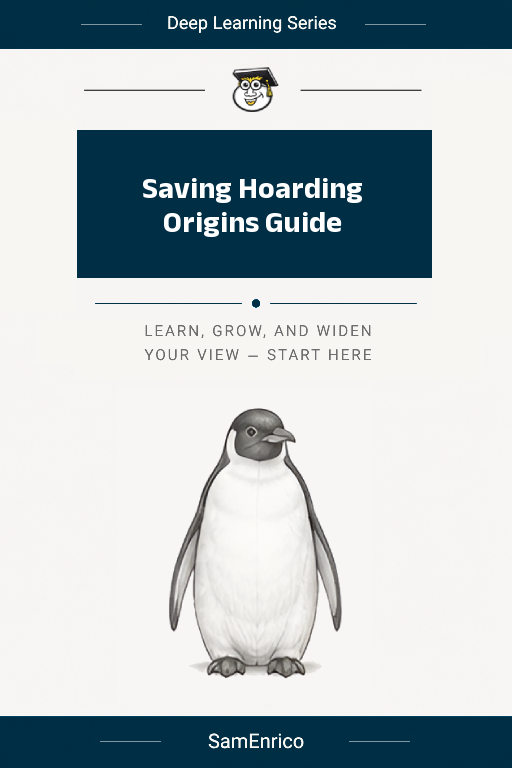
Saving Hoarding Origins Guide eBook
Differentiate between healthy saving and fear-driv
Differentiate between healthy saving and fear-driven hoarding learned from financially unstable childhoods, finding balance.
Formats
Free sample
Chapter 1: The Ghost in Your Wallet...--The first time Marcus realized he had a problem, he was standing in a grocery store aisle, holding a dented can of beans, unable to remember the last time he had eaten anything that hadn't come from a can or a freezer bag. He was thirty-four years old, earning one hundred and eighty thousand dollars a year as a senior software engineer, and his net worth had just crossed four hundred thousand dollars. His checking account balance that morning was fifty-one thousand dollars. And yet, when he saw the price of fresh vegetables—three dollars for a bag of spinach—his chest tightened, his palms began to sweat, and he put the spinach back on the shelf.He drove home in a car that had not had functioning air conditioning in three summers. The check engine light had been on for fourteen months.
The driver's side door handle was held in place with a zip tie. Marcus could have paid cash for a new vehicle, a reliable one, without touching his long-term investments. But every time he considered it, the same voice appeared in his head, a voice that sounded like his mother but spoke with the cold logic of a survival manual: "You never know what's coming. Don't get comfortable. The second you let your guard down, that's when it all falls apart."That voice was the ghost.The ghost is not a hallucination or a metaphor for weakness.
It is the name this book gives to the invisible, inherited emotional program that runs in the background of your financial life, making decisions for you long after the original danger has passed. The ghost is the reason you can look at a bank balance that would have seemed like a fortune to your childhood self and feel nothing but dread. The ghost is why you check your accounts three times a day, why you feel sick when you spend money on something you actually want, why you have twelve months of expenses saved and are still saving for the thirteenth month as if your life depended on it.The ghost is not irrational. It is not a sign of mental illness. It is a survival algorithm written in your nervous system during a time when money really was scarce, when stability really was fragile, when one unexpected expense really could have tipped your family over the edge.
The problem is not that the ghost exists. The problem is that the ghost does not know you are no longer that child.This book is about exorcising that ghost. Not by pretending it never existed, and not by shaming yourself for carrying it, but by understanding where it came from, how it operates, and finally—finally—taking back control of your own financial life.The Hidden Epidemic of the High-Earning Hoarder If you picked up this book, you are likely a high-functioning saver who is secretly miserable. You are not the person the financial advice industry typically talks about. You do not have a spending problem.
You do not carry credit card debt. You have an emergency fund, and then some, and then some more. You have done everything the personal finance gurus told you to do: live below your means, save aggressively, invest for the future. By every external metric, you are winning.So why do you feel like you are losing?The answer lies in a distinction this book will return to again and again: the difference between deliberate saving and fear-driven hoarding.Deliberate saving is goal-oriented. You save for a specific purpose—a down payment, a vacation, retirement—and when you reach that goal, you feel satisfaction, even relief.
Deliberate saving is flexible; you can adjust your targets as your life changes. And most importantly, deliberate saving allows you to spend without guilt on the things that matter to you, because you have already accounted for your future security.Fear-driven hoarding is different. It has no finish line. You save because saving feels like the only thing standing between you and catastrophe. You do not have a specific number in mind; you have an endless horizon of "just in case." Every dollar you spend feels like a betrayal, a lapse in vigilance, a step closer to the disaster you have been running from your entire life.
You have enough—objectively, mathematically, you have enough—but you cannot feel enough.The high-earning hoarder is a silent epidemic. She is the attorney making two hundred and fifty thousand dollars who eats ramen noodles in her apartment because a restaurant bill feels like a threat. He is the tech executive with a million-dollar portfolio who wears shoes with holes in the soles because buying new ones would mean "wasting" money. They are not poor. They are haunted.And they are not alone.The Emotional Audit: How to Know If You Are Hoarding Before we go any further, let us get clear about where you stand.
The following exercise is called the Emotional Audit. It will take you three days to complete, and it will give you your first real data about whether your relationship with money is healthy or fearful.Day One: The Saving Audit Recall the last time you added a significant amount of money to your savings. Not a routine paycheck deposit, but a deliberate transfer—perhaps a bonus, a tax refund, or a lump sum you moved from checking to savings. Write down the following:The amount you saved The reason you saved it (be honest: was it for a specific goal, or just "for later"?)Your physical sensations in the moment: heart rate, muscle tension, breathing, any sweating or churning in your stomach Your emotional state: relief, joy, neutrality, or anxiety Day Two: The Spending Audit Recall the last time you spent more than fifty dollars on something you wanted but did not strictly need. This could be a meal out, a piece of clothing, a concert ticket, a weekend trip.
Write down:The amount you spent What you spent it on Your physical sensations in the moment Your emotional state Day Three: The Comparison Place the two experiences side by side. Ask yourself: Which felt better? Which felt safer? Did saving bring you relief and spending bring you shame? Or did both feel neutral and appropriate?Here is the truth the audit will reveal: if saving produces joy or relief and spending produces anxiety or guilt, you are likely hoarding, not saving.
You have crossed the line from prudent preparation to fear-driven accumulation. And that line is not drawn by a bank account balance. It is drawn by the emotional intent behind the behavior.Marcus, the software engineer with the dented can of beans, completed this audit after his grocery store realization. He discovered that saving gave him a brief hit of relief that evaporated within hours, replaced by the same low-grade dread he always carried. Spending, even on necessities, gave him a somatic reaction he could not control: racing heart, shallow breathing, a sensation of falling.
He had four hundred thousand dollars and felt like he was always five minutes away from being broke.That is the ghost.The Three Psychological…
This is the end of the free sample. Get the eBook to keep going. Buy now
About this book
Details
- Author
- Francis Alvin
- Publisher
- SamEnrico
- Language
- English
- Genre
- Non-Fiction, Mental Wealth
- Released
- 2026-05-29
- Pages (approx.)
- 141
- Available as
- eBook, Audiobook

Read better in the ZLOADR app
Your eBooks on your phone or tablet. Sign in with your SamEnrico account and start reading.
More by Francis Alvin
 Personal Branding Voice DiscoveryFrancis Alvin$11.99
 Dolley Madison First LadyFrancis Alvin$11.99
 Self Hypnosis for Fear of DeathFrancis Alvin$11.99
 Linda Hoffman Pugh SuspicionFrancis Alvin$11.99
 TM for TMJ Relief GuideFrancis Alvin$11.99
 Pertussis Vaccination For FamiliesFrancis Alvin$11.99
 Emotional Eating and AnxietyFrancis Alvin$11.99
 Driver Safety Sensory LossFrancis Alvin$11.99
 The Skateboarding Prince: Henry VIII and the Forgotten Renaissance WheelsFrancis Alvin$11.99
 The Bones of Berlin: The Prohibition-Era Murder That Revolutionized ForensicsFrancis Alvin$11.99
 A Collector's Handbook to the Berkeley Sports Se328Francis Alvin$11.99
 How to Setup and Launch an Award CeremonyFrancis Alvin$11.99
You may also like
 Hong Kong Handover 1997Dunn Johnnie$11.99
 Zumba For Postnatal Recovery CourseNeal Christian$11.99
 Zumba for BeginnersLadner Nikia$11.99
 YouTube Comment Mining GuideHumes Pandora$12.99
 Worry Box MeditationCarlin Rudy$11.99
 Workplace Stress MeditationNguyen Lynn$11.99
 Workplace Stress and Sleep RepairHawley Ivory$11.99
 Workplace Perfectionism CureDelaney Jeffry$11.99
 Workplace Injustice Anger GuideWallen Isabelle$11.99
 Work Addiction and Burnout LinkGreenwood Ester$11.99
 Women in Yoga and WellnessBeattie Galina$11.99
 Women in Stand Up ComedyChun Evangeline$11.99