
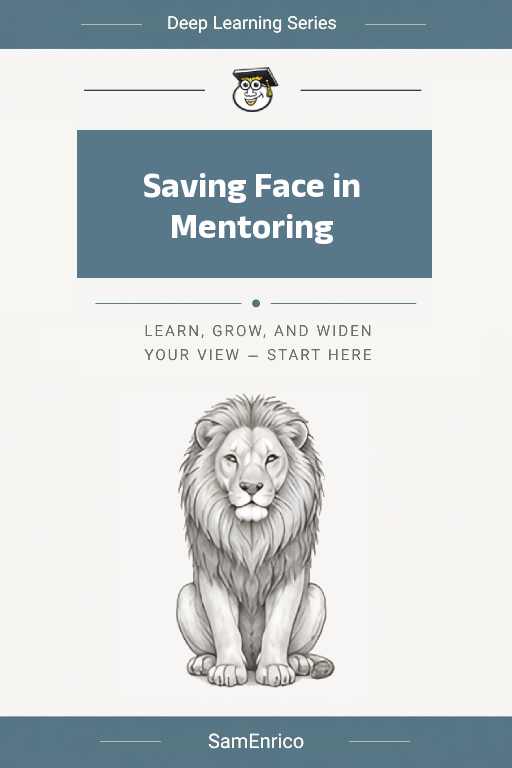
Non-FictionProfessional's Cheat SheetFace
Saving Face in Mentoring eBook
Avoid public correction and use private, gentle fe
Avoid public correction and use private, gentle feedback for East Asian and Middle Eastern mentees.
Formats
Free sample
Chapter 1: The Silence After Praise--–- The phone rang at 11:47 PM in a hotel room in Shenzhen. David, a senior product director from Chicago, had just finished a fourteen-hour day of manufacturing negotiations. On the other end was his most promising Chinese mentee, a thirty-two-year-old engineer named Liang who had been fast-tracked for leadership. David had spent six months coaching Liang: weekly one-on-ones, public shout-outs in team meetings, detailed feedback on technical reports. By every Western metric, the mentorship was thriving.Liang spoke quietly.
"David, I am writing to tell you that I am accepting another position. My last day is Friday."David sat up. "What? Why? Did you get an offer you can't refuse?
We were about to put you on the global track."A long pause. "You have been very kind," Liang said. "But after the stand-up meeting on Tuesday, I cannot stay."The stand-up meeting. David replayed it in his mind. Ten people in a glass-walled room.
Liang had presented a timeline that was, frankly, too aggressive. David had cut in—gently, he thought—and said, "Liang, that's not quite right. Let me show you the correct way to calculate these dependencies." He had drawn a quick diagram on the whiteboard. The meeting continued. It had taken perhaps forty-five seconds."Liang," David said, "I was just trying to help.
I didn't mean to—""I know," Liang said. "That is why this is hard. But you corrected me in front of my peers. My team saw that I do not know something that my mentor needed to correct. I cannot lead them now.
The face is gone."The call ended. David stared at his phone. He had lost his best mentee. He had no idea what "the face is gone" meant. And he had just made the same mistake with every East Asian and Middle Eastern mentee he had ever coached—because no one had ever told him that his kindness was actually a kind of harm.The Epidemic of Invisible Attrition This is not an isolated story.
Across global corporations, universities, and professional service firms, a silent epidemic is underway. Western mentors—well-intentioned, highly educated, genuinely caring—are losing their best talent from East Asian and Middle Eastern backgrounds at rates they do not track, do not measure, and do not even see.The losses do not show up as resignations with exit interviews citing "cultural differences." They show up as quiet departures: "I found another opportunity." "I'm moving back home." "I've decided to pursue a different path." They show up as mentees who stop asking questions, stop volunteering ideas, stop bringing problems before they become crises. They show up as brilliant professionals who, by all objective measures, were thriving—until they vanished.Consider the data. According to a 2022 study by the Harvard Business Review on global talent retention, employees from high-context, collectivist cultures (including China, Japan, Korea, Saudi Arabia, and the UAE) are 3.7 times more likely to leave a mentorship relationship within six months if they have experienced a single episode of public correction—even when that correction was intended as helpful. The same study found that 84 percent of those departing employees never disclosed the real reason for their departure to their mentor or manager.
Instead, they cited "career growth," "personal reasons," or simply gave no reason at all.This is not a failure of technical competence. It is not a failure of language fluency. It is not even a failure of good intentions. It is a failure of cultural translation—specifically, a failure to understand what "face" means in high-context societies and how public correction, even when wrapped in kindness, can shatter the relational foundation required for mentoring to function.This book exists because that failure is preventable. And the solution is simpler—and harder—than most mentors expect: private, gentle, indirect feedback delivered in a way that preserves dignity while driving excellence.The Giver's Assumption: Why We Think Public Correction Helps Before we can understand why public correction fails in East Asian and Middle Eastern contexts, we must first understand why Western mentors are so attached to it in the first place.
The attachment is not random. It is rooted in two influential management philosophies that have shaped leadership training for the past decade: Radical Candor and the broader "brutal honesty" movement.The Radical Candor Framework Kim Scott's Radical Candor (2017) became a bestseller by arguing that the best leaders care personally while challenging directly. The famous quadrant places "Ruinous Empathy" (caring without challenging) in the same failure zone as "Obnoxious Aggression" (challenging without caring). The goal is the upper-right quadrant: Radical Candor, where you say what you think, immediately, publicly if appropriate, because you care enough to be honest.In low-context Western cultures—particularly the United States, Germany, the Netherlands, and Scandinavia—this framework works reasonably well. When a German manager tells a German engineer, "Your calculation is wrong, and here is why," the engineer may feel momentary discomfort but does not experience existential threat.
The feedback is about the calculation, not the self. The relationship is transactional enough to survive directness.But Scott herself has acknowledged limitations. In a 2019 interview, she noted that Radical Candor requires "shared context" to work. What she did not fully address is that in high-context cultures, the context is never shared in the same way. The meaning of "You made an error" shifts from "Your action was incorrect" to "You are an incorrect person."The Brutal Honesty Movement Radical Candor's edgier cousin is the "brutal honesty" movement, popularized by figures like Jordan Peterson and corporate trainers who argue that "soft" feedback is actually disrespectful because it treats adults like children.
The logic goes: If you respect someone, you tell them the truth directly. You do not "sugarcoat." You do not wait for a private moment. You say it to their face, in front of whoever needs to hear it, because that is how trust is built.This philosophy has a certain muscular appeal. It feels virtuous. It feels brave.
It feels like the opposite of political correctness. And in a homogeneous, low-context, individualist culture, it can work.But when applied across cultures, brutal honesty is not honest—it is culturally illiterate. It assumes that the recipient processes feedback the same way the giver does. It assumes that "directness" is a universal virtue rather than a culturally specific preference. And it completely misses the reality that in shame cultures, "honesty without relationship" is not respect—it is violence.The Neural Reality of Public Correction The reason public correction feels so devastating to mentees from East Asian and Middle Eastern backgrounds is not "sensitivity" or "thin skin." It is neurobiology.Research from social cognitive neuroscience, particularly the work of Naomi Eisenberger at UCLA, has shown that social pain—rejection, exclusion, public embarrassment—activates the same neural regions (the dorsal anterior cingulate cortex and the anterior insula) as physical pain.
In functional MRI studies, participants who were socially excluded showed brain activity indistinguishable from participants who experienced a physical burn.But here is the crucial cultural dimension: The amplitude of that neural response varies by culture. Studies comparing East Asian and Western participants have found that public social evaluation triggers a significantly…
This is the end of the free sample. Get the eBook to keep going. Buy now
About this book
Details
- Author
- Brownlee Annemarie
- Publisher
- SamEnrico
- Language
- English
- Genre
- Non-Fiction, Professional's Cheat Sheet, Face
- Released
- 2026-05-29
- Pages (approx.)
- 155
- Available as
- eBook, Audiobook

Read better in the ZLOADR app
Your eBooks on your phone or tablet. Sign in with your SamEnrico account and start reading.
More by Brownlee Annemarie
 Martial Arts Joint Lock SafetyBrownlee Annemarie$11.99
 Assertiveness In StoresBrownlee Annemarie$11.99
 The Toxic Boss Shield GuideBrownlee Annemarie$11.99
 Creative Block HandbookBrownlee Annemarie$11.99
 Immigrant Photography Studio Chain GuideBrownlee Annemarie$11.99
 Mentorship for Startup FoundersBrownlee Annemarie$11.99
 The CrossFit Starter GuideBrownlee Annemarie$11.99
 Rain Driving Stress ReliefBrownlee Annemarie$11.99
 Calming Breath Sensation MeditationBrownlee Annemarie$11.99
 The Oracle of Delphi: Whispers of the DivineBrownlee Annemarie$11.99
 The Midnight Compromise: How a Sleep-Deprived Congress Saved a NationBrownlee Annemarie$11.99
 Pill Poppers & Power Brokers: The Opioid Empire That Bought WashingtonBrownlee Annemarie$11.99
You may also like
 Hong Kong Handover 1997Dunn Johnnie$11.99
 Zumba For Postnatal Recovery CourseNeal Christian$11.99
 Zumba for BeginnersLadner Nikia$11.99
 YouTube Comment Mining GuideHumes Pandora$12.99
 Worry Box MeditationCarlin Rudy$11.99
 Workplace Stress MeditationNguyen Lynn$11.99
 Workplace Stress and Sleep RepairHawley Ivory$11.99
 Workplace Perfectionism CureDelaney Jeffry$11.99
 Workplace Injustice Anger GuideWallen Isabelle$11.99
 Work Addiction and Burnout LinkGreenwood Ester$11.99
 Women in Yoga and WellnessBeattie Galina$11.99
 Women in Stand Up ComedyChun Evangeline$11.99