

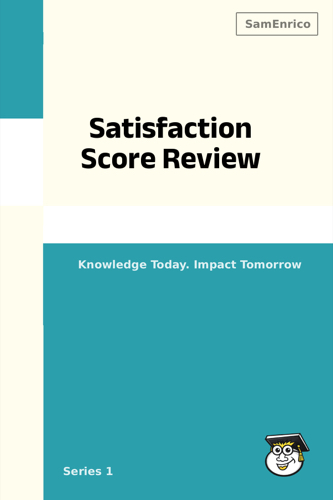
Satisfaction Score Review eBook
Rate daily satisfaction and track patterns over ti
Rate daily satisfaction and track patterns over time.
Formats
Free sample
Chapter 1: The Recall Paradox--–- Let me tell you something that will unsettle you: your memory of last week is a lie.Not a small lie, not an exaggeration you can correct with a little effort, but a fundamental, structural deception baked into the architecture of your brain. The week you think you lived is not the week you actually lived. The good days you remember were probably not that good. The bad days you recall were likely not that bad. And the “average” week you describe to a friend or jot down in a journal is, in the most literal sense, a fiction.This is not a philosophical claim about the nature of perception.
It is a well-documented fact of cognitive psychology, demonstrated in dozens of peer-reviewed studies over the past fifty years. The implications are straightforward and brutal: you cannot trust your feelings about your own life. Not because you are dishonest, but because your brain is designed to remember experiences in a way that systematically distorts reality.If you have ever wondered why you feel vaguely unsatisfied despite having what looks like a good life on paper, or why you cannot seem to break out of cycles of burnout even though you “know” what makes you happy, or why every attempt at self-improvement feels like guesswork—this is the reason. You are flying blind, navigating by a map drawn by a cartographer who was deliberately misleading you.This chapter exists to show you the flaw, to prove to you that your own memory cannot be trusted, and to introduce the only reliable solution: the Daily Satisfaction Score. By the time you finish reading, you will understand why every previous attempt to “figure out what makes you happy” has failed, and you will have the first tool you need to finally see your life clearly.The Peak-End Rule: Why Your Brain Is a Bad Editor In the 1990s, the psychologist Daniel Kahneman—who would later win a Nobel Prize in Economics for his work on decision-making—conducted a series of experiments that should have changed how every person thinks about their own happiness.
In one famous study, he asked participants to undergo two versions of an unpleasant experience: immersing their hands in painfully cold water.In the short version, participants kept their hands in cold water for sixty seconds. The water was a steady 14 degrees Celsius (57 degrees Fahrenheit)—uncomfortable but bearable.In the long version, participants kept their hands in the water for ninety seconds. But here was the trick: for the final thirty seconds, the water was slowly warmed to 15 degrees Celsius (59 degrees Fahrenheit)—still cold, still uncomfortable, but slightly less painful than the first sixty seconds.After both trials, participants were asked which experience they would prefer to repeat. The overwhelming majority chose the longer version—the one that lasted ninety seconds instead of sixty, the one that included more total discomfort. Why?
Because the longer version ended slightly less painfully. The brain, Kahneman discovered, does not remember the total sum of an experience. It remembers two things: the peak (the most intense moment) and the end (the final moment). Everything else is largely discarded.This is called the peak-end rule, and it governs how you remember everything from vacations to arguments to entire relationships. A vacation with ten wonderful days and one disastrous final afternoon will be remembered as a bad vacation.
A relationship with years of steady affection and a painful breakup will be remembered as a painful relationship. A workweek with four productive, pleasant days and one awful Friday afternoon meeting will be remembered as a bad week.The peak-end rule explains why your memory is not a recording device. It is an editor—and a dramatic one at that. It throws away most of the footage, keeps only the most intense scene and the final scene, and then presents the result to you as “what happened.”Think about your own life for a moment. Think about the last week you would describe as “terrible.” Now ask yourself: was it actually seven full days of misery?
Or were there moments—hours, even entire mornings—that were fine, or even good, but you have forgotten them because they were not the peak or the end? The answer, almost certainly, is that your memory has compressed and distorted the experience.Duration Neglect: The Second Lie The peak-end rule is bad enough. But it has a partner in crime: duration neglect. This is the finding that the length of an experience has almost no effect on how we remember it. A two-week vacation that ends badly is remembered as no better than a two-day vacation that ends badly.
A ten-minute argument that ends in tears is remembered as just as painful as a two-hour argument that ends the same way.Duration neglect means that your brain does not care how long something lasted. It only cares about how it felt at the peak and at the end. This is why you can have a day that is mostly wonderful—eight hours of joy, productivity, connection, and meaning—and yet remember it as “bad” because a twenty-minute argument with your partner ruined the ending. By every rational measure, that day was 96 percent good. But your memory treats it as 100 percent bad.Consider a concrete example.
Imagine a Thursday that looks like this:7:00 AM to 9:00 AM: Peaceful morning, good coffee, successful workout (satisfaction: 8/10)9:00 AM to 12:00 PM: Productive work session, completed a difficult task (satisfaction: 9/10)12:00 PM to 1:00 PM: Enjoyable lunch with a colleague, good conversation (satisfaction: 8/10)1:00 PM to 4:00 PM: Focused afternoon work, made progress on a project (satisfaction: 8/10)4:00 PM to 5:00 PM: Stressful meeting with a difficult client, felt criticized (satisfaction: 3/10)5:00 PM to 6:00 PM: Commute home, traffic, felt drained (satisfaction: 4/10)6:00 PM to 7:00 PM: Argument with partner about household chores (satisfaction: 2/10)7:00 PM to 10:00 PM: Ate dinner in silence, scrolled phone, went to bed early (satisfaction: 4/10)The average satisfaction of this day, if you could somehow measure every hour, would be approximately 6.3 out of 10—a slightly above-average day. But how will you remember it on Friday morning? You will remember the stressful meeting (peak intensity) and the argument with your partner (the end). You will remember the day as bad. You might rate it a 3 or a 4 if someone asked you, “How was yesterday?”And then, based on that distorted memory, you might make decisions.
You might decide that your job is the problem, or your partner is the problem, or that you need a complete lifestyle change. You might cancel plans, pick a fight, or fall into a spiral of negative thinking. All because your brain discarded sixteen hours of good experience and kept two hours of bad.The Case Study: Three Professionals Who Thought They Were Fine Let me introduce you to three people who participated in the early testing of the Satisfaction Score methodology. Their names have been changed, but their stories are real.Maria the Nurse Maria was a nurse in her late forties. She worked three twelve-hour shifts per week in a busy emergency department.
She loved her work—she said it gave her meaning and purpose. But she also told researchers that she felt “constantly exhausted” and…
This is the end of the free sample. Get the eBook to keep going. Buy now
About this book
Details
- Author
- Mitchell Frankie
- Publisher
- SamEnrico
- Language
- English
- Genre
- Non-Fiction, Self-Help, Wellbeing
- Released
- 2026-06-08
- Pages (approx.)
- 133
- Available as
- eBook, Audiobook

Read better in the ZLOADR app
Your eBooks on your phone or tablet. Sign in with your SamEnrico account and start reading.
More by Mitchell Frankie
 Road Rage and SleepMitchell Frankie$11.99
 Body Positive Self TalkMitchell Frankie$11.99
 South African Business FundingMitchell Frankie$11.99
 The Emotional Regulation for GriefMitchell Frankie$11.99
 Presentation Rehearsal MethodsMitchell Frankie$11.99
 Chief Seattle Environmental LegacyMitchell Frankie$11.99
 Habit Formation for SalespeopleMitchell Frankie$11.99
 The Vanishing Point: The Untold Story of the First Woman to Circumnavigate the Globe SoloMitchell Frankie$11.99
 The Navigators of the Indian Ocean: The Swahili Explorers and the Age of DiscoveryMitchell Frankie$11.99
 A Collector's Handbook to the Invicta 2½-litreMitchell Frankie$11.99
 Service Providers Guide to UrologyMitchell Frankie$11.99
 Rural User Freemium ConversionMitchell Frankie$12.99
You may also like
 Hong Kong Handover 1997Dunn Johnnie$11.99
 Zumba For Postnatal Recovery CourseNeal Christian$11.99
 Zumba for BeginnersLadner Nikia$11.99
 YouTube Comment Mining GuideHumes Pandora$12.99
 Worry Box MeditationCarlin Rudy$11.99
 Workplace Stress MeditationNguyen Lynn$11.99
 Workplace Stress and Sleep RepairHawley Ivory$11.99
 Workplace Perfectionism CureDelaney Jeffry$11.99
 Workplace Injustice Anger GuideWallen Isabelle$11.99
 Work Addiction and Burnout LinkGreenwood Ester$11.99
 Women in Yoga and WellnessBeattie Galina$11.99
 Women in Stand Up ComedyChun Evangeline$11.99